 A farm boy was drafted. On his first furlough, his father asked him what he thought of army life.
“It’s pretty good, Pa. The food’s not bad, the work’s easy, but best of all, they let ya sleep real late in the morning.”
This is what a real American looks and sounds like.
Enjoy and pass it on!
Master Sergeant (then Staff Sergeant) Roy P. Benavidez United States Army, who distinguished himself by a series of daring and extremely valorous actions on 2 May 1968 while assigned to Detachment B56, 5th Special Forces Group (Airborne), 1st Special Forces, Republic of Vietnam.
On the morning of 2 May 1968, a 12-man Special Forces Reconnaissance Team was inserted by helicopters in a dense jungle area west of Loc Ninh, Vietnam to gather intelligence information about confirmed large-scale enemy activity. This area was controlled and routinely patrolled by the North Vietnamese Army. After a short period of time on the ground, the team met heavy enemy resistance, and requested emergency extraction. Three helicopters attempted extraction, but were unable to land due to intense enemy small arms and anti-aircraft fire.
Sergeant Benavidez was at the Forward Operating Base in Loc Ninh monitoring the operation by radio when these helicopters returned to off-load wounded crewmembers and to assess aircraft damage. Sergeant Benavidez voluntarily boarded a returning aircraft to assist in another extraction attempt. Realizing that all the team members were either dead or wounded and unable to move to the pickup zone, he directed the aircraft to a nearby clearing where he jumped from the hovering helicopter, and ran approximately 75 meters under withering small arms fire to the crippled team.
Prior to reaching the team’s position he was wounded in his right leg, face, and head. Despite these painful injuries, he took charge, repositioning the team members and directing their fire to facilitate the landing of an extraction aircraft, and the loading of wounded and dead team members. He then threw smoke canisters to direct the aircraft to the team’s position. Despite his severe wounds and under intense enemy fire, he carried and dragged half of the wounded team members to the awaiting aircraft. He then provided protective fire by running alongside the aircraft as it moved to pick up the remaining team members. As the enemy’s fire intensified, he hurried to recover the body and classified documents on the dead team leader.
When he reached the leader’s body, Sergeant Benavidez was severely wounded by small arms fire in the abdomen and grenade fragments in his back. At nearly the same moment, the aircraft pilot was mortally wounded, and his helicopter crashed. Although in extremely critical condition due to his multiple wounds, Sergeant Benavidez secured the classified documents and made his way back to the wreckage, where he aided the wounded out of the overturned aircraft, and gathered the stunned survivors into a defensive perimeter. Under increasing enemy automatic weapons and grenade fire, he moved around the perimeter distributing water and ammunition to his weary men, reinstilling in them a will to live and fight. Facing a buildup of enemy opposition with a beleaguered team, Sergeant Benavidez mustered his strength, began calling in tactical air strikes and directed the fire from supporting gunships to suppress the enemy’s fire and so permit another extraction attempt.
He was wounded again in his thigh by small arms fire while administering first aid to a wounded team member just before another extraction helicopter was able to land. His indomitable spirit kept him going as he began to ferry his comrades to the craft. On his second trip with the wounded, he was clubbed from behind by an enemy soldier. In the ensuing hand-to-hand combat, he sustained additional wounds to his head and arms before killing his adversary. He then continued under devastating fire to carry the wounded to the helicopter. Upon reaching the aircraft, he spotted and killed two enemy soldiers who were rushing the craft from an angle that prevented the aircraft door gunner from firing upon them. With little strength remaining, he made one last trip to the perimeter to ensure that all classified material had been collected or destroyed, and to bring in the remaining wounded.
Only then, in extremely serious condition from numerous wounds and loss of blood, did he allow himself to be pulled into the extraction aircraft. Sergeant Benavidez’ gallant choice to join voluntarily his comrades who were in critical straits, to expose himself constantly to withering enemy fire, and his refusal to be stopped despite numerous severe wounds, saved the lives of at least eight men. His fearless personal leadership, tenacious devotion to duty, and extremely valorous actions in the face of overwhelming odds were in keeping with the highest traditions of the military service, and reflect the utmost credit on him and the United States Army.
In the wake of unspeakable tragedy, there is a hero who brings the colors flying. His name is Larry Eckhardt, but many people who meet him do not know it. They only know that he has come to honor one of their fallen soldiers with what he considers a comparatively small tribute: 2200 American flags.
And so they call him the Flag Man.
This is an excellent article by Alan Caruba that appeared on the Canada Free Press website this past weekend.
“Of the four wars in my lifetime, none came about because the U.S. was too strong.” — Ronald Reagan
If you want to know how President Obama feels about the U.S. military, consider that in all the years since D-Day 1945 there have been three occasions when a President failed to go to the D-Day Monument that honors the soldiers killed during the Invasion.
The occasions were:
1. Barack Obama 2010
2. Barack Obama 2011
3. Barack Obama 2012For the past 68 years, all Presidents, except Obama, have paid tribute to the fallen soldiers killed on D-Day. This year, instead of honoring the soldiers, he made a campaign trip on Air Force 1 to California to raise funds for his reelection.
The U.S. military has been systematically weakened from within by a combination of idiotic and duplicitous decisions that suggest how far the nation has come from the fundamental understanding that an enemy must be destroyed with sufficient devastation as to never contemplate attacking us or our allies again.
World War Two was a success because both Germany and Japan were required to sign instruments of unconditional surrender. Both nations are now our allies. Even Vietnam where the U.S. blundered into a civil war and was ultimately forced to withdraw now has normalized diplomatic relations and welcomes U.S. investment.
The wars in Iraq and Afghanistan remain inconclusive due to a combination of timid rules of engagement and the transformation of our military’s mission into “nation-building” that have yielded unsatisfactory results.
The military force that distinguished America as a super power at the mid-point of the last century now is facing draconian funding reductions from a Congress unwilling to make hard decisions about our historic debt.
A July Wall Street Journal editorial, “The Coming Defense Crack-Up”, warned the automatic sequestration, “If implemented, the Pentagon budget would be cut by another 9% (or $492 billion) over the next decade, on top of the $487 billion in cuts that are already planned. Defense accounts for the largest share of total sequestration, or 42.6%m according to the Congressional Budget Office.”
“The sequestration cuts would leave the defense budget some 30% smaller in 10 years.” Does anyone believe that the world will be any safer in two years or ten years? Or that weakening our defense will make us safer in a world bristling with nuclear arms and other weapons of mass destruction?
If the sequestration cuts are pure folly, then the use of our defense forces as a means to avoid “global warming” is sheer insanity. There is no global warming insofar as the Earth entered a natural cooling cycle in 1998 and the claim that carbon dioxide is “causing” global warming is completely baseless. A tiny element of the Earth’s atmosphere—0.038%—carbon dioxide (CO2) has been the excuse environmentalists have used to attack our manufacturing and energy sectors. Now it is being used to render our military weaker through a requirement to use biofuels.
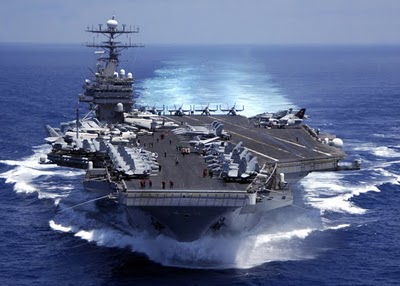
On October 8, 2009, President Obama issued Executive Order 13514, ordering the Defense Department and other agencies to reduce CO2 and other so-called greenhouse gas emissions. He set a goal of having the ships that defend our nuclear carriers powered by biofuels.
How stupid is this? First of all, America sits atop enough oil reserves to make us energy independent if the Obama administration would permit exploration and extraction domestically and offshore. The U.S. Geological Survey reports that the U.S. possesses 26% of the world’s oil supply. The Obama administration assertion that the U.S. has only 2% of the world’s supply is a lie.
There is zero need for biofuels. By 2020, the Navy has been instructed to use alternative fuel for half of its consumption. A recent naval exercise cost the Navy $27 per gallon of biofuel, versus $3.50 to $4.00 for standard petroleum fuel. As this is being written, Americans are required to use ethanol, a biofuel, in every gallon of gas they put in their cars, needlessly increasing the cost with no benefit in mileage and at the risk of damaging their car engines.
The Air Force is also subject to these mandates for biofuels that cost more than $26 per gallon, compared with standard jet fuel at $4 per gallon. Both the Navy and Air Force face the prospect of having to refuel ships and planes in potential battle zones where every gallon of biofuel would have to be transported from the U.S. for lack of biofuel refineries in Asian, Mideast or Mediterranean ports. Can you spell d-e-f-e-a-t?
These biofuel mandates are part of the Obama administration’s crony capitalism that has seen “alternative energy” lose billions in loan guarantees to solar companies and the government mandates that maintain the wind power industry that, like ethanol, would not exist without federal government support.
Phil Dunmire, the national president of the Navy League of the United States, on July 18, warned that “The defense and maritime industries are being jeopardized from within” noting that “programs related to our nation’s defense will absorb half of the sequestration costs despite being just 19% of the national spending budget.” These cuts go into effect in January!
The sequestration and other budget cuts, and the global warming biofuel mandates will leave the U.S. more vulnerable to attack and defeat since the end of World War Two. Our Navy has shrunk. Our combat air fleet is old. The manpower of military forces has been reduced and subjected to restrictions that leave every soldier and marine subject to investigation for every enemy they kill.
The exception to the long engagement in the Middle East was the successful killing of Osama bin Laden, but even that was tarnished by a President who took full credit for it and released information about it that runs contrary to the safety of all comparable future missions. Within days, the White House provided a briefing on it to a Hollywood producer and writer in order to facilitate a film lauding the mission.
The greatest force for the defense of the nation and for freedom in the world is being reduced by a Congress and a White House who refuse to recognize the threats that exist in a dangerous world.
© Alan Caruba, 2012
