Jan 102017
 
It could endanger the lives of much more than 500,000 people.
Europe's Most Dangerous Supervolcano Is Waking Up; 500,000 Lives At Risk

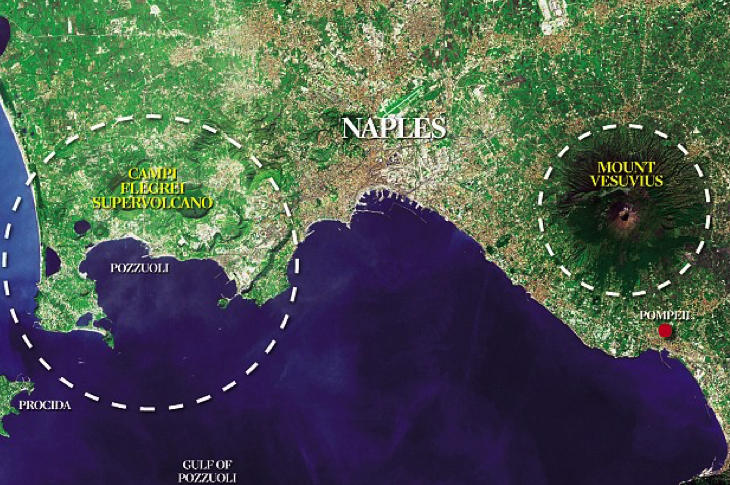
When Mount Vesuvius erupted and buried the Italian city of Pompeii in ash, killing 2,000 people, it was regarded as one of the most catastrophic natural disasters and is still studied heavily today. By comparison, a nearby supervolcano called Campi Flegrei, which means “burning fields,” would put the lives of 500,000 Italians at risk and cause damage that would extend to the surrounding nations.

Campi Flegrei has been around for many years and has notable eruptions that occurred 39,000 and 12,000 years ago. The first eruption is thought to have contributed to the extinction of the Neanderthals; though this is heavily debated, what’s indisputable is that it caused heinous weather changes, toxic levels of sulfur in the air which caused dark red sunsets for a year, and tons acid rain. In the most recent eruption, the supervolcano erupted for 8 days straight and formed a new mountain, aptly named Monte Nuovo.

Scientists have been detecting an increase in low-level activity since 2005, which they have called an “uplift.” The recent activity prompted the Italian government to raise the threat level from green to yellow, which means that the volcano is now monitored 24/7 to detect any increases in the likelihood that it could erupt. A recent study found that the activity has increased substantially, which spurred the government into action.
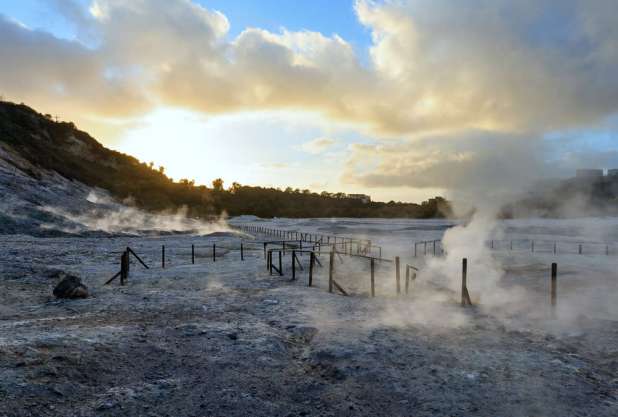
Solfatara

Half a million people are living directly on top of and on the flanks of the supervolcano in the bustling metropolitan area of Naples. If it were to erupt, these people would likely die if not given enough time to evacuate, but the repercussions could extend much further than that if it reaches the same magnitude as it did 39,000 years ago.

If that were to happen, the ash clouds would surely block the sun and lower the Earth’s temperature. As a result, livestock, crops, and other plant species would die, causing wild animal extinctions and leading to starvation around the world and maybe even a long, perpetual winter.

Of course, this would all be the worst case scenario and scientists say it’s impossible to know when or if the supervolcano will actually erupt. Some speculate that, based on past eruptions, we have at least a few decades to wait before really needing to worry, but that could still be in our lifetime. Others say that the levels of degassing pressure that are being reached are critical and could mean an explosion in the very near future. Thankfully, the scientists are watching the movements 24 hours a day to determine what the risks are and those affected by the disaster will hopefully be given ample time to evacuate.

 
via

Jan 092017
 
A recent report from corporate media suggests the elite taking blood from children to prolong their lives may soon be mainstream.

Mainstream Media Reports Elites Can Drink The Blood Of Children To Prevent Aging
Last week, a study published in Science and Nature Medicine revealed that transfusing young mouse blood into old mice can actually prevent the symptoms of aging. This groundbreaking discovery could lead to medical breakthroughs and the development of new medicines. However, a report from the Vice health news outlet “Tonic” has pointed out far more sinister applications for this knowledge.

It was suggested in the report that aging elites are using the blood of young people as a type of youth serum.

A similar claim was made by journalist Jeff Bercovici last year, after he conducted several interviews with Silicon Valley aristocrats including Peter Thiel, and learned about a transfusion procedure called “parabiosis,” where the blood of young people is used to prevent aging.

“There are widespread rumors in Silicon Valley, where life-extension science is a popular obsession, that various wealthy individuals from the tech world have already begun practicing parabiosis, spending tens of thousands of dollars for the procedures and young-person-blood, and repeating the exercise several times a year,” Bercovici reported.

In his article, Bercovici also expressed concerns about a developing black market for young people’s blood.

I know it sounds too outrageous to be true, but these horrific practices have been commonplace among aristocrats in various different cultures throughout history. In most modern cultures, mass murder and human sacrifice still takes place out in the open under the cover of warfare, while many argue that cannibalism also still takes place, but behind closed doors.

It is only in the past few hundred years that the practice of cannibalism among royals has not been publicized. In Europe, around the time of the American Revolution “corpse medicine” was very popular among the ruling class, Charles II even brewed his own.

Mainstream Media Reports Elites Can Drink The Blood Of Children To Prevent Aging

Dr. Richard Sugg of Durham University has conducted extensive research into the practice of corpse medicine among the royalty.

“The human body has been widely used as a therapeutic agent with the most popular treatments involving flesh, bone or blood. Cannibalism was found not only in the New World, as often believed, but also in Europe,” Sugg said.

“One thing we are rarely taught at school yet is evidenced in literary and historic texts of the time is this: James I refused corpse medicine; Charles II made his own corpse medicine; and Charles I was made into corpse medicine. Along with Charles II, eminent users or prescribers included Francis I, Elizabeth I’s surgeon John Banister, Elizabeth Grey, Countess of Kent, Robert Boyle, Thomas Willis, William III, and Queen Mary,” he added.

If this wasn’t strange enough, the current royal family of England are direct descendants of Prince Vlad III Dracula of Wallachia (modern Romania).  This was the sick and depraved ruler, Vlad the Impaler, who was known as a butcher and who eventually became the inspiration for the most famous vampire stories in history.

Mark Passio and other speakers and whistleblowers at this year’s Free Your Mind Conference are some of the only researchers who delve into these deep topics.

Of course, the recent reports do not point to any specific person or provide any evidence of people who are drinking blood to prevent aging. However, the science is now there and there is a historical precedent for aristocrats being involved in these types of activities.

 
via

Why Is A Dollar Called A ‘Buck’?

 Information  Comments Off on Why Is A Dollar Called A ‘Buck’?
Jan 082017
 

In colonial times in USA, traders used deer’s skin as a mean of payment. That’s why a dollar is called a “buck”.

As with many etymologies, the exact root of this word is difficult to say with one hundred percent certainty. However, the leading theory is extremely plausible and backed up by a fair bit of documented evidence. Specifically, it is thought that a dollar is called a “buck” thanks to deer.

One of the earliest references of this was in 1748, about 44 years before the first U.S. dollar was minted, where there is a reference to the exchange rate for a cask of whiskey traded to Native Americans being “5 bucks”, referring to deerskins.

In yet another documented reference from 1748, Conrad Weiser, while traveling through present day Ohio, noted in his journal that someone had been “robbed of the value of 300 Bucks.”

At this time, a buck skin was a common medium of exchange. There is also evidence that a “buck” didn’t simply mean one deerskin, but may have meant multiple skins, depending on quality. For instance, skins from deer killed in the winter were considered superior to those killed in the summer, due to the fur being thicker.

It is thought that the highest quality skins were generally assigned a one to one value with one skin equaling one buck. In contrast, for lower quality skins, it might take several of them to be valued at a single buck. The specific value for given sets of skins was then set at trading.

In addition, when the skin was from another animal, the number of skins required to equal a buck varied based on the animal and the quality of the skins. For instance, there is one documented trade where six high quality beaver skins or twelve high quality rabbit pelts each equaled one buck.

This use of skins as a medium of exchange gradually died off over the next century as more and more Europeans moved in and built towns and cities. Once the U.S. dollar was officially introduced after the passing of the Coinage Act of 1792, it quickly became the leading item used as a medium of exchange, but the term “buck” stuck around and by the mid-nineteenth century was being used as a slang term for the dollar.

Bonus Fact:

While it may be tempting to think that the “buck” in this sense is where we also get the phrase “pass the buck”, most etymologists don’t think the two are related. The leading theory on the origin of the phrase “pass the buck” is thought to come from poker, with one of the earliest known references of the idea of literally passing a buck being found in the 1887 work by J.W. Keller, titled “Draw Poker”. In it, Keller states:

The ‘buck’ is any inanimate object, usually knife or pencil, which is thrown into a jack pot and temporarily taken by the winner of the pot. Whenever the deal reaches the holder of the ‘buck,’ a new jack pot must be made.

As to why it is then called a buck, it is thought that may have arisen from the fact that buck-handled knives were once common and knives were often used as the “buck” in this sense. As for the figurative sense of passing the buck, this didn’t start popping up until the early twentieth century.

Source…