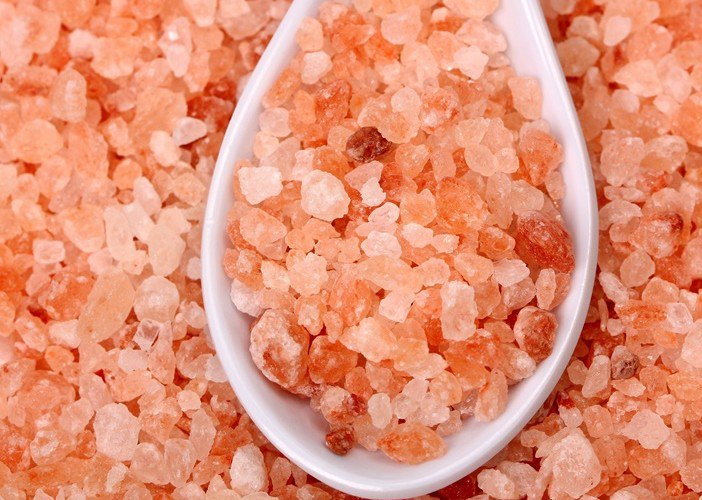
Pink Himalayan salt is sometimes called pink salt or rose salt because of its pale rose color. A natural salt, it is harvested in mountains in Pakistan and is prized by some for its nutritional content and the fact that it is unprocessed.
Below is a good breakdown on the history and benefits of using it as compared to other types of salt.
So you’ve been hearing about this amazing Himalayan crystal salt for the last few years, and now you’re wondering, is it really better than sea salt or table salt? How does it benefit my body vs those other salts? Well, it is packed with some pretty amazing benefits, making it a wonderful alternative to table salt and an exciting new staple to add to your pantry.
The History
First of all, what makes Himalayan crystal salt so amazing? About 200 million years ago, there were crystallized sea salt beds that were covered with lava. Because this salt was subsequently enveloped in snow and ice for millennia, it was protected from modern day pollution and preserved in an untouched, pristine environment.
The Himalayan mountain range goes across Asia, and passes through China, Nepal, Myanmar, Pakistan, Bhutan, Afghanistan, and India. Many people believe that this pink salt is the purest salt that can be found on the planet.
Minerals & Energy
Himalayan Salt contains the same 84 trace minerals and elements that are found in the human body; that alone is quite impressive! A few of these minerals include: sodium chloride, sulphate, calcium, potassium, and magnesium. When consuming this salt, you are actually getting less sodium intake per serving than regular table salt because it is less refined and the pieces are larger. Therefore Himalayan salt has less sodium per serving because the crystals or flakes take up less room than the highly processed table salt variety.
Anothe great thing about this salt is that, because of its unique cellular structure, it stores vibrational energy. The minerals in this salt exist in colloidal form, which means that they are small enough for our cells to easily absorb.
What Exactly Are The Benefits?
Some of the benefits that you can expect to enjoy by consuming this salt in place of regular table salt include:
- Aids in vascular health
- Supports healthy lungs and respiratory function
- Promotes a stable pH balance within the cells
- Reduces the signs of aging
- Promotes healthy sleep patterns
- Increases libido
- Prevents muscle cramps
- Increases hydration
- Strengthen bones
- Lowers blood pressure
- Improves circulation
- Detoxifies the body of heavy metals
Comparing Himalayan Salt To Other Salts
Sea Salt
While still a better choice than table salt, sea salt is becoming increasingly processed, and, let’s face it, our oceans are becoming more and more polluted each year. Because of the pristine conditions that Himalayan salt has been kept in, it is said to be the purest salt available today.
Table Salt
Regular, commercial table salt is completely stripped of the majority of its minerals with the exception of sodium and chloride. It is then bleached, cleaned with chemicals, and then heated at extremely high temperatures. The iodine that is added to table salt is almost always synthetic, which is difficult for our bodies absorb properly. It is treated with anti-caking agents, which prevents the salt from dissolving in water and clumping in the salt container. These agents then prevent the salt from absorbing into our own bodies, which leads to a buildup and deposit within the organs. This can cause severe health problems. Studies have shown that for each gram of table salt that is consumed that the body cannot process, your body will use 20 TIMES the amount of cellular water to neutralize the amount of sodium chloride that is present in this chemically treated salt.
This is largely the reason why salt has gotten such a bad name over the years. It is not necessarily salt that is unhealthy for us, but rather refined table salt that is inferior for our health. Aside from that, many of us are consuming way too much processed food. These foods contain astronomical amounts of salt, and it isn’t the good kind. It’s not about limiting our intake of salt; it’s about consuming more natural, homemade, whole foods. This way we can add salt while cooking or sprinkle some on our meals without having to worry about high blood pressure and so on.
Himalayan Salt Uses
Cooking and curing — Always use pre-ground salt or grinders like any other kind of salt.
Salt Slabs — Slabs will impart a better taste and mineral content. Chilled: use fruits, sushi, veggies, or cheese as a decoration. Frozen: cold delicious desserts and sorbets. Heated: slabs can be used to sear veggies, shrimp, fish fillets, and thinly sliced beef, and you can even fry eggs. Dense salt blocks conduct heat amazingly.
What is even better, Himalayan salt is a natural anti-microbial product, and the clean up requires only a simple scrub or rinse.
Bathing — Enjoy a detoxifying Himalayan salt bath. Its nutrients will stimulate your circulation and soothe sore muscles. Himalayan salt contains 80+ nourishing and skin-friendly minerals, so this bath will provide a healing and amazingly therapeutic experience for both body and soul.
Air purification — You can also find crystal rock lamps on-line.
You should be able to find this amazing Himalayan Crystal Salt online or at your local health food store.