Have you ever wondered how insects can survive through the winter? Check out this episode of the Scishow to find out how!
Enjoy!
Birds fly south, humans bundle up, but what do insects do to survive the winter? From creating antifreeze-like alcohols to burrowing in the ground, bugs have a few solutions to carry on.
The first German serviceman killed in the war was killed by the Japanese (China, 1937)
The first American serviceman killed was killed by the Russians (Finland 1940).
The highest ranking American killed was Lt. Gen. Lesley McNair, killed by the US Army Air Corps.
The youngest US serviceman was 12 year old Calvin Graham, USN. He was wounded in combat and given a Dishonorable Discharge for lying about his age. (His benefits were later restored by act of Congress).
At the time of Pearl Harbor, the top US Navy command was called CINCUS (pronounced “sink us”), the shoulder patch of the US Army’s 45th Infantry division was the Swastika, and Hitler’s private train was named “Amerika”. All three were soon changed for PR purposes.
More US servicemen died in the Air Corps that the Marine Corps. While completing the required 30 missions, your chance of being killed was 71%. Not that bombers were helpless. A B-17 carried 4 tons of bombs and 1.5 tons of machine gun ammo. The US 8th Air Force shot down 6,098 fighter planes, 1 for every 12,700 shots fired.
Germany’s power grid was much more vulnerable than realized. One estimate is that if just 1% of the bombs dropped on German industry had instead been dropped on power plants, German industry would have collapsed.
Generally speaking, there was no such thing as an average fighter pilot. You were either an ace or a target. For instance, Japanese ace Hiroyoshi Nishizawa shot down over 80 planes. He died while a passenger on a cargo plane.
It was a common practice on fighter planes to load every 5th found with a tracer round to aid in aiming. That was a mistake. The tracers had different ballistics so (at long range) if your tracers were hitting the target, 80% of your rounds were missing. Worse yet, the tracers instantly told your enemy he was under fire and from which direction. Worst of all was the practice of loading a string of tracers at the end of the belt to tell you that you were out of ammo. That was definitely not something you wanted to tell the enemy. Units that stopped using tracers saw their success rate nearly double and their loss rate go down.
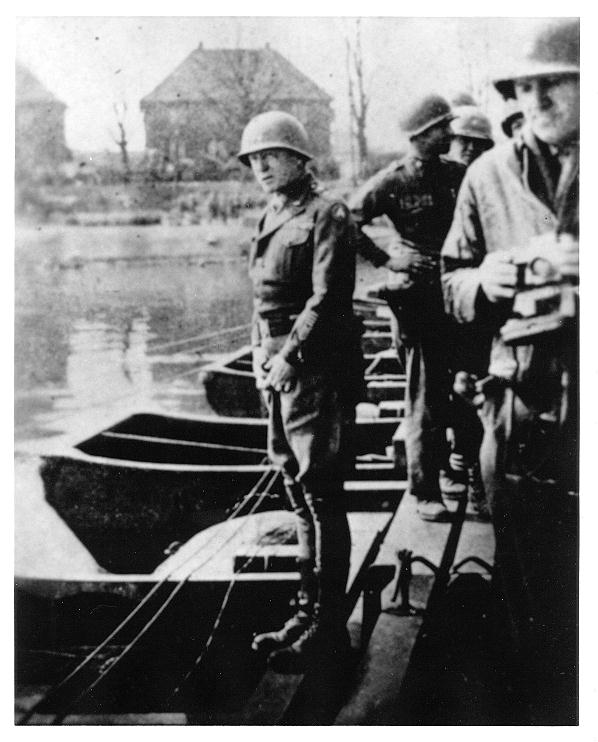
When allied armies reached the Rhine, the first thing men did was pee in it. This was pretty universal from the lowest private to Winston Churchill (who made a big show of it) and Gen. Patton (who had himself photographed in the act).
Don’t believe me? Take a look at this:
Gen. Patton peeing in the Rhine.
German Me-264 bombers were capable of bombing New York City but it wasn’t worth the effort.
A number of air crewmen died of farts. (ascending to 20,000 ft. in an un-pressurized aircraft causes intestinal gas to expand 300%!)
The Russians destroyed over 500 German aircraft by ramming them in midair (they also sometimes cleared minefields by marching over them). “It takes a brave man not to be a hero in the Red Army”. Joseph Stalin
The US Army had more ships that the US Navy.
The German Air Force had 22 infantry divisions, 2 armor divisions, and 11 paratroop divisions. None of them were capable of airborne operations. The German Army had paratroops who WERE capable of airborne operations.
When the US Army landed in North Africa, among the equipment brought ashore were 3 complete Coca Cola bottling plants.
Among the first “Germans” captured at Normandy were several Koreans. They had been forced to fight for the Japanese Army until they were captured by the Russians and forced to fight for the Russian Army until they were captured by the Germans and forced to fight for the German Army until they were capture by the US Army.
The Graf Spee never sank, The scuttling attempt failed and the ship was bought by the British. On board was Germany’s newest radar system.
One of Japan’s methods of destroying tanks was to bury a very large artillery shell with on ly the nose exposed. When a tank came near the enough a soldier would whack the shell with a hammer. “Lack of weapons is no excuse for defeat.” – Lt. Gen. Mataguchi
Following a massive naval bombardment, 35,000 US and Canadian troops stormed ashore at Kiska. 21 troops were killed in the fire-fight. It would have been worse if there had been Japanese on the island.
The MISS ME was an unarmed Piper Cub. While spotting for US artillery her pilot saw a similar German plane doing the same thing. He dove on the German plane and he and his co-pilot fired their pistols damaging the German plane enough that it had to make a forced landing. Whereupon they landed and took the Germans prisoner. It is unknown where they put them since the MISS ME only had two seats.
Most members of the Waffen SS were not German.
The only nation that Germany declared was on was the USA.
During the Japanese attack on Hong Kong, British officers objected to Canadian infantrymen taking up positions in the officer’s mess. No enlisted men allowed!
Nuclear physicist Niels Bohr was rescued in the nick of time from German occupied Denmark. While Danish resistance fighters provided covering fire he ran out the back door of his home stopping momentarily to grab a beer bottle full of precious “heavy water”. He finally reached England still clutching the bottle, which contained beer. Perhaps some German drank the heavy water…
As printed in, The Victory Division News. No. 4. December, 2000.
Amusing, InformationComments Off on The Dumbest Deaths In Recorded History
Jan242017
Attila the Hun:
One of the most notorious villains in history, Attila’s army had conquered all of Asia by 450 AD-from Mongolia to the edge of the Russian Empire-by destroying villages and pillaging the countryside. How he died: He got a nosebleed on his wedding night.
In 453 AD, Attila married a young girl named Ildico. Despite his reputation for ferocity on the battlefield, he tended to eat and drink lightly during large banquets. On his wedding night, however, he really cut loose, gorging himself on food and drink. Sometime during the night he suffered a nosebleed, but was too drunk to notice. He drowned in his own blood and was found dead the next morning.
Tycho Brahe:
An important Danish astronomer of the 16th century. His ground breaking research allowed Sir Isaac Newton to come up with the theory of gravity. How he died: Didn’t get to the bathroom in time.
In the 16th century, it was considered an insult to leave a banquet table before the meal was over. Brahe, known to drink excessively, had a bladder condition-but failed to relieve himself before the banquet started. He made matters worse by drinking too much at dinner, and was too polite to ask to be excused. His bladder finally burst, killing him slowly and painfully over the next 11 days.
Horace Wells:
Pioneered the use of anesthesia in the 1840s How he died: Used anesthetics to commit suicide.
While experimenting with various gases during his anesthesia research, Wells became addicted to chloroform. In 1848 he was arrested for spraying two women with sulfuric acid. In a letter he wrote from jail, he blamed chloroform for his problems, claiming that he’d gotten high before the attack. Four days later he was found dead in his cell. He’d anaesthetized himself with chloroform and slashed open his thigh with a razor.
Francis Bacon:
One of the most influential minds of the late 16th century. A statesman, a philosopher, a writer, and a scientist, he was even rumored to have written some of Shakespeare’s plays. How he died: Stuffing snow into a chicken
One afternoon in 1625, Bacon was watching a snowstorm and was struck by the wondrous notion that maybe snow could be used to preserve meat in the same way that salt was used. Determined to find out, he purchased a chicken from a nearby village, killed it, and then, standing outside in the snow, attempted to stuff the chicken full of snow to freeze it. The chicken never froze, but Bacon did.
Jerome Irving Rodale:
Founding father of the organic food movement, creator of “Organic Farming and Gardening” magazine, and founder of Rodale Press, a major publishing corporation. How he died: On the “Dick Cavett Show”, while discussing the benefits of organic foods.
Rodale, who bragged “I’m going to live to be 100 unless I’m run down by a sugar-crazed taxi driver,” was only 72 when he appeared on the “Dick Cavett Show” in January 1971. Part way through the interview, he dropped dead in his chair. Cause of death: heart attack. The show was never aired.
Aeschylus:
A Greek playwright back in 500 BC. Many historians consider him the father of Greek tragedies. How he died: An eagle dropped a tortoise on his head
According to legend, eagles picked up tortoises and attempt to crack them open by dropping them on rocks. An eagle mistook Aeschylus’ head for a rock (he was bald) and dropped it on him instead.
Jim Fixx:
Author of the best selling “Complete Book of Running,” which started the jogging craze of the 1970s. How he died: A heart attack….while jogging
Fixx was visiting Greensboro, Vermont when he walked out of his house and began jogging. He’d only gone a short distance when he had a massive coronary. His autopsy revealed that one of his coronary arteries was 99% clogged, another was 80% obstructed, and a third was 70% blocked….and that Fixx had had three other attacks in the weeks prior to his death.
The world is filled with people who, no matter what you do, no matter what you try, will simply not like you. But the world is also filled with those who will love you fiercely. The ones who love you: they are your people.
Don’t waste your finite time and heart trying to convince people who aren’t your people that you have value. They will miss it completely. They won’t buy what you are selling. Don’t try to convince them to walk your path with you because you will only waste your time and your emotional good health. You are not for them and they are not for you. You are not their cup of tea and they are not yours.
Politely wave them along and you move away as well. Seek to share your path with those who recognize and appreciate your gifts, who you are.
Be who you are. You are not everyone’s cup of tea and that is OK.
If you ever find yourself stranded in the snowy Arctic (or bored in Minecraft), you’re gonna need to know how to build an igloo. But how can building a house made of ice keep you warm? The science behind building an igloo is the same reason that otters and reindeer don’t freeze to death!
The principle behind an igloo is hidden in the material it’s constructed out of. Igloos are normally built from compressed snow, which is sawn into blocks, and then these blocks are stacked around a hole, which is dug out after the blocks have been set. Solid ice is a poor insulator, when compared to compressed snow. The snow has many many more air pockets per cubic foot, and is also lighter. Also, igloos do not have flat bottoms. The inside of the igloo is tiered, or terraced, the uppermost level being where the people sleep, the middle is where the fire is and the work takes place, and the bottom level actually is a “cold sump”. The principle is that all the coldest air from inside the igloo runs downward off the terraces and collects in the bottom, thus allowing the upper portions to stay warmer.
The entrance for the igloo is usually at the bottom, and includes at least one right angle, which keeps the high winds from blowing straight into the igloo and chilling the residents or blowing out the fire. They also all have a small hole on the top that keeps the smoke from building up inside the igloo. All of these factors take advantage of underlying physics, and the temperature inside an igloo is likely to be 20 degrees or so, while the outside temperature in northern regions can drop down to -50 degree Fahrenheit during the daytime. 20 degrees may not be what some consider to be comfortable, but a 70 degree difference is certainly welcome somewhere so cold.