Apr 072026
 

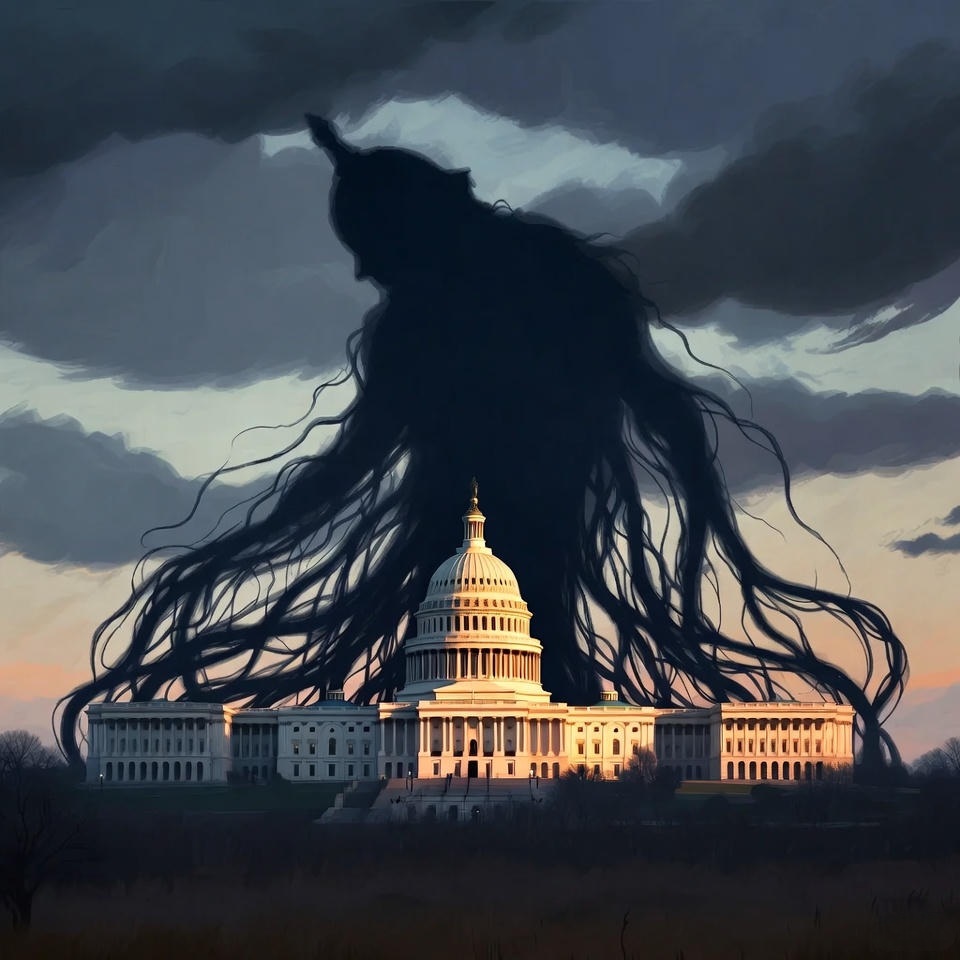
Ignored by the Political Class - The painful truth: Washington politicians no longer live in the same world as the rest of us. Why regular Americans feel forgotten and powerless.

You wake up before dawn, grab your coffee, and head out the door to a job that barely covers the bills. Gas prices climb again. Groceries eat up half your paycheck. Your kids come home from school with questions you cannot answer because the world feels heavier than it did last year. Meanwhile, the people in Washington smile for the cameras, talk about “progress,” and jet off to their next fundraiser.

It is not in your head. Millions of regular folks feel the same sting every single day. The political class does not just overlook you. They operate in a world so removed from yours that your daily fights barely register on their radar. This is not a glitch in the system. It is how the system now runs.

The Bubble That Separates Leaders from Everyone Else

Picture the average lawmaker. They spend most of their time inside secure buildings, riding in cars with tinted windows, and eating meals most families could never afford. Their kids attend private schools. Their health care comes through special plans. When they need something fixed, someone else handles it.

You do not get that luxury. You wait in line at the DMV. You stretch every dollar until it screams. You lie awake wondering if the next layoff notice will land on your desk. The distance between their daily reality and yours grows wider each year. They fly first class while you sit in traffic. They debate billion-dollar projects while you decide whether to fix the car or buy new shoes for your child.

This separation is not accidental. Once people gain power in Washington, a quiet shift happens. Their circle shrinks to other powerful people. Advisors, donors, and media handlers surround them. The voices of truck drivers, nurses, factory workers, and small-business owners fade into background noise. They hear statistics instead of stories. They see polls instead of people.

“The men and women who make our laws no longer live among us. They visit during campaign season, shake a few hands, and disappear back into their protected world.”

That distance explains why so many promises dissolve the moment the election dust settles. They simply do not feel the pain you feel.

Empty Words That Never Turn into Real Change

Listen to any campaign speech. You hear the same script: “We will fight for working families.” “We will secure the border.” “We will lower costs and protect your future.” The crowd cheers. Signs wave. Then the candidate wins, and the real work begins.

Months later, the cost of living keeps rising. Factories still close. Communities watch their best young people move away for better opportunities that never seem to arrive. The same leaders who vowed to fix things now explain why the problem is “complicated” or “requires more study.”

You have seen this pattern repeat across both parties for decades. It is not that they lack intelligence. Many are sharp, well-educated, and surrounded by experts. The trouble is priorities. Their calendar fills with meetings that matter to their donors and their reelection chances. Your concerns stay on the back burner because fixing them would upset the comfortable balance they enjoy.

This cycle breeds a deep exhaustion. You vote. You show up. You hope. Then nothing meaningful shifts. The frustration builds because the political class has mastered the art of looking busy without delivering results that reach your kitchen table.

How Big Money Quietly Shapes Every Decision

Follow the dollars and the picture clears fast. Campaigns cost tens of millions. Only a small group of wealthy donors, corporations, and interest groups can write those checks. Once elected, officials must keep those relationships warm if they want to run again.

That money does not come from your neighborhood. It comes from boardrooms, law firms, and gated communities far from the daily grind most Americans face. Policy starts to tilt toward the people who write the biggest checks. Tax rules favor certain industries. Regulations protect established players while crushing new competition. Trade deals sound great on paper but leave local factories empty.

Meanwhile, your letter to your representative gets a polite form reply. Your call to the district office gets routed to an intern. The system is built to reward those who can pay to play and sideline those who cannot.

You notice it in the little things. Drug prices stay high even though the same pills cost pennies to make overseas. Energy policy swings wildly while your heating bill climbs. Infrastructure projects get announced with fanfare, yet the potholes on your street remain. The political class serves the interests that keep them in power. Your voice, no matter how loud, carries less weight.

The Media Machine That Protects the Status Quo

Turn on any major news channel or open a big newspaper. The stories rarely center on the quiet desperation in towns across Pennsylvania, Ohio, or rural America. Instead, you get endless coverage of what the powerful say to one another. Scandals involving regular people get buried. Failures of policy get spun as “challenges” or blamed on the other side.

This echo chamber reinforces the disconnect. Reporters and editors often live in the same expensive cities and attend the same events as the politicians they cover. They breathe the same air. They share the same assumptions. When you point out that life feels harder than the headlines suggest, you are told the data says otherwise.

The result is simple: your lived experience gets dismissed as anecdotal. Your neighbor who lost his job gets labeled part of a “transition period.” Your family’s struggle with medical debt becomes a “systemic issue” that needs another blue-ribbon commission. The political class and their media allies convince themselves everything is mostly fine because their version of fine looks nothing like yours.

The Everyday Battles That Never Make the Agenda

Inflation does not care about party platforms. It shows up in your grocery cart and your utility bill. Good-paying jobs keep disappearing while the official unemployment number looks acceptable on paper. Schools teach theories that feel disconnected from the skills your kids will actually need to survive. Neighborhoods feel less safe, yet leaders debate topics that seem worlds away from the fear you feel when your teenager walks home at night.

These are not abstract problems. They are the air you breathe. Yet time after time, the political class treats them as secondary. They chase headlines instead of solutions. They argue over process while your world shrinks.

You are not asking for special treatment. You want leaders who understand that a strong country starts with strong families, stable communities, and honest work that pays the bills. When those basics erode, trust collapses.

What This Disconnect Really Costs All of Us

When millions feel ignored, something deeper breaks. People stop believing their effort matters. They stop trusting institutions that once felt solid. They withdraw from the public square because it no longer feels like it belongs to them.

This is not healthy for any nation. A country divided between those who hold power and those who feel powerless cannot last in its current form. The political class may not lose sleep over it, but you do.

The good news is that awareness itself is power. When enough people see the pattern clearly, they begin to demand better. They focus on local action where their voice still carries weight. They support candidates who live closer to the ground. They refuse to accept the scripted answers and start asking harder questions.

You already know the truth in your bones. The political class has grown too comfortable, too insulated, and too focused on its own survival. Your struggles are real. Your concerns are valid. And the only way the game changes is when enough regular people decide they will no longer settle for being invisible.

The next time a smiling face on television promises the world while your bills pile up, remember this: you are not alone in what you see. The disconnect is wide, but your eyes are open. That matters more than they want you to believe.


Mar 312026
 

Why elites stay untouched by rising costs while ordinary citizens struggle. A clear look at the growing divide and how to close it in your life.

I remember the exact moment it hit me. I was standing in line at the grocery store, watching the price of a simple loaf of bread climb again. The woman behind me sighed and said, “I just don’t know how we’re supposed to keep up.” A few hours later, I scrolled through news on my phone and saw headlines about another record-breaking year for tech billionaires and high-level politicians. Their worlds seemed untouched by the same forces squeezing the rest of us.

That contrast is not random. It is widening every single day, and it affects everything from what you pay for gas to the rules that govern your daily choices. The people at the top operate by one set of standards while the rest of us follow another. Let’s look at what is really happening, why it matters, and what it means for your future.

Spotting the Divide in Everyday Life

Walk through any small town or suburb and you see the signs right away. Families choose between filling the tank or buying fresh food. Young people delay starting families because rent eats half their paycheck. Meanwhile, the same policies that promise to help ordinary citizens somehow leave them further behind.

The gap shows up in simple numbers anyone can understand. Wages for most workers have barely moved after you subtract the rising cost of living. Housing prices in major cities have doubled or tripled in the last decade, pushing regular people into longer commutes or smaller spaces. Education costs keep climbing, yet the promised better jobs never quite arrive for everyone.

Ordinary citizens feel the weight of every new expense, while those at the top seem immune to the same pressures.

These are not isolated complaints. They form a pattern. When one group gains more control over resources and decisions, the other group loses ground. The divide grows because the system quietly rewards those who already hold the levers of power.

How Wealth Flows to the Top

Wealth does not stay still. It moves toward those who already have plenty. Look at how investment gains, stock options, and property values concentrate in a small circle. A handful of large companies and their leaders capture most of the new money created each year. The average worker sees wages that rise slowly, if at all, after inflation takes its cut.

This is not about hard work or luck alone. Rules around taxes, investment breaks, and corporate structures tilt the field. Big players write the regulations that protect their advantages. Small businesses and regular families pay the full price without the same protections.

Think about it this way: when markets dip, the largest institutions often receive support that keeps them afloat. When times are good, the gains flow upward even faster. The result is a steady transfer of resources away from the middle and toward the top. Ordinary citizens watch their savings lose value while the elite build bigger cushions.

Power Concentrated in Few Hands

Power follows wealth, but it goes deeper than money. Decisions that shape daily life now rest with a narrow group of leaders in government offices, large corporations, and major institutions. These choices affect what information reaches you, what products you can buy, and even what opinions are allowed in public spaces.

Ordinary citizens once had more direct say through local voices and community networks. Today, distant boards and agencies set rules that reach into your home, your job, and your children’s schools. A single policy change from far away can alter the price of energy, the availability of medicine, or the freedom to speak openly.

When a small group holds the real decision-making power, the rest of us are left reacting instead of directing our own lives.

This concentration creates distance. Leaders lose touch with the daily struggles of people they claim to represent. They fly in private jets while lecturing others about fuel costs. They enjoy security details and private health care while ordinary families wait in long lines for basic services. The divide is not just financial. It is a separation in lived experience.

Why Government Actions Make It Worse

Government steps in with programs that sound helpful on paper. Yet time after time, the benefits flow to the connected few while the costs land on everyone else. New regulations often burden small employers and independent workers the most. Large organizations have teams of lawyers and lobbyists to navigate the rules or even shape them.

Taxes and spending follow the same pattern. Money collected from working people funds projects that enrich insiders through contracts and grants. Inflation, which acts like a hidden tax, erodes the value of savings and paychecks for those who live paycheck to paycheck. Those at the top protect their assets in ways most citizens cannot.

The pattern repeats across different administrations because the underlying incentives stay the same. Officials promise fairness and equality, but the outcomes favor those who already sit at the table. Ordinary citizens end up funding the very system that widens the gap.

Information and the Control of Narratives

What you hear and see shapes how you understand the world. Major media outlets and technology platforms now decide which stories gain attention and which disappear. This control keeps the divide hidden in plain sight. Positive news about elite achievements fills the airwaves, while struggles of regular families receive less focus or get framed as personal failings.

Questioning the official line brings quick pushback. Independent voices struggle to reach wide audiences because the platforms favor established players. This creates a one-way flow of information that protects those in power and discourages ordinary citizens from connecting the dots.

Real understanding comes when you step back and compare the daily reality around you with the stories presented from above.

When information is filtered this way, trust breaks down. People sense something is off even if they cannot name every detail. The growing divide thrives in that fog.

What This Means for Your Future and Your Family

The divide does not stop at money or power. It reaches your children’s opportunities, your retirement security, and the stability of your community. If the pattern continues, ordinary citizens will face tighter constraints while elites enjoy wider freedom. Mobility between groups shrinks. The ladder that once allowed hard work to lift families upward gets pulled higher and higher.

This is not inevitable, but it requires clear eyes. Ignoring the trend leaves you and your loved ones more exposed. Recognizing it lets you prepare and protect what matters most.

Practical Steps to Bridge the Gap in Your Own Life

You do not need permission from anyone to start closing the personal divide. Begin by questioning every major decision that affects your money and time. Track where your dollars go and look for ways to keep more of them working for you instead of feeding distant systems.

Build skills that matter locally. Learn to grow food, repair what you own, or trade directly with neighbors. These steps reduce dependence on large institutions that often fail everyday people first.

Connect with others who see the same patterns. Shared understanding creates strength. Local networks of trust can replace reliance on far-off authorities. Support businesses that treat customers and workers fairly rather than chasing only the biggest profits.

Stay informed through direct sources. Read original documents when possible. Compare claims against your own experience. Over time, this builds the judgment needed to spot when rules are bent in favor of the few.

Finally, vote with your wallet and your voice. Choose where you spend, where you work, and what you support based on real outcomes, not polished promises. Small consistent choices add up to real change at the individual level.

The divide between elites and ordinary citizens is real and growing. It shows in prices at the store, rules handed down from above, and the widening distance between daily life and the decisions that shape it. Facing this truth does not mean giving up hope. It means taking clear, steady action to protect your own ground and build stronger foundations for the people around you.

The future still belongs to those who see the pattern early and refuse to accept it as permanent. Start today with one small step. Your family and your community will thank you for it.

Why the Political Establishment Fears Ordinary Americans

 Conspiracy, Featured, Political  Comments Off on Why the Political Establishment Fears Ordinary Americans
Feb 032026
 

Discover the unspoken reason the Political Establishment fears everyday citizens. It's not what you think. The shift of power back to you.

Let’s start with a story you probably know.

For decades, the people who run things told you what to eat. They published official guidelines, shamed certain foods, and promoted others. They spoke with one voice, from the TV news to your doctor’s office.

Then something happened. Regular people started talking. They shared stories online. They did their own experiments. They ignored the official playbook and tried something different—cutting sugar, eating more fat, skipping meals. And a funny thing occurred: they got healthier. They lost weight they couldn’t shed for years. Their energy came back.

The establishment didn’t celebrate. They got nervous. They called these people dangerous. They tried to shut down the conversation.

Why?

Because a person who thinks for themselves is the single greatest threat to any centralized system of control. The political establishment isn’t afraid of the other party. They’re afraid of you waking up. Here’s why, broken down.


You Break Their Most Powerful Tool: The Story

Governments and their connected institutions don’t run on laws first. They run on stories. The story is everything.

The story is: “Only we have the expertise to handle this.” The story is: “This complex problem requires a complex solution that only we can provide.” The story is: “The world is a dangerous place, and you need us to protect you.”

This story is their operating system. It justifies their size, their power, their budget, and their existence.

An ordinary American who decides to question the story is like a computer virus. You look at your own life, your own community, your own results, and you see a mismatch. The story says you should be helpless without their program, yet you find strength on your own. The story says a certain path leads to success, yet you see that path leading to debt and dependency.

When you start trusting your own eyes more than their narrative, the entire framework begins to crack. They aren’t afraid of your anger. They’re afraid of your quiet, simple disbelief.

A person who stops listening is harder to control than a thousand angry protesters.


You Can Build Things They Can’t Control

Look at any major innovation of the last 20 years. The internet. Social media. Cryptocurrency. Independent publishing. Remote work.

Nearly every one started at the edges. It was a couple of people in a garage, or a coder working alone, or a writer starting a blog. It was ordinary people building tools that bypassed traditional gatekeepers.

The establishment thrives on being the middleman. The permission-slip issuer. The toll collector on the bridge of opportunity.

What happens when you build a new bridge? Their tollbooth becomes worthless. They fear the innate creativity and capability of regular people because they cannot regulate it, tax it easily, or stop it in its infancy. Your ability to build a business from your kitchen table, to reach an audience without a network TV contract, to learn a high-income skill for free online—it makes their old rulebook obsolete.

Your self-reliance is their kryptonite. A population that needs nothing from them is a population they cannot command.


You Expose the Reality of Dependency

This is the uncomfortable core of it all. A significant portion of political power is built on creating and managing dependency.

It’s a simple transaction, but they never say it out loud: We will provide for you, and in return, you will cede control to us. Your security for your sovereignty.

The ordinary American who chooses a different path—who gardens, who homeschools, who learns to fix their own things, who builds a local network, who saves in assets they can’t devalue—opts out of that transaction.

This is terrifying to them. Not because they’re evil cartoon villains, but because their entire model is based on a certain percentage of people staying in the system. When you opt out, you do two things. First, you show others it’s possible. Second, you drain their base of influence. A person who isn’t waiting for a check, a permit, or an approval is a person who speaks with a free voice.

They fear the example you set simply by living independently.


You Remember What They Want You to Forget

There’s a foundational American idea that’s been buried under layers of bureaucracy and fear. It’s the idea that authority flows from the people to the government. Not the other way around.

The political establishment works day and night to make you forget this. They use language that positions them as parents and you as children. They speak of “providing benefits,” “administering programs,” and “granting approvals.”

The ordinary American who rediscovers this founding idea is a profound threat. You start to see yourself not as a beneficiary or a subject, but as a shareholder. And a shareholder has a right to audit the books, question the management, and demand better performance.

When you begin to act like the owner of this country, they have no choice but to see you as a threat. You are claiming power they have come to see as theirs.

The most radical thing you can do today is to assume you are in charge of your own life.


What This Means For You Tomorrow

So, what do you do with this? Understanding their fear is not about paranoia. It’s about recognizing your own leverage.

First, audit your dependencies. Where are you relying on a distant, centralized system for something you could source locally, learn yourself, or do without? Start with one thing. Your food? Your information? Your income?

Second, build parallel systems. Invest in your community. Trade skills with neighbors. Support local businesses. Put your time and money into networks where you see and know the people in charge. This creates resilience no government program can match.

Finally, trust your own data. Your life is a collection of experiments. Did a policy make your town better or worse? Did a recommended diet improve your health? Your personal experience is valid data. Stop dismissing it because it doesn’t match the official report.

The political establishment fears the moment you look around and realize you don’t need their permission to live a good life. They fear the day you stop asking, “What are they going to do for me?” and start asking, “What do I choose to build for myself and my family?”

That shift, from a mindset of waiting to a mindset of building, is what changes history. It always has. It starts with you, ordinary and powerful, deciding to stop being afraid of them—and realizing, perhaps, that the fear has always flowed the other way.

Ration Lines

 Featured, Political, View Point  Comments Off on Ration Lines
Jan 282026
 

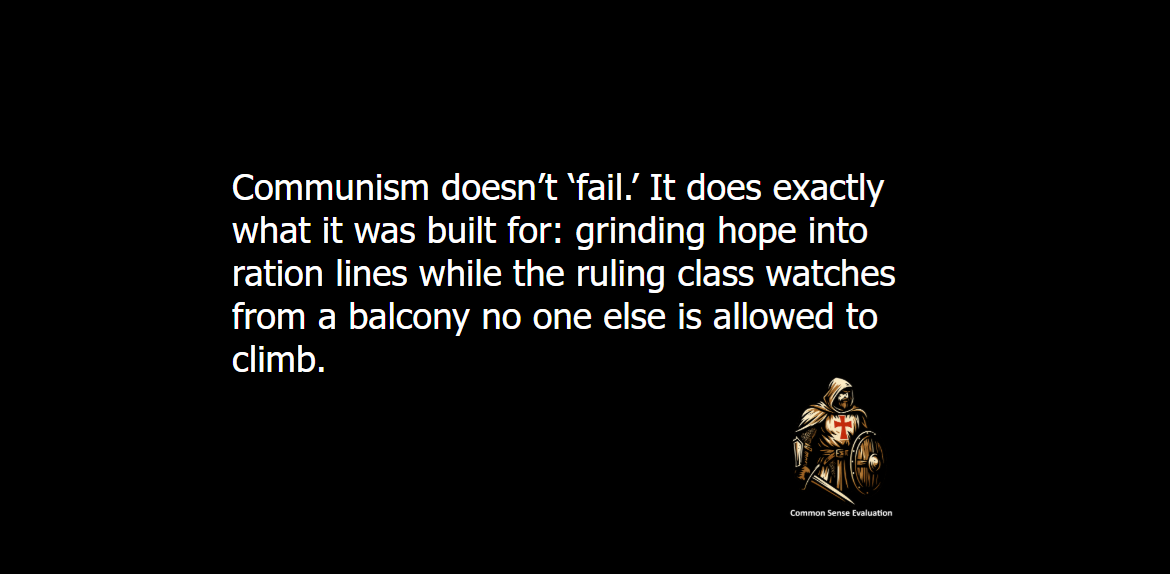
Communism doesn’t ‘fail.’ It does exactly what it was built for: grinding hope into ration lines while the ruling class watches from a balcony no one else is allowed to climb.


Communism doesn’t ‘fail.’ It does exactly what it was built for: grinding hope into ration lines while the ruling class watches from a balcony no one else is allowed to climb.

The Permanent Class: Why Your Vote Doesn’t Really Matter

 Conspiracy, Featured, Political  Comments Off on The Permanent Class: Why Your Vote Doesn’t Really Matter
Dec 012025
 

Feel like your vote changes nothing? You're right. Uncover “The Permanent Class,” the bureaucratic apparatus that actually controls Washington, regardless of the outcome.

Let’s be honest for a second.

You walk into a voting booth every couple of years. You pull the lever, fill in the bubble, or press the screen. For a moment, you feel a spark of possibility. Maybe this time, things will be different. Maybe this candidate will finally be the one to shake things up.

Then, the confetti settles. The news cycle moves on. And nothing of substance changes.

The wars continue. The national debt gets bigger. The same old policies, the ones that never seem to work for regular people, chug along like a train on a fixed track. It doesn’t matter which party holds the fancy title in the White House. The destination is always the same.

Why?

Because elections are not about changing who holds power. They are about making you think you can change who holds power.

The real game is run by a different group entirely.


The People Who Never Leave

Think of Washington not as a city of politicians, but as a giant company. The President and the members of Congress are like the board of directors and the flashy CEO. They get all the media attention. They give the speeches. They take the heat when things go wrong.

But the day-to-day operations? The long-term strategy? The real work is done by the managers and the senior employees who have been there for decades. They don’t leave when a new CEO comes in. They outlast every boss.

This is the Permanent Class.

It’s a dense network of lifers you’ve probably never heard of. They are the senior staffers who actually write the laws. They are the appointed officials who run the three-letter agencies, shifting from a role in an administration to a lucrative lobbying job and back again. They are the think-tank intellectuals and the consultants who provide the intellectual wallpaper for whatever the establishment wants to do.

They all went to the same handful of schools. They live in the same few neighborhoods. Their kids go to the same private schools. They attend the same cocktail parties. They are not loyal to a party, or to an idea, or to you.

They are loyal to the system itself.


The Bureaucratic Machine

The most powerful part of this Permanent Class is the one we talk about the least: the federal bureaucracy.

These are the people who aren’t elected. You can’t vote them out. They are protected by a system that makes it nearly impossible to fire them. And they have the power to create, interpret, and enforce rules that have the force of law.

When a new law is passed, it’s often just a vague set of ideas. It might be a few hundred pages long. Then, it’s handed over to the agencies. They get to write the real rules—the regulations that determine how the law actually works in practice. This process can generate thousands of pages of fine print.

The real laws aren’t passed by Congress; they are written in quiet offices by people you did not elect and cannot hold accountable.

Who are these rule-writers? They are career government employees. And when the political appointee who is nominally their boss leaves town, they stay. They were there before he arrived, and they’ll be there long after he’s gone, cashing his own lobbying checks.

They have one main goal: to protect and expand the power and budget of their own agency. Their entire incentive structure is to make their department bigger, more involved, and more intrusive, regardless of which party is in power.


The Golden Door

So why does nothing ever change, even when a so-called “outsider” manages to win an election?

It’s simple. The system is designed to co-opt or crush any real threat.

A new president arrives in Washington, full of promises. He brings with him a few hundred people he thinks he can trust to run the government. These people are immediately surrounded by tens of thousands of career bureaucrats who see them as temporary visitors. The resistance is instant and invisible.

The new appointees are told, “That’s not how things are done here.” They are buried in paperwork. Their initiatives are slowed to a crawl by “process.” They are lectured about “norms.”

Most eventually give up. They realize that to get anything done, even a small thing, they have to play ball with the Permanent Class. They absorb the culture. They start to see things from the inside perspective.

Then, when their short time in “public service” is over, they walk through the golden door.

They leave their $160,000-a-year government job and step into a million-dollar-a-year job as a lobbyist, consultant, or board member for the very industries they were supposed to be regulating. Their value isn’t their brilliance; it’s their little black book of contacts back in the agencies they just left.

This is the real reward for playing the game. It’s a cycle that guarantees the status quo. The people who are supposed to be reforming the system are bought off with the promise of a future payday that depends on the system staying exactly as it is.


The Illusion of Choice

This brings us back to the elections themselves.

The two parties work very hard to make you believe the stakes could not be higher. They want you to be terrified of the other side. They use fear to get your vote, your money, and your attention.

But behind the scenes, on the things that truly matter, there is a quiet consensus.

War and military spending. Bailing out large banks and corporations. Eroding personal privacy. Expanding the national debt. On these core issues, the leadership of both parties largely agrees. The debates are about the details—about a 1% difference in a budget or the specific wording of a provision. They fight viciously over cultural issues to distract you from the economic and power structures that they all benefit from.

It’s a brilliant magic trick. They keep you focused on the left hand, waving dramatically, while the right hand is quietly picking your pocket. You’re so busy arguing about the magician’s personality that you never see how the trick is done.


What Can You Actually Do?

If voting for a different politician doesn’t change the system, what does?

First, you have to see the system for what it is. Stop believing the fairy tale. Stop getting emotionally invested in the political sports team you’ve been told to support. This doesn’t mean you stop voting. It means you vote without the illusion that it’s the main event. It’s a gesture, not a lever of power.

The real work happens offline.

Stop looking to Washington for solutions. The people in charge have no incentive to solve the problems that give them their power. Instead, focus on building your own life, your own family, and your own community.

Build a business they can’t control. Learn skills they can’t tax away. Create a network of people you trust. Protect your privacy. Put your time and energy into things that are real and local—your health, your finances, your relationships.

The Permanent Class depends on your belief in their system. When you withdraw your faith, your emotional energy, and your dependence, you take away their power.

They want you to feel helpless. They want you to believe that only they can fix the complex problems of the world.

Don’t believe it. The most powerful rebellion is to build a life so independent and so resilient that their decisions in Washington become irrelevant background noise to your own world.

That is how you opt out of their game. And that is something they can never control.