| I make you weak at the worst of times but in the end I keep you safe. You will sweat in my presence, even as you grow cold. I dwell with the weak and easily the brave, but without me who could tell the difference.?
Who am I? |
 |
| I make you weak at the worst of times but in the end I keep you safe. You will sweat in my presence, even as you grow cold. I dwell with the weak and easily the brave, but without me who could tell the difference.?
Who am I? |
|
 |
For a couple of years I’ve been blaming it on lack of sleep and too much pressure from my job, but now I found out the real reason: I’m tired because I’m overworked.
The population of this country is 237 million. 104 million are retired. That leaves 133 million to do the work. There are 85 million in school, which leaves 48 million to do the work. Of this there are 29 million employed by the federal government, leaving 19 million to do the work. 2.8 million are in the Armed Forces, which leaves 16.2 million to do the work. Take from the total the 14,800,000 people who work for State and City Governments and that leaves 1.4 million to do the work. At any given time there are 188,000 people in hospitals, leaving 1,212,000 to do the work. Now, there are 1,211,998 people in prisons. That leaves just two people to do the work. You and me. And you’re sitting at your computer reading jokes. |
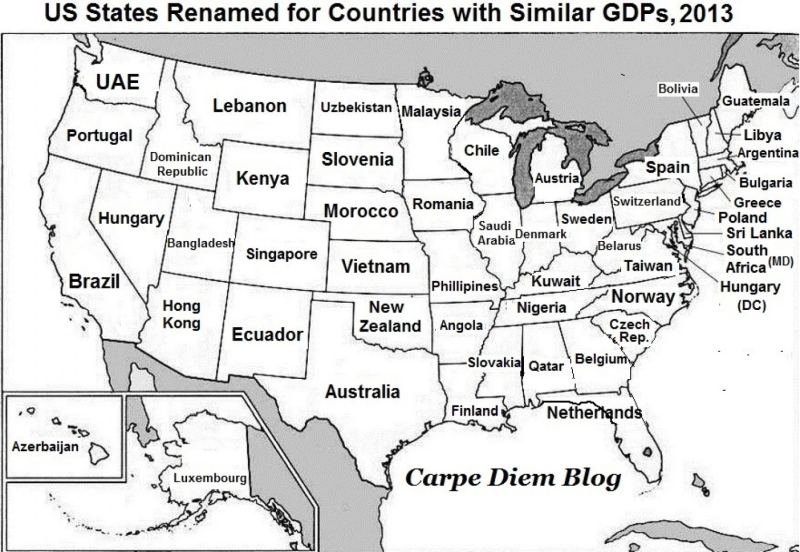
This amazing map shows just how really big the U.S. economy is!
From The Washington Post:
The American economy is really big. That’s the takeaway of this fascinating map of the United States from Mark Perry, an economist who runs the Carpe Diem blog at the American Enterprise Institute.
The map, which has been around for a while, has a lot of explanatory power when it comes to America’s position in the global economy. For each state, Perry finds a country that had a roughly similarly sized economy in 2013.
The results are pretty stunning: California, America’s most economically powerful state, has a gross domestic product roughly the size of Brazil’s. Texas pumps out around the same GDP as Australia. Ohio’s economy is as big as Sweden’s, while New York’s economy is similar to Spain’s.
The smaller states are interesting, too: Connecticut’s GDP is roughly similar to Greece, while Utah is on par with Bangladesh. Alaska’s GDP is about the same size as the tiny European country of Luxembourg.
Altogether, the map drives home just how massive the U.S. economy really is. U.S. GDP was about $17.4 trillion in 2014, followed by China with $10.4 trillion. (It’s worth noting that many of China’s provinces are the same size as country economies as well.)
Other countries trailed much further behind the United States and China in 2014: Japan ($4.6 trillion), Germany ($3.9 trillion), Britain ($2.9 trillion), France ($2.8 trillion), India ($2.0 trillion), then finally Brazil ($2.3 trillion).
These rankings are based on nominal GDP and don’t take into account differences in the cost of living around the world. GDP can also be measured on a purchasing power parity (PPP) basis, which takes into account the cost of living and inflation. Economists see this practice as a better way to capture standards of living around the world — the idea being that, if certain goods and services are very cheap in your country, you can have a high standard of living even if you don’t make a lot of money.
On this basis, China’s economy is a lot closer to the U.S. economy in size. According to IMF figures, China’s PPP-adjusted GDP was $17.6 trillion in 2014, ahead of the United States at $17.4 trillion.
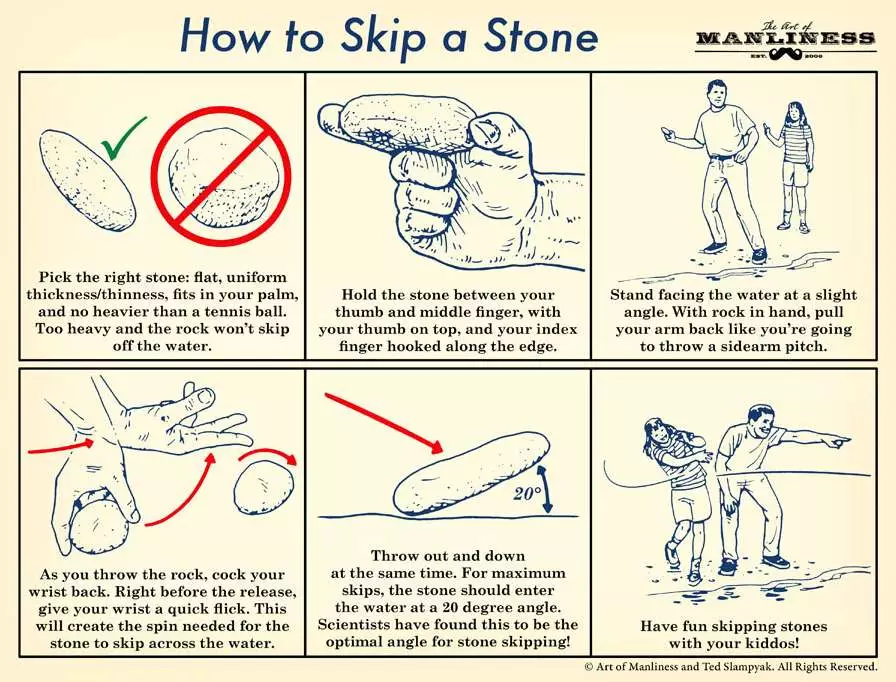
Skipping a stone is a fun way to wile away the time on a camping trip or picnic. It’s something every uncle and dad should know how to teach and pass on to the kiddos. If you never learned how, here’s your tutorial.
