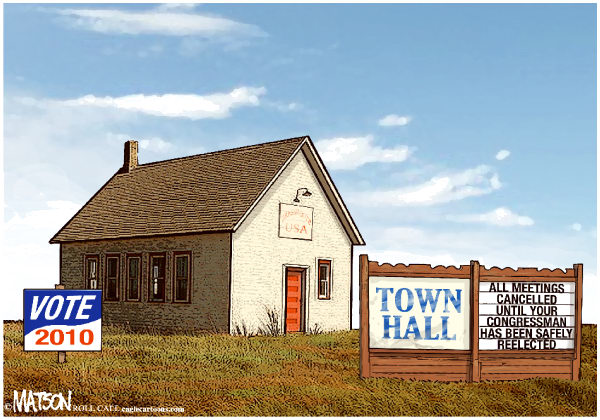
Cartoon Of The Day
Cartoons
Comments Off on Cartoon Of The Day
Jul 292010
1. All pipe is to be made of a long hole, surrounded by metal or plastic centered around the hole.
2. All pipe is to be hollow throughout the entire length – do not use holes of different length than the pipe.
3. The I.D. (inside diameter) of all pipe must not exceed the O.D. (outside diameter) – otherwise the hole will be on the outside.
4. All pipe is to be supplied with nothing in the hole so that water, steam or other stuff can be put inside at a later date.
5. All pipe should be supplied without rust – this can be more readily applied at the job site. N.B. Some Vendors are now able to supply pre-rusted pipe. If available in your area, this product is recommended as it will save a lot of time on the job site.
6. All pipe over 500 ft (153m) in length should have the words “long pipe” clearly painted on each end, so the Contractor will know it is a long pipe
7. Pipe over 2 miles (3.2 km) in length must have the words “very long pipe” painted in the middle, so the Contractor will not have to walk the entire length of the pipe to determine whether or not it is a long pipe or a very long pipe.
8. All pipe over 6″ (152 mm) in diameter must have the words “large pipe” painted on it, so the Contractor will not mistake it for small pipe.
9. Flanges must be used on all pipe. Flanges must have holes for bolts quite separate from the big hole in the middle.
10. When ordering 90 degrees, 45 degrees or 30 degrees elbow, be sure to specify right hand or left hand; otherwise you will end up going the wrong way.
11. Be sure to specify to your vendor whether you want level, uphill or downhill pipe. If you use downhill pipe for going uphill, the water will flow the wrong way.
12. All couplings should have either right hand or left hand thread, but do not mix the threads – otherwise, as the coupling is being screwed on one pipe, it is unscrewed from the other.
The tribal wisdom of the Dakota Indians, passed on from generation to generation, says that when you discover that you are riding a dead horse, the best strategy is to dismount.
In modern education and government, however, a whole range of far more advanced strategies are often employed, such as:
1. Buying a stronger whip.
2. Changing riders.
3. Threatening the horse with termination.
4. Appointing a committee to study the horse.
5. Visiting other sites to see how others ride dead horses.
6. Lowering the standards so that dead horses can be included.
7. Re-classifying the dead horse as “living, impaired”.
8. Hiring outside contractors to ride the dead horse.
9. Harnessing several dead horses together to increase the speed.
10. Attempting to mount multiple dead horses in hopes that one of them will spring to life.
11. Providing additional funding and/or training to increase the dead horse’s performance.
12. Doing a productivity study to see if lighter riders would improve the dead horse’s performance.
13. Declaring that as the dead horse does not have to be fed, it is less costly, carries lower overhead, and therefore contributes substantially more to the bottom line of the economy than do some other horses.
14. Re-writing the expected performance requirements for all horses.
15. Promoting the dead horse to a supervisory position.