The Syndicate Goes Global

 Conspiracy, Featured, Political  Comments Off on The Syndicate Goes Global
Dec 162025
 

The Red Syndicate – Part 5
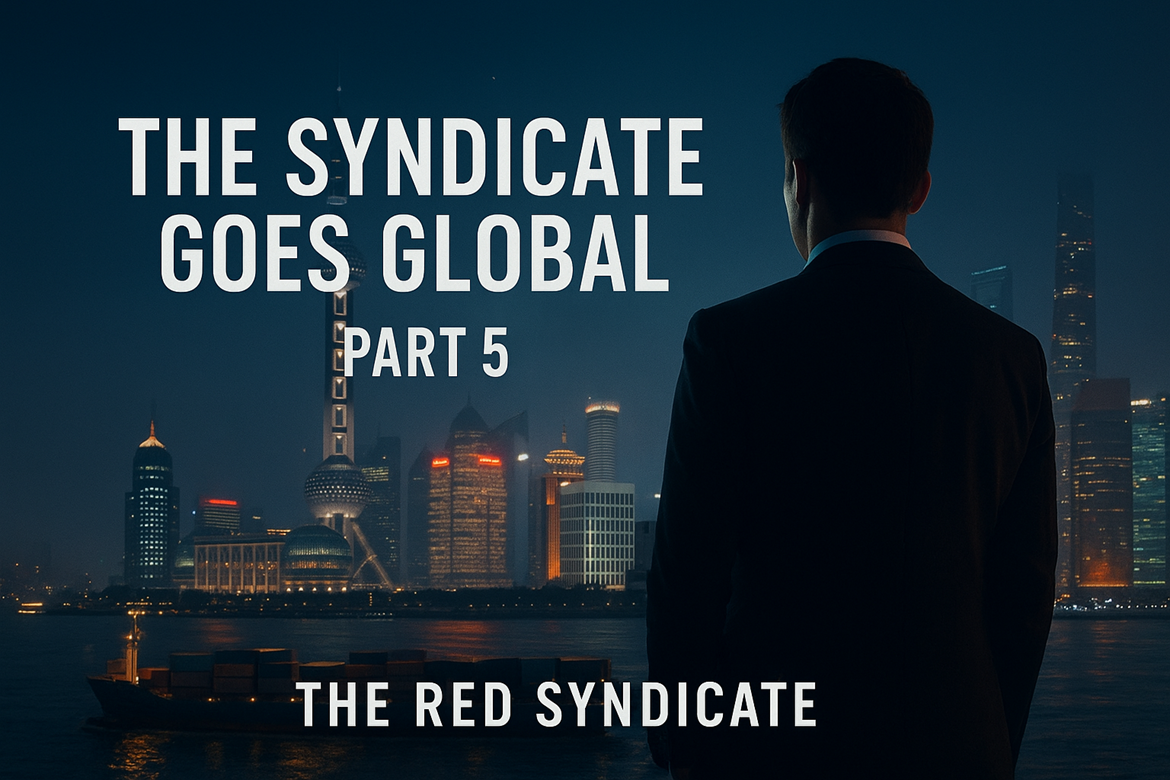
How China’s underworld expands worldwide—money laundering, ports, and power in The Red Syndicate, Part 5.

At a quiet marina in the Mediterranean, a new superyacht appeared one summer without fanfare. Its hull was painted a muted metallic gray. The crew spoke little and kept to themselves. The vessel’s beneficial owner was buried inside a maze of offshore companies registered in jurisdictions most people could not find on a map.

On the other side of the world, a modest apartment in a Chinese provincial city sat empty most of the year. Its listed owner was a retired factory manager with a small pension. In reality, the property had been bought with money routed through that same offshore maze, part of a portfolio that included luxury condominiums in Vancouver, office space in London, and a shopping mall project in Southeast Asia.

The paperwork made it look like a collection of unrelated investments. It was not. It was the visible edge of a hidden architecture.

The Red Syndicate had outgrown Shanghai, outgrown China’s borders, and moved into the bloodstream of global finance.


From Local Power to Global Reach

For decades, the fusion of political authority, business privilege, and underworld methods operated mostly within China. Local bosses, party cadres, and trusted entrepreneurs extracted value from land deals, state contracts, and gray markets. Their fortunes were significant, but their options were limited. Most wealth stayed inside the country, trapped in local currencies and real estate.

As China’s economy expanded and capital controls gradually loosened, the equation changed. New channels opened. Foreign banks set up branches. Global law firms arrived with thick manuals on cross-border investment. Countries across Asia, Africa, Europe, and Latin America courted Chinese capital to build ports, railways, and power plants.

The old habits adapted. Networks that had once smuggled contraband now smuggled money. The same mindset that had treated regulations as obstacles to be negotiated now applied itself to international law.

The syndicate did not need to send gangsters abroad. It sent companies and contracts instead.


The Offshore Escape Hatch

Inside China, political campaigns, policy shifts, and anti-corruption drives could threaten even well connected elites. A single investigation could freeze accounts, seize villas, and demote patrons. For those who had accumulated fortunes through their position, there was a clear incentive to move part of their wealth beyond domestic reach.

Offshore financial centers provided the perfect escape hatch. They offered:

  • Companies that could be created in hours, with directors and shareholders hidden behind nominee services
  • Bank accounts under foreign names
  • Trusts that separated legal ownership from control

For some, these tools were used to plan legitimate investments. For others, they became instruments to launder bribes, kickbacks, and embezzled funds. Profits from inflated infrastructure contracts, “consulting fees” on arms deals, or protection payments from local businesses could be wired abroad, transformed into shares, bonds, or properties, and then quietly enjoyed.

This pattern was not unique to China. Elites from many countries engaged in similar practices. What made the Red Syndicate’s version distinctive was the way it linked official authority, party structure, and commercial entities into one fluid system.

In this system, a provincial official, a state owned enterprise executive, and a private real estate developer could jointly hold assets that existed nowhere on paper inside China. Their interests were protected not only by secrecy laws abroad but also by the political influence they still held at home.


Projects, Partners, and Quiet Leverage

As Chinese companies ventured abroad, they rarely traveled alone. They often arrived with financing from policy banks, diplomatic backing, and a narrative of mutual development. For many host countries, this offered advantages: new infrastructure, quick financing, and a partner that did not insist loudly on political conditions.

Inside some of these projects, however, the old syndicate logic reappeared.

In certain ports and industrial zones, local elites found that partnering with Chinese firms brought not just roads and jobs, but also new opportunities for corruption. Overpriced contracts, unexplained “service companies,” and side agreements opened channels for money to move in both directions.

A governor who steered a port concession toward a particular consortium might receive “consulting” income through a relative’s overseas firm. A minister might secure scholarships for his children or equity in a joint venture. The deals were wrapped in development language, but they operated in part as mechanisms of elite capture.

Beijing did not need to instruct every such arrangement. The system incentivized them. Chinese companies under pressure to win bids and complete projects learned quickly that working through local power brokers was often the fastest route. Local power brokers learned that cultivating ties with these companies and their patrons brought influence and wealth.

The effect was cumulative. Over time, networks formed that linked provincial officials and corporate managers in China with political families and business clans abroad. These were not mere business relationships. They were mutual dependencies made durable by secrecy.


The Diplomacy of Deals

In the past, ships and armies had carried imperial influence. Now, influence arrived through memoranda of understanding, infrastructure loans, and investment forums.

High level visits were often accompanied by delegations of state owned and private firms. Agreements were signed under chandeliers, photographed for front pages, and then handed to teams of lawyers and managers who would translate them into operational reality.

Within this process, some patterns echoed the underworld’s approach to negotiation:

  • Relationships were personal, anchored in trusted intermediaries
  • Information about key terms often stayed restricted to a small circle
  • Conflicts were settled quietly, away from courts or public scrutiny

In some countries, parliamentarians and civil society groups complained that they had limited visibility into the details of long term agreements. In others, opposition politicians accused ruling parties of trading national assets for personal gain.

For the Red Syndicate’s operators, this environment felt familiar. They were accustomed to systems where power was negotiated, not codified, where contracts meant less than relationships, and where a discreet compromise could be more effective than a public dispute.

The result was a form of influence that did not need bases or treaties. It rested on a web of material interests that tied foreign elites to deals whose profitability depended on continued goodwill from Beijing and its corporate satellites.


Real Estate, Safe Havens, and Quiet Neighbors

In many global cities, an observer walking through certain neighborhoods could spot the footprint of this outward flow of wealth without seeing the story behind it.

Luxury apartments sat empty for months, blinds closed. Entire floors of new towers were owned by holding companies with nondescript names. Suburban mansions were purchased in cash by buyers who rarely appeared. Local residents speculated about the owners: tech executives, foreign dignitaries, lottery winners, or criminals.

In some cases, the beneficiaries were neither pure nor simple. They were individuals who occupied ambiguous positions at the intersection of state, business, and shadow networks. Their fortunes depended on a system that was entirely legal on the surface and deeply compromised beneath it.

Host countries often welcomed the inflow of capital, even when it distorted housing markets. Some reassured themselves that money was neutral. Yet neutrality ended where dependence began.

When significant portions of a city’s high end property sector, or a country’s debt, or a strategic port came under the control of entities tied to a foreign authoritarian system, local decision makers faced new incentives. Policies that might anger that system could carry hidden costs for the well connected.

The syndicate did not need to threaten anyone directly. It needed only to be present in the portfolios of those who shaped opinion and policy.


Information, Influence, and the Subtler Tools

The old underworld relied on bribery, coercion, and physical intimidation. The globalized version still used those tools in some corners, but it also developed subtler methods.

Chinese companies sponsored research institutes, think tank programs, and academic chairs abroad. These initiatives brought funding to cash strapped institutions, exchange opportunities to scholars, and prestige to university administrators. They sometimes also created pressure to avoid topics that could embarrass or anger their sponsors.

Media organizations accepted advertising contracts or content deals. Some signed partnerships with outlets linked to the Chinese state. In certain cases, critical reporting about sensitive topics began to shrink, replaced by neutral or positive coverage. Journalists who pushed further found their access curtailed or their editors hesitant.

Former diplomats and political figures joined boards or advisory councils of firms with significant Chinese exposure. Their presence offered legitimacy. Their networks offered access. Their compensation, while legal, created a conflict between personal interest and public duty.

This was not a conspiracy controlled from a single room. It was the natural outcome of a system where economic weight, political ambition, and carefully cultivated relationships converged. The Red Syndicate had learned that influence does not always require control. Sometimes it only requires that key players become accustomed to the idea that certain lines should not be crossed.


Reputation Laundering

One of the most striking features of the syndicate’s globalization was its hunger not only for assets but also for respectability.

Wealth generated in opaque environments sought cleansing in open ones. A business magnate with close ties to political power would endow scholarships, sponsor museums, donate to hospitals, and support cultural exchanges abroad. Foundations appeared under his family’s name, staffed by professionals fluent in the language of philanthropy.

At home, this figure might be known for ruthless land acquisitions or collusion with security services. Abroad, he appeared as a benefactor. Institutions that received his support rarely inquired deeply into the origin of the funds. Many did not want to know.

This laundering of reputation mirrored the laundering of money. It converted dubious capital into social capital. It also created defenders in foreign societies who were reluctant to see their patrons criticized or investigated.

In effect, the syndicate purchased fragments of the moral authority it lacked.


The Silent Vulnerability

For countries on the receiving end of this global expansion, the danger was not immediate collapse or open conquest. It was a gradual drift in the balance of incentives.

  • When a politician’s family business relies on joint ventures with Chinese partners, how boldly will that politician criticize human rights abuses or security risks?
  • When a major newspaper depends on advertising from companies tied to China’s market, how aggressively will it pursue investigations that could prompt retaliation?
  • When a think tank’s budget leans heavily on foreign funding that prefers certain narratives, how balanced will its reports remain?

Democracies often assume that their openness and institutional checks are enough to prevent capture. The Red Syndicate’s spread tests that assumption. It exploits legal pathways, not illegal ones. It rewards silence, not explicit collaboration. It wraps itself in the language of investment, partnership, and shared growth.

By the time conflicts of interest become visible, patterns of dependence may already be entrenched.


Fragmentation and Competition Inside the Syndicate

From a distance, the system can look monolithic. Up close, it is anything but. Different factions, companies, and agencies compete for influence and profit. Local power brokers abroad play them against each other. Not every project succeeds. Not every actor is loyal. Some fall spectacularly from grace.

Anti-corruption campaigns inside China have swept up officials whose families parked wealth overseas. Investigations abroad have revealed bribe schemes involving Chinese firms and foreign counterparts. Each scandal exposes part of the network. Each cleanup operation functions like a violent audit, reshuffling who controls which channels.

Yet the overall architecture survives. Individual pieces are sacrificed to reassure the public or punish rivals. The code endures.

This adaptability makes the Red Syndicate hard to confront. It can present itself as investor, development partner, victim of bias, or champion of multipolarity, depending on the audience.


Why It Matters

The story of the syndicate’s global rise is not an argument against engagement with China or against trade itself. It is a warning about what happens when engagement occurs without transparency, accountability, or an honest assessment of power.

At the heart of this story lies a continuity that runs from the Green Gang’s control of Shanghai’s docks, through the Party’s mastery of secrecy and patronage, to the present web of offshore companies, influence networks, and elite entanglements.

In each phase, power has expressed itself in the same basic pattern:

  • Control the flows: of goods, money, information, and opportunity.
  • Wrap that control in a story: revolution, development, win win cooperation.
  • Use the darkness between what is said and what is done as the space where real decisions are made.

The syndicate goes global not only through ships and contracts, but through the quiet bargains that individuals and institutions accept in exchange for access.


The View from the Bund, Again

Stand once more on the Bund in Shanghai and look outward. Cargo ships slide past under flags from many countries. Containers stacked like bricks carry the goods of a vast trading empire. Somewhere in those holds are products of honest labor, the fruits of ordinary people’s hopes for a better life. Somewhere else, less visible, numbers stream across fiber optic cables, shifting fortunes between accounts that will never bear the true names of their owners.

The city that once taught the world how crime and politics could fuse into a single organism now sends that lesson abroad in more subtle form. Its skyline reflects in waters touched by vessels that dock in every major port on earth.

The Red Syndicate is no longer a local phenomenon. It is a mode of power that has learned to breathe global air.

In the final parts of this series, we will examine how this system intersects with the concept of elite capture, what it means for countries that believed themselves protected by distance or law, and what, if anything, can be done to resist an architecture of influence that hides in plain sight.


Next in the Series

Part 6 – Elite Capture and the Price of Silence
How political, business, and media elites become entangled in the syndicate’s web, why they rarely talk about it, and how their silence reshapes the choices available to everyone else.


© 2025 The Red Syndicate Investigations / Common Sense Evaluation. All rights reserved.
Reform, Openness, and the New Underworld

 Conspiracy, Featured, Political  Comments Off on Reform, Openness, and the New Underworld
Dec 092025
 

The Red Syndicate – Part 4

Reform and opening were sold as the end of chaos and the beginning of prosperity. In reality, loosening the economy while tightening political control created perfect conditions for a new kind of underworld. Part 4 of The Red Syndicate follows how party cadres became gatekeepers to markets, how smuggling and shadow finance flourished, and how the old syndicate logic adapted to the skyscraper age.
Reform and opening brought skyscrapers and markets, but it also created a new underworld fused with official power.

The first skyscrapers of the new China did not rise over Shanghai or Shenzhen. They rose in the minds of the men who realized that ideology could be converted, brick by brick, into cash.

In the late 1970s, Beijing was a gray city of bicycles and ration coupons. Streets were quiet at night. Store shelves were half empty. A generation had grown up repeating slogans and standing in line. The Cultural Revolution had burned through institutions and reputations alike. When the dust finally settled, the Chinese Communist Party faced a crisis it could no longer hide. The country was poor, exhausted, and falling behind.

Into this vacuum stepped Deng Xiaoping, a survivor of purges, a veteran of Yan’an, and a man who understood that power depended on results. He did not talk about the Green Gang or the old Shanghai. He spoke instead of “reform and opening,” of letting some get rich first, of “crossing the river by feeling for the stones.”

But beneath the careful language lay a familiar logic. To revive the economy, the Party would have to loosen control over money while tightening control over politics. It would allow markets to bloom, then graft itself onto them. Old habits from the underworld, once used for survival, now reappeared as tools for enrichment.

A new era was beginning, and with it, a new underworld.


Opening the Gates

In 1978, at the Third Plenum of the Eleventh Central Committee, the Party officially shifted its focus from class struggle to economic development. The phrase sounded dry. Its consequences were anything but.

Collective farms began to contract land to individual households. State factories were given more autonomy over hiring and production. Special Economic Zones appeared along the coast, offering tax breaks and looser regulations to attract foreign capital.

The gates opened slowly at first, then wider. Foreign businessmen arrived, some in cheap suits, others in tailored ones. They brought technology, consumer goods, and cash. Local officials watched them closely, calculating opportunities.

For decades, political loyalty had been the only currency that mattered. Now there was another one. Money returned to public life, not as an enemy of socialism, but as its new instrument.

The Party promised that reform would make the system more efficient and more just. In reality, it created a landscape where rules were flexible, information was uneven, and those closest to power had the best chance to win.

It was, in other words, fertile ground for a new kind of syndicate.


Cadres as Gatekeepers

The shift to a mixed economy did not weaken the Party’s control. It changed the form of that control.

Local officials remained responsible for enforcing regulations, issuing permits, and allocating land. They also became responsible for attracting investment, hitting growth targets, and keeping social order. Their careers depended less on ideological purity and more on delivering economic results.

This combination turned them into gatekeepers. Entrepreneurs, foreign companies, and rural migrants all had to pass through them to get what they wanted. A factory license, a land lease, a bank loan, a contract with a state-owned enterprise, all these flowed through the hands of officials who often earned modest salaries but wielded enormous informal power.

The temptation was obvious. Many officials saw no reason to refuse a “gift” from a company eager to move to the front of the line. Some demanded a share in the profits or placed relatives in key positions. Others used their authority to steer public contracts toward private firms they secretly controlled.

The underworld no longer stood outside the state. It seeped into it. The Party had once studied how syndicates controlled docks and markets. Now its own members controlled access to the most profitable resource of all, the new Chinese marketplace.


The Birth of the “Red Capitalist”

As private and quasi-private enterprises multiplied, a new figure emerged in Chinese life: the “red capitalist.”

Some were former engineers or managers who left state factories to start their own companies. Others were returnees from Hong Kong or overseas who brought capital and skills. Still others were children of senior cadres who used their family connections to secure land, licenses, and financing at bargain prices.

These businesspeople depended on political protection. In return, they offered something the Party needed: growth, employment, and a modern image. It was a mutually rewarding arrangement.

In coastal cities, deals took shape in hotel banquet rooms, karaoke bars, and golf courses. Contracts were signed after rounds of toasts. “Consulting fees” appeared on balance sheets, disguising bribes. Shell companies registered under the names of relatives hid the true beneficiaries of profitable ventures.

The structure resembled a joint venture between a government and an invisible cartel. The Party provided policy support, legal cover, and access to land and markets. The entrepreneurs provided money, both for official projects and for private pockets.

The new capitalists were not outsiders challenging the system. They were its offspring.


Smuggling, Protection, and the Gray Economy

Reform created opportunities not only for legitimate business but also for smuggling on a scale the old Green Gang could never have imagined.

China’s long coastline and porous borders became channels for untaxed goods. Cars, cigarettes, alcohol, electronics, and oil flowed in and out through networks that linked local officials, customs officers, and criminal groups.

One of the most notorious examples surfaced in the 1990s in the port city of Xiamen. A businessman named Lai Changxing built a smuggling empire that evaded billions of dollars in customs duties. He did not do it with boats alone. He did it with relationships. Officials across the police, customs, and security services accepted bribes, gifts, and ownership stakes. In return, they looked the other way, altered paperwork, or provided intelligence on investigations.

When the scandal finally exploded, dozens of officials were arrested. Some received long prison terms. Others were sentenced to death. The Party portrayed the crackdown as proof of its determination to fight corruption.

Yet the scale of the case revealed something more disturbing. Smuggling had fused seamlessly with official structures. The boundaries between bureaucrats and gangsters had blurred into a single gray network.

Across the country, smaller versions of the same pattern played out. Local authorities ran “protection” operations, sometimes under the banner of economic development. Crime bosses who could deliver stability and revenue received quiet tolerance. Entrepreneurs who refused to pay were harassed by inspectors or suddenly discovered they had violated obscure regulations.

The state did not simply tolerate the new underworld. Parts of it partnered with it.


Privatizing the Old Monopoly

Under Mao, the state had monopolized the commanding heights of the economy. Under reform, those heights were partially privatized, sometimes openly, sometimes through back channels.

State-owned enterprises were restructured, merged, or sold. Many of the buyers were insiders, managers who already controlled the assets, or investors with political backing. The process often took place in a fog of incomplete disclosures and hurried valuations.

Mines, factories, and transport firms passed into the hands of individuals who, on paper, were simply businesspeople, but in practice were deeply entangled with local party committees. In some cases, organized crime groups moved in as well, offering muscle for land seizures, debt collection, and labor control.

Coal mining regions in particular became notorious for deadly accidents, illegal operations, and collusion between owners and inspectors. Profits rose. Safety plummeted. Families who complained faced threats. Journalists who reported too aggressively encountered censorship or intimidation.

The pattern was familiar. A formal monopoly gave way to a hybrid system where private gain thrived under public protection, and where the lines of responsibility were deliberately blurred.


The Return of Protection Rackets

In villages and small towns, another form of the new underworld took shape. Local strongmen, sometimes former soldiers or ex-convicts, built groups that offered “protection” for markets, construction sites, and entertainment venues. They collected fees from vendors and businesses, enforced their claims through beatings or vandalism, and settled disputes.

What made this new generation different was its relationship to official power. Many strongmen had patrons in the local police or party apparatus. Some held minor posts themselves. Their violence could be switched on or off depending on political needs.

When protests broke out over land seizures or unpaid wages, these groups sometimes appeared alongside uniformed officers, intimidating organizers. When elections for village committees were introduced, they backed favored candidates. Their presence allowed authorities to keep their hands clean while sending a clear message.

These arrangements resembled the old relationship between the Green Gang and certain warlords or police officials, but now they operated within a system that claimed to be building “rule of law.” Publicly, the Party denounced “evil forces” and organized crime. Privately, some of its local agents still found those forces useful.


Anti-Corruption as Housekeeping

Every system that tolerates corruption eventually must discipline it, not to eliminate it completely, but to manage it. In the reform era, anti-corruption campaigns became a recurring feature of political life.

Inspections would sweep through provinces. High-profile cases would be announced. Officials were paraded on television in handcuffs, confessing their crimes. Some were executed. Others quietly disappeared into prisons.

These campaigns served several purposes at once. They frightened lower-level cadres, reminded them that their positions were conditional, and allowed the central leadership to remove rivals or rebalance power among factions. They also reassured the public that the Party was serious about self-correction.

Yet the campaigns rarely touched the deeper architecture of the system. Officials still controlled access to land, credit, and permits. Information about their wealth remained hidden. Whistleblowers faced retaliation. Media outlets were allowed to expose certain scandals but not others.

Corruption in such a setting behaved less like an aberration and more like a tax, sometimes reduced, sometimes raised, but rarely abolished.


Shadow Finance and the Rise of Informal Networks

As China’s economy accelerated in the 1990s and 2000s, formal banks struggled to meet the demand for credit. State-owned banks prioritized politically important projects and large state firms. Small businesses and private ventures turned to informal lenders, many with criminal ties.

So-called “underground banks” handled transfers for companies and individuals who wanted to move money across borders or conceal its origin. Loan sharks provided capital at high interest rates, using threats instead of contracts to ensure repayment.

At the same time, party-connected investors began to use complex webs of shell companies and offshore entities to invest abroad. Wealth that had once been hidden under mattresses or in local property now flowed into foreign real estate, luxury goods, and financial markets.

The techniques echoed earlier smuggling and money-laundering methods, refined by access to global finance. The underworld was no longer limited to physical contraband. It moved through spreadsheets and wire transfers.

For ordinary citizens, this shadow system was invisible. For those inside it, it was a way to convert political advantage into generational wealth.


The New Urban Nightlife

In the big cities, the effects of reform were most visible after dark. Bars, nightclubs, and massage parlors multiplied. Casinos operated illegally in back rooms and high-rise apartments. Drugs, once nearly eradicated, resurfaced in designer forms.

Behind many of these businesses stood organized groups that looked very different from the rough gangs of the past. They wore suits, carried smartphones, and drove imported cars. Some were former rural migrants who had worked their way up through street-level crime. Others were the sons of officials and businessmen, using their status as a shield.

Police crackdowns came in waves. Raids shut down hundreds of venues at a time. Yet the nightlife always regenerated, often with the same operators, sometimes under new names and licenses.

The persistence of these operations was not accidental. They functioned as nodes in a much larger network that included landlords, security companies, local regulators, and sometimes senior officials. In exchange for stability and informal revenue, authorities allowed certain lines not to be crossed and looked away from others.

Shanghai, Guangzhou, and Shenzhen again became cities where the line between legitimate entertainment and criminal exploitation was intentionally blurred.


Continuity Under New Slogans

On the surface, the story of reform and opening is one of dramatic transformation. Villages turned into cities. State farms turned into industrial parks. Millions were lifted out of poverty. Foreign executives praised the country’s efficiency. Economists pointed to growth rates that had no parallel in modern history.

Yet the deeper patterns explored in this series did not vanish. They adapted.

The Party remained the ultimate arbiter of opportunity. Access to that arbiter often depended on personal networks that functioned like a legal syndicate. Those who mastered these networks prospered. Those who did not were left to navigate a maze of paperwork and unwritten rules.

The underworld no longer wore the face of Du Yuesheng or carried boxes of opium up gangplanks at the Bund. It wore the face of the businessman who held a monopoly because his cousin chaired a committee, the official who protected a smuggling ring in exchange for shares, the security chief who used thugs to clear a village slated for redevelopment.

The tools had changed. The code had not.


A System Looking Outward

As China’s wealth and influence expanded beyond its borders, the same logic of intertwined state, business, and hidden networks began to appear abroad.

State-linked companies invested in ports, mines, and infrastructure projects on several continents. Local partners were chosen through opaque tenders. Allegations of bribery and kickbacks surfaced in some countries. Political elites in partner states sometimes found the arrangement convenient. The techniques that once shaped Shanghai’s underworld now adapted to global geopolitics.

Inside China, this outward expansion was presented as a peaceful rise, a natural extension of economic power. Outside, it sometimes looked like the export of a system where deals were made behind closed doors and accountability was optional.

The new underworld was not confined to any single city or border. It flowed wherever opportunity met opacity.


Echoes from the Bund

Walk along the Bund in Shanghai today and you will see glass towers bearing the names of banks, insurers, and multinationals. Tour boats slide along the river, their decks glowing with LED lights. Tourists pose for photographs where foreign merchants once unloaded cargo and gang couriers once met in the shadows.

The city presents itself as a monument to progress. Yet the history that unfolded here a century ago still whispers beneath the pavements.

Back then, a criminal syndicate learned how to fuse business, politics, and force into a single machine. The revolution studied that machine, then built its own. Reform did not dismantle it. Reform extended it.

The underworld that now exists is not merely a collection of criminals in the shadows. It is the network of relationships in which official authority, private gain, and organized coercion intersect. It is the quiet understanding that certain people and institutions stand above the rules they enforce on others.

Understanding that network is essential for anyone who wants to understand how power really works in the world’s most populous nation and in the global system that increasingly depends on it.


Next in the Series

Part 5 – The Syndicate Goes Global
How financial secrecy, offshore wealth, and elite networks carried the Red Syndicate’s logic beyond China’s borders, and what that means for countries that believed they were immune.


Source Notes

This article draws on:

  • Official Chinese documents and speeches from the reform era, particularly those associated with Deng Xiaoping’s economic policies
  • Scholarly work on local governance, privatization, and corruption in reform-era China
  • Investigative reporting and court records related to major smuggling and corruption cases, including the Xiamen scandal involving Lai Changxing
  • Research on organized crime in contemporary Chinese cities and its links to local political structures
  • Studies of informal finance, underground banking, and capital flight


© 2025 The Red Syndicate Investigations / Common Sense Evaluation. All rights reserved.
The Party Learns the Code

 Conspiracy, Featured, Political  Comments Off on The Party Learns the Code
Dec 022025
 

The Red Syndicate – Part 3

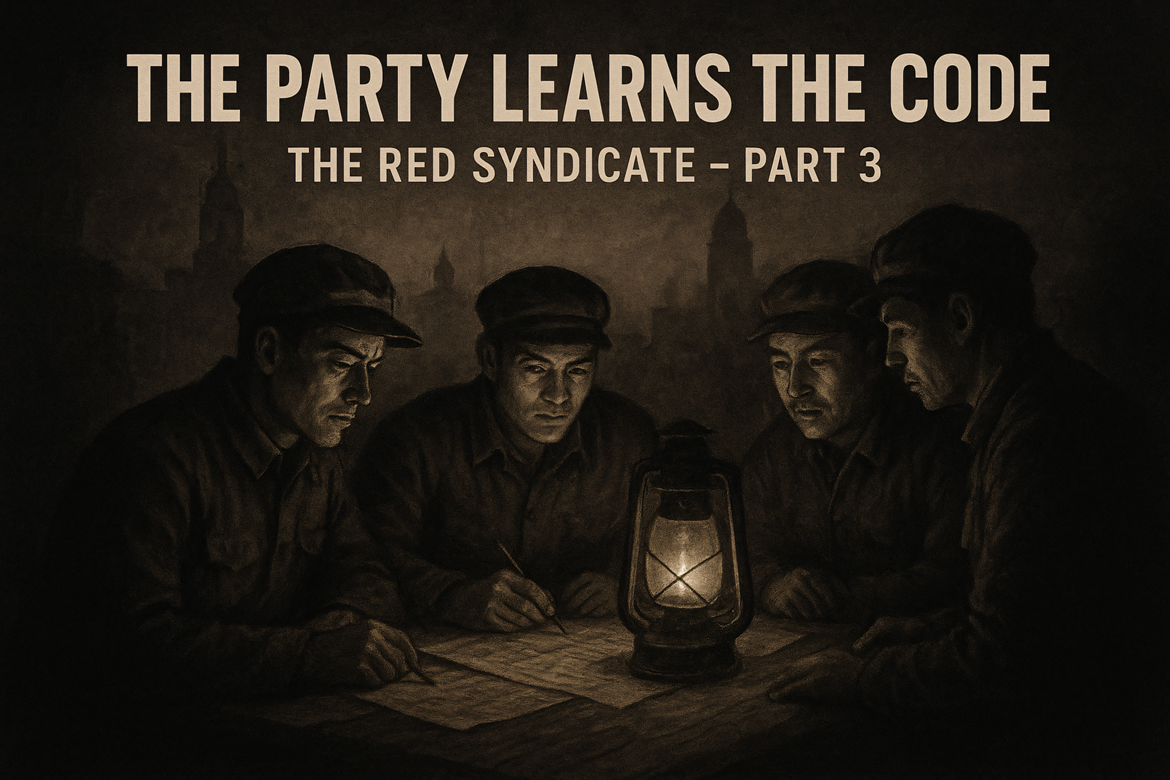
The Red Syndicate - Revolutionary cadres gathered around a lantern-lit table in the countryside, with a faint image of old Shanghai’s skyline behind them.
In the hills and caves far from Shanghai, the Party studied the methods of the underworld it once condemned.

Night in the hills of Jiangxi was not like night in Shanghai. There were no neon signs, no jazz drifting from dance halls, no riverfront lights painting silver streaks on the water. There was only the whisper of pine trees, the crackle of campfires, and the quiet murmur of men planning how to seize a country they could barely feed.

In a farmhouse lit by a single oil lamp, a group of Communist leaders sat around a rough wooden table. The walls sweated damp. Mosquitoes circled the light. Maps lay unrolled beside notebooks filled with coded names and numbers.

At the head of the table, a young cadre reviewed reports from the city. Shanghai was hundreds of miles away, yet its influence filled the room. The documents described strikebreakers, gang enforcers, and secret police. They also described something more important: how power actually worked on the streets.

The revolutionaries had lost Shanghai. They had been hunted, betrayed, and driven into the countryside. But they had not forgotten what the city taught them. In fact, they were taking careful notes.


After the Massacre

The 1927 purge in Shanghai shattered the early alliance between the Communist Party and the Nationalists. Thousands of union organizers, student activists, and sympathizers were killed or disappeared. Survivors fled to rural bases or went deep underground in the cities.

In public, Party propaganda framed the catastrophe as the work of traitors and imperialists. In private, the leadership knew they had been outplayed by a system that understood power better than they did. The Green Gang and Chiang Kai-shek had shown them how quickly ideals could be crushed by organized violence and how fragile a movement was when it relied on open meetings and visible leaders.

The Party now faced an uncomfortable truth. If it wanted to survive, it had to become less like a debating society and more like a syndicate. It needed secrecy, discipline, and a structure that could withstand infiltration and betrayal. It needed to learn the code of the underworld.


From Street Cells to Secret Cells

The first change was structural. In the early years, party branches in cities like Shanghai had operated almost like open clubs. Members knew each other by name. Meetings took place in factories, schools, and rented rooms. After 1927, that openness became a death sentence.

Borrowing from the method used by secret societies and gangs, the Party reorganized into small, compartmentalized cells. Each unit knew only a handful of other members. Communication passed through trusted couriers and coded notes. If one cell was compromised, the damage stopped there.

This was the underworld’s logic applied to politics. The Green Gang had survived for decades because information was distributed carefully. The Communists now adopted the same approach. They introduced rigorous vetting, surveillance of their own members, and harsh punishments for informants.

The Party’s internal regulations began to resemble the rules of a criminal brotherhood. Loyalty was everything. Disobedience was treated as betrayal. New members underwent ideological training that functioned like an initiation rite. They swore to put the Party above family, above friends, above self.

A movement that had once imagined itself as a spontaneous uprising of the people was becoming something more controlled and more dangerous.


The Cult of Discipline

In Shanghai, gang members obeyed their bosses because of a clear hierarchy backed by violence. In the revolutionary base areas, discipline had to serve a different purpose. The Party did not have the money or guns to compete with warlords and gangs outright. What it did have was ideology.

Leaders such as Mao Zedong began to fuse ideological devotion with the kind of personal loyalty once demanded by syndicate bosses. Cadres were taught that the Party was the sole guardian of the people’s future. To doubt its line was not just a mistake but a moral failing. To defy orders was treason.

Criticism sessions and self-criticism rituals reinforced this mindset. Members confessed their doubts, denounced their own “errors,” and reaffirmed their loyalty in group meetings. This process resembled the way the Green Gang used shame and ritual to bind members together, but it added an element of psychological control that went beyond money or fear.

The result was a new form of discipline. It blended the underworld’s code of silence with the fervor of a religious sect. The Party did not simply command obedience. It colonized conscience.


Intelligence as a Weapon

In Shanghai, the Green Gang had relied on spies in the police, the customs office, and competing gangs. Information was their most valuable asset. The Communists, now excluded from official power, came to the same conclusion.

The Party built a sophisticated intelligence network that stretched from treaty ports to inland towns. Operatives infiltrated unions, merchant associations, and even the Nationalist government. Underground members kept lists of sympathetic officials who could be bribed or persuaded. They also tracked enemies for future reprisals.

One crucial innovation was the use of cover identities. Urban cadres posed as shopkeepers, rickshaw pullers, or clerks. Rural operatives became teachers, peddlers, or minor officials. Their lives became a series of masks, just as gang couriers in Shanghai had used legitimate jobs as fronts for smuggling.

Codes and ciphers filled notebooks. Correspondence referred to key figures by nicknames or numbers. Safe houses were rotated. Meetings took place in teahouses, temples, or crowded markets. The Party had turned espionage into a routine part of its survival, a mirror of the underworld’s reliance on informants and double agents.

Intelligence gathering did more than keep the Party alive. It taught the leadership how society actually functioned. They learned which officials could be bought, which merchants were desperate for protection, which neighborhoods resented the Nationalists. This knowledge would later shape their strategy for taking power, then for keeping it.


Financing the Revolution

No movement can survive on slogans alone. It needs money, and money has a tendency to come with strings attached.

In the countryside, the Party raised funds by taxing the local population, confiscating land from landlords, and controlling trade routes. In the cities, however, it had to operate more like a criminal organization.

Underground cells turned to many of the same sources that had financed gangs in Shanghai. They collected “protection fees” from sympathetic shop owners in exchange for defense against extortion by warlord troops or local police. They ran small-scale smuggling operations, moved goods across blockades, and occasionally robbed banks or seized Nationalist payrolls.

Officially, such activities were portrayed as revolutionary requisitions. In practice, they blurred the line between political fundraising and racketeering. A pattern emerged. Once a territory fell under Communist control, legitimate economic activity and secret Party finances became deeply intertwined.

The lesson from Shanghai was clear. True power lay in controlling the flow of resources. If you controlled who could buy and sell, who received loans, and who got access to transport, you controlled everything else.

This philosophy would eventually become the backbone of state planning and state-linked business. But in the revolutionary years, it was still a survival tactic, borrowed from the underworld and dressed in the language of class struggle.


The Politics of Fear

In the gang-dominated districts of Shanghai, fear acted as a kind of currency. People obeyed because they believed refusal would bring swift and brutal punishment. The Communists, determined to avoid past mistakes, began to use fear more consciously.

Early on, the Party leadership insisted that its violence was purely defensive, directed only at landlords, traitors, and agents of foreign powers. Over time, however, the definition of “enemy” expanded. Public executions and “struggle meetings” in the base areas served a dual purpose. They eliminated opponents and sent a message to everyone else.

When a landlord was denounced before a crowd, beaten, and sometimes killed, the spectacle communicated more than any pamphlet. It said that the Party possessed the authority to decide who lived and who died. It also reminded recruits of what would happen if their own loyalty wavered.

The underworld had long used displays of violence to maintain control. The Party added a political justification and a vocabulary of justice. The combination proved powerful and enduring.


Mao’s Synthesis

Among the Party’s leaders, Mao Zedong was the one who most fully absorbed the lessons of Shanghai’s underworld and transformed them into a governing philosophy.

Mao recognized that sheer repression could not sustain a movement. Nor could moral purity alone. What he sought instead was a system that combined popular support, ideological fervor, and the efficient brutality of a syndicate.

He insisted on tight control over the local branches, echoing the centralized authority of a gang boss. At the same time, he promoted land reform and peasant mobilization, which gave millions of ordinary Chinese a reason to see the Party as their defender.

The synthesis was subtle but decisive. The Party presented itself as a champion of the poor while building an internal culture that rewarded unquestioning obedience and punished dissent. Mao framed internal rivals as “factionalists” or “counterrevolutionaries,” labels that justified purges comparable to the Green Gang’s treatment of informants.

By the time the Long March ended and the Party regrouped in Yan’an, this new structure was firmly in place. The Communists no longer resembled a loose coalition of students and workers. They had become a disciplined organization that combined the emotional appeal of a liberation movement with the internal discipline of a criminal syndicate.


Yan’an: The New Headquarters

If Shanghai had been the classroom, Yan’an became the laboratory. The remote caves and mud-brick houses of this northern town were a world away from the cosmopolitan streets of the Bund, yet the ideas that shaped the movement there were born in the same crucible.

In Yan’an, the Party tested its methods of control on a captive community. Cadres managed every aspect of life, from food rations to marriage approvals. Study sessions blended ideological training with surveillance, as members were encouraged to expose each other’s “incorrect thoughts.”

The leadership scrutinized personal histories, looking for signs of suspect class background or past ties to rival factions. Those who failed political tests were ostracized, demoted, or imprisoned. The process resembled a background check for a secret society, except that the consequences were often harsher.

At the same time, Yan’an projected an image of simplicity and sacrifice. Foreign visitors saw leaders in plain clothes eating coarse grain and living in caves. They rarely saw the classified files, the internal struggles, or the punishments meted out behind closed doors.

In this environment, the Party transformed secrecy and discipline into everyday habits. Children grew up learning that the Party’s needs came before personal ones. Adults learned to guard their words even among friends. A code had been written into daily life.


The Capture of the State

When the Communists finally won the civil war and captured major cities in 1949, they did not confront a blank slate. They inherited the same kind of fragmented, corrupt, and semi-criminal environment that had existed under the Nationalists, but now they possessed the tools to control it.

They took over banks, factories, and shipping companies. They seized opium stocks and declared an end to the drug trade. They arrested or executed known gang leaders. To the public, it looked like the destruction of the old underworld.

Behind the scenes, however, many of the functions that gangs had once performed were absorbed into party and state institutions.

The Party now controlled labor allocation, just as the Green Gang once controlled dock workers. It controlled trade and smuggling routes through state monopolies. It controlled information through censorship and the consolidation of media. Loyalty and silence were still rewarded. Dissent was still expensive.

The difference was that these mechanisms now operated with the authority of a government. What had once been an informal syndicate became a formal system of rule.


A Code Written in the Dark

By the early 1950s, the Party had succeeded in presenting itself as the clean, disciplined alternative to the chaos of the past. It outlawed prostitution, gambling, and opium. It spoke of building a new society governed by law and equality. Many ordinary people believed in that promise, because they had witnessed the predatory nature of the old system.

Yet beneath the surface, the same logic persisted. Political power remained opaque. Personal connections still mattered more than formal procedure. High-level decisions were made behind closed doors, recorded in secret archives, and explained to the public only after the fact.

The revolution had learned from the Green Gang that the true strength of a syndicate lies in its ability to control information and enforce loyalty without exposing its inner workings. The Party now wielded that strength on a national scale.

The code that guided this system had been written in the back alleys of Shanghai and refined in the caves of Yan’an. It spoke in the language of ideology, but its grammar was that of the underworld: silence, hierarchy, and control.


From Survival Strategy to Blueprint

What began as a desperate survival strategy during the years of persecution gradually solidified into a permanent model of governance. After Mao’s victory, there was no clear dividing line between the habits formed in the revolutionary struggle and the practices of the new state.

Cadres continued to treat information as a private resource. Policies were enforced by a mixture of persuasion and fear. Economic decisions favored those with the best connections to the center.

The Party had not only learned the code of the underworld. It had normalized it. It became the invisible operating system of Chinese politics.

As the decades passed and the country industrialized, this operating system proved remarkably adaptable. It could manage collective farms or joint ventures, state-owned factories or stock exchanges. Its core principle did not change. Power remained concentrated in networks of loyalty that functioned much like a legalized syndicate.


The Shadow of Shanghai

Modern China often describes the fall of the old order as the end of chaos and the beginning of stability. The gangs are gone, the opium dens have been replaced by banks and cafes, and the docks are monitored by customs officials and security cameras.

Yet the shadow of Shanghai’s underworld still stretches across the landscape. The habits forged in that city continue to influence how decisions are made, how careers rise and fall, and how truth is managed.

The Party did not simply replace the Green Gang. It learned from it, copied its most effective methods, and then buried the evidence under layers of official history.

In the next stage of this investigation, we will follow how that hidden code adapted to a new era of reform and opening, where opportunity and corruption again marched side by side, and where the syndicate spirit found fresh ways to prosper.


Next in the Series

Part 4 – Reform, Openness, and the New Underworld
How economic liberalization in the late twentieth century revived old patterns of patronage and smuggling, turned party cadres into businessmen, and opened the door for a new generation of state-protected criminal enterprises.


Source Notes

This article draws on:

  • Frederic Wakeman Jr., Policing Shanghai, 1927–1937
  • Brian G. Martin, The Shanghai Green Gang: Politics and Organized Crime, 1919–1937
  • Gao Hua, How the Red Sun Rose: The Origin and Development of the Yan’an Rectification Movement
  • Selected Chinese Communist Party documents from the revolutionary base areas and Yan’an period
  • Contemporary scholarship on CCP organizational history and intelligence work

© 2025 The Red Syndicate Investigations / Common Sense Evaluation. All rights reserved.
Adrenochrome Proof?

 Conspiracy, Featured, Political, Videos  Comments Off on Adrenochrome Proof?
Feb 042024
 

Do you believe Adrenochrome is used by the Elite?

This Associated Press piece gets pretty close… and may be proof.

South Korea said it found smuggled drug capsules from China containing the dried, powdered flesh from dead babies. (May 8, 2012)


The Hidden Economy of Corrupt Politicians: Money Laundering Exposed

 Conspiracy, Featured, Political  Comments Off on The Hidden Economy of Corrupt Politicians: Money Laundering Exposed
Nov 012023
 

Explore the dark secrets of political money laundering in our latest post. Uncover the hidden economy of corrupt politicians today.

There’s a term in politics that often lurks in the shadows, whispered in hushed tones: money laundering. It’s a concept that, while sounding complex, can be broken down into simpler terms for you to understand. Money laundering isn’t just something from a gangster movie – it happens in the world of politics too. In this article, we’ll explore the art of political money laundering, demystifying the process and shining a light on the methods corrupt politicians use in funneling ill-gotten gains back to themselves.

The Basics: What is Money Laundering?

Money laundering is like a magic trick that makes dirty money look clean. Imagine a criminal wants to buy a fancy car with the cash they earned from illegal activities. They can’t just waltz into the dealership with a briefcase full of cash, right? That’s where money laundering comes into play. It’s the process of making that dirty money seem legit, like it was earned through legal means.

Shell Companies: A Corrupt Politician’s Best Friend

One of the favorite tools in a politician’s arsenal is the creation of shell companies. These are companies that exist on paper but don’t do much real business. The trick is to hide the origin of the money by funneling it through these entities. Imagine having a secret bank account that nobody knows about – a shell company is like that, but on a grander scale.

Politicians often set up these shell companies in tax havens or places with lax financial regulations. These offshore accounts provide an added layer of secrecy, making it difficult for authorities to trace the money back to its source.

Real Estate Shenanigans

Have you ever wondered how a corrupt politician with a modest salary ends up owning luxurious mansions and properties? Real estate is a popular destination for laundered money. Here’s how it works:

Corrupt politicians might purchase properties using illicit funds through shell companies or intermediaries. Once they own these properties, they can either sell them for a hefty profit, generating clean money, or use the properties as collateral for loans. The borrowed money then appears to be a legitimate income source.

The Casino Caper

Another trick up their sleeves is to launder money through casinos. Here’s the scoop: a politician walks into a casino with a bag full of dirty cash and converts it into chips. They can then play a few hands, lose some chips, and cash out the rest. The money they receive in return appears to be winnings from gambling – a seemingly clean source of income.

Cryptocurrency: The New Frontier

As technology advances, so do the methods of money laundering. Cryptocurrencies like Bitcoin offer politicians a new avenue to launder their ill-gotten gains. It’s like digital cash that can be moved around the world with relative ease and anonymity.

They might buy cryptocurrencies using dirty money, and then trade or transfer them to other accounts. With some digital sleight of hand, the money can be made to look clean. It’s a challenge for law enforcement agencies to trace these transactions due to the decentralized nature of cryptocurrencies.

Smurfing and Structuring: The Money Laundering Twins

Smurfing and structuring are like two sides of the same coin when it comes to money laundering. Politicians employ these techniques to fly under the radar and avoid suspicion.

Smurfing involves breaking down large sums of money into smaller, less noticeable transactions. Imagine if you had $50,000 in dirty cash – instead of depositing it all at once, you’d make multiple smaller deposits, like $5,000 each, in different accounts. This makes it less likely to trigger alarm bells at the bank.

Structuring is the flip side. It’s about keeping deposits under a certain threshold to avoid raising suspicion. For example, if a dirty career politician wants to launder $100,000, they might make ten separate deposits of $9,000 each to avoid hitting the $10,000 reporting limit.

The Importance of Offshore Accounts

Offshore bank accounts are like secret treasure chests for these politicians. They use these accounts to stash their dirty money away from prying eyes. The laws and regulations in some countries make it challenging for authorities to access information about offshore accounts, allowing the corrupt to operate in secrecy.

Political Campaigns: A Convenient Cover

Ever wondered why some politicians pour an incredible amount of their own money into their campaigns? It’s not just a show of support; it can be a way to launder money. Here’s how it works:

A politician injects their dirty money into their election campaign fund, and then, like magic, the money is clean. Donations to political campaigns are heavily regulated, but this technique allows them to legitimize their ill-gotten gains.

Book Deals: The Written Cover-Up

Now, let’s talk about a relatively new and trendy method of money laundering among politicians – book deals. Politicians author books and secure hefty advances from publishing houses. While this may seem like a legitimate endeavor, it can also serve as a convenient cover to launder money.

Here’s how it works: A corrupt politician writes a book or hires someone to ghostwrite it. A publishing house offers them a substantial advance – a large sum of money upfront. This money may come from legitimate book sales, but it can also serve as a way to legitimize dirty funds. The book can be sold, or even given away, to supporters and organizations associated with the politician, effectively returning the money to the corrupt author in a seemingly legal manner.

Foreign Aid: The Unaudited Path

In the intricate world of political money laundering, foreign aid often becomes a shadowy conduit for politicians to further their illicit schemes. Recent events, notably involving unaudited funds sent to Ukraine, shed light on this covert avenue that allows politicians to exploit financial aid intended for nations in need.

Ukraine’s Mysterious Funds: The Unseen Trail

The tale of unaudited money sent to Ukraine is one that highlights the dark side of foreign aid. Funds allocated for humanitarian aid and national development are meant to uplift struggling nations. However, when those funds are sent without proper oversight and auditing, they become a playground for corruption.

In this context, politicians can exploit the lack of accountability and transparency to divert foreign aid into their personal coffers. It’s like a magician’s trick; they move the money from one pocket to another, making it disappear from the public’s view.

The Consequences of Misused Aid

When foreign aid is misappropriated or siphoned off through unaudited channels, the intended beneficiaries suffer the most. Funds that should be dedicated to infrastructure, healthcare, and education are instead used for personal gain or concealed in offshore accounts.

This misuse erodes trust in the system and jeopardizes the lives of those who depend on foreign aid for their survival and well-being. It’s a betrayal of the trust placed in politicians to act in the best interests of their countries and the international community.

The Need for Oversight

The case of unaudited money sent to Ukraine underscores the importance of robust oversight and transparency in foreign aid distribution. It’s a call to action for governments and international organizations to ensure that aid reaches its intended recipients and is used for its designated purpose.

In an age where technology and information can provide real-time tracking of financial transactions, there is no excuse for funds to go unaudited and unaccounted for. We must demand accountability from our “representatives” to ensure that foreign aid serves its true purpose: helping those in need.

Conclusion

Corrupt politicians employ a shadowy arsenal of clever tricks and techniques to launder their ill-gotten money. While this may seem like a tale out of a thriller movie, it’s a stark reality that casts a long, dark shadow over the political landscape. Understanding these methods is crucial, as it reveals the sinister underbelly of corruption and how it infiltrates our most trusted institutions.

The fight against political money laundering is an ongoing battle, often waged in the shadows. Transparency and diligence are our best tools, but the darkness of greed and deception perpetually threatens to engulf the light of accountability. As we unveil these intricate webs of deceit, we must remain vigilant, for it is in the dark corners of corruption that the true extent of its damage becomes horrifyingly clear.