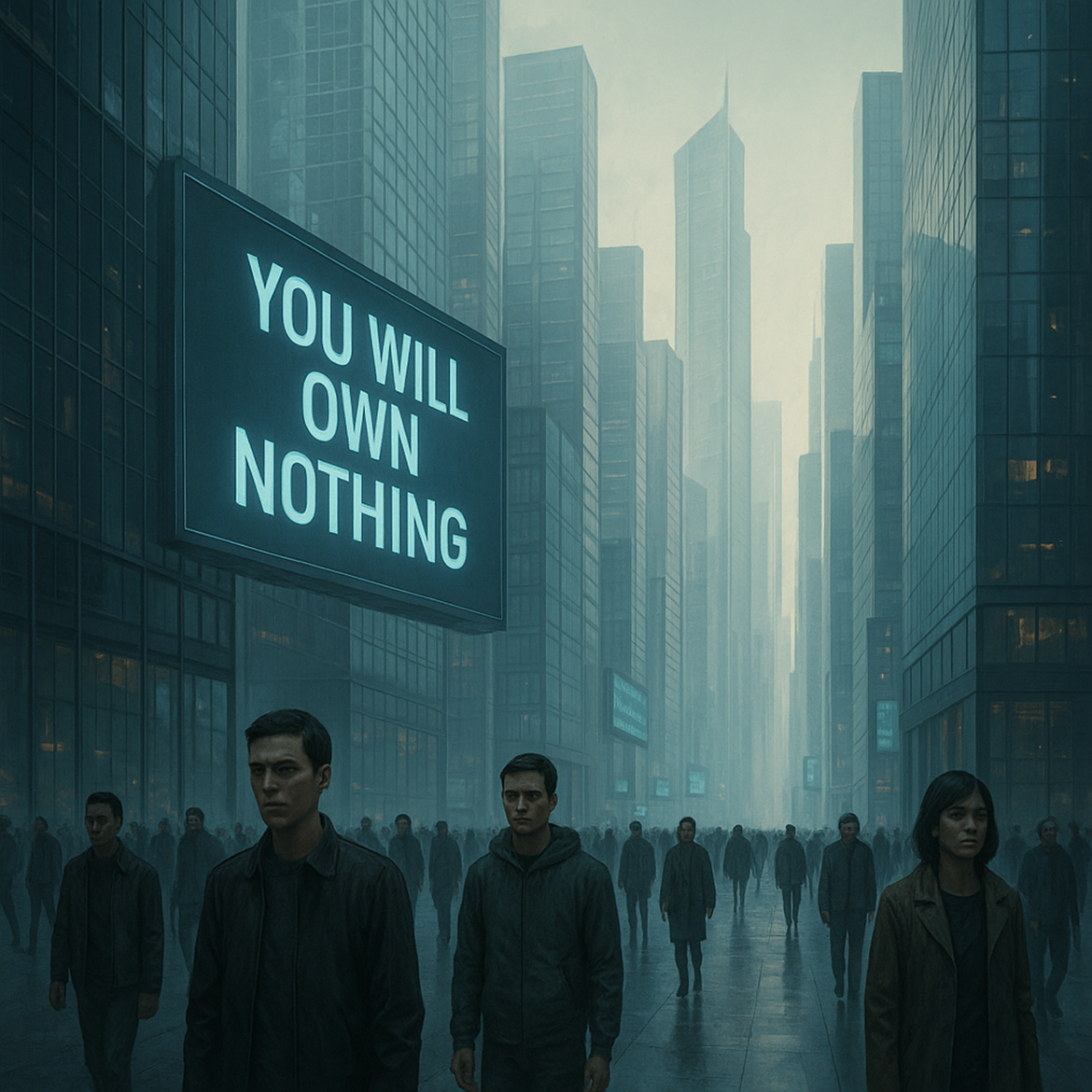
You Will Own Nothing and You Will Hate It

 Conspiracy, Featured, Political  Comments Off on You Will Own Nothing and You Will Hate It
Aug 122025
 

You will own nothing and be happy? Not likely. Here’s what they’re not telling you about the future they’re planning.

Let’s stop pretending. The future we’re being sold is not freedom. It’s a leash—digitally polished, branded with your favorite eco-friendly buzzwords, and tightened around your neck by unelected elites who want to control everything.

They’re not even hiding it anymore. Klaus Schwab, founder of the World Economic Forum, famously said: “You will own nothing, and you will be happy.” Translation? You will rent everything, from your home to your transportation to your access to basic services. And if you step out of line, access denied.

This isn’t some far-off nightmare. It’s already being built around you, brick by digital brick. And if you don’t take a hard look at what’s happening, by the time you realize you’re trapped, there won’t be a door left to escape through.


Ownership Is Power. That’s Why They’re Taking It Away

For generations, owning a home was the backbone of freedom. It meant independence. Stability. Legacy. But today, more and more people are stuck renting—homes, cars, even furniture. And not because they want to. Because they can’t afford not to.

Look around. Corporations backed by global finance giants are buying up entire neighborhoods. They’re not flipping houses. They’re hoarding them—then renting them back to you. Forever. The dream of homeownership is being crushed by design.

And this isn’t just about property. It’s about everything. Why buy a car when you can “subscribe” to a ride-sharing service? Why own tools when you can rent them through an app? Why have money in your hand when your digital wallet can be turned off with the press of a button?


One World Government Is Not a Theory. It’s a Business Plan.

The goal is simple: central control. If you don’t own anything, then someone else does. And that someone else wants to control you.

Step back and look at the pattern. Global institutions and so-called “partnerships” between governments and tech companies are pushing for a future where everything is connected, monitored, and managed. Your house? Smart. Your car? Tracked. Your money? Programmable.

If a single authority can decide what you can buy, how far you can travel, and whether you can access your bank account, what does that make you?

Not a customer. Not a citizen.

A tenant in your own life.


Digital Cages Disguised as Convenience

They’ll tell you it’s for your safety. They’ll tell you it’s efficient. They’ll tell you it’s the future.

Here’s what they won’t tell you: Once everything is digital, it’s no longer yours.

You don’t have to look far to see it. Digital driver’s licenses. Central bank digital currencies. Smart home devices that listen more than they help. Subscription services for everyday needs that used to be one-time purchases.

Each new “feature” quietly removes one more piece of control from your hands and transfers it to someone else. You’re not buying a product—you’re buying time in their system. And when that time’s up, or you break the terms? You’re out.

They don’t have to knock down your door. They just lock you out of your own account.


Future Generations Will Inherit Nothing—and That’s the Plan

Your grandparents could buy a house on one income. Your parents could afford a car without a monthly subscription. You? You’re being told that renting everything is “freedom.”

But let’s call it what it really is: dependence.

Without ownership, you can’t build wealth. Without assets, you can’t pass anything down. The next generation will be born into a system where everything is leased, monitored, and tracked.

And that’s exactly what global planners want: a compliant, dependent population with no leverage, no legacy, and no way out.


Happiness on a Leash

“You will own nothing, and you will be happy.” That’s not a promise. It’s a threat.

They want to replace fulfillment with convenience. Replace responsibility with subscriptions. Replace freedom with access.

But access can be revoked. Always.

The tools being built today aren’t neutral. They’re loaded with intentions. Behind every “smart” product is a kill switch. Behind every “sustainable” option is a restriction. Behind every “universal” system is a gatekeeper.

And that gatekeeper doesn’t work for you.


This Is Your Wake-Up Call

There’s still time. But not much.

Start asking harder questions. Who profits from the subscription economy? Who benefits when you can’t own land? Who gets to decide what’s “allowed” in a fully digital world?

You do not have to buy what they’re selling. You do not have to accept that a future without ownership is “inevitable.” You can still choose a different path.

Start by reclaiming control over whatever you can—your money, your time, your property. Build real-world skills. Support local businesses. Save to own, not rent. Speak up before your voice is algorithmically filtered into silence.

Because if you don’t fight for ownership now, you may not have the right to fight for anything later.


Own something. Or be owned.

The choice is still yours—for now.

The War on the Suburbs: Why the Left Hates Your Backyard

 Conspiracy, Featured, Political  Comments Off on The War on the Suburbs: Why the Left Hates Your Backyard
Aug 052025
 

The War on the Suburbs — Uncover the war on middle-class homes: zoning changes, green mandates, and the fight to protect property from government overreach.

The quietest revolutions don’t happen with protests or headlines. They happen in boardrooms, zoning meetings, and policy documents. If you’ve noticed your property taxes creeping up, your local mom-and-pop stores closing, or new apartment complexes replacing parks, you’re seeing the edges of a battle most people don’t even realize is being fought. This isn’t about politics—it’s about your freedom to live how you choose.

The Quiet Takeover of Your Neighborhood

Picture this: You bought a home in the suburbs for space, safety, and privacy. But suddenly, the rules change. Local officials push “high-density housing” plans, arguing it’s for “community growth” or “sustainability.” What they don’t say? These projects often come with strings attached. Tax hikes fund new infrastructure, but the benefits flow to developers and urban planners, not you. Property values might dip as crammed townhomes block sunlight and streets swell with traffic.

It’s not an accident. Think tanks and lobbyists have spent years promoting policies that funnel people into cities, claiming suburbs are “inefficient” or “harmful to the planet.” They call it “smart growth,” but the real goal seems clearer: Control. The more people cluster in cities, the easier it is to monitor behavior, restrict resources, and dictate lifestyles. Your backyard barbecue? A relic of “wasteful” independence.

The Myth of the Sustainable City

Ever hear the phrase “15-minute cities”? The idea is you can walk to work, school, and groceries within 15 minutes. Sounds convenient, right? But dig deeper. This model requires surrendering cars, shrinking living spaces, and relying on government-managed services. It’s sold as “eco-friendly”, but it strips away your ability to choose where—and how—you live.

Meanwhile, suburban homes are labeled “environmental disasters” for their lawns and driveways. Never mind that many suburbs have more trees per acre than downtown areas. The push for “green” building codes forces costly renovations—solar panels, triple-pane windows, rainwater systems—that price middle-class families out of their own neighborhoods. The globalist message is clear: Stay in your apartment, don’t own land, and let experts manage your life.

The Attack on Property Rights

Zoning laws used to protect homeowners. Now, they’re weaponized. In California, single-family zoning is being dismantled to allow multi-unit buildings on residential streets. Proponents say it’s about “affordable housing,” but it’s really a land grab. Developers partner with politicians to replace suburbs with rental units, creating a generation forever stuck leasing from corporate landlords.

Worse, “climate change” policies are invented to seize control. Imagine being told you can’t renovate your kitchen unless you install $20,000 in energy-efficient appliances. Or learning your neighborhood is now a “flood zone” due to revised federal maps, slashing your home’s value overnight. These aren’t hypotheticals—they’re happening now, with little media coverage.

The Push for Public Transit … And Against Your Freedom

Public transit is essential for cities. But suburbanites don’t hate buses or trains—they hate being forced to depend on them. Massive transit projects, like light-rail expansions, are pitched as “alternatives” to cars. Yet these systems often lose money, require endless tax subsidies, and serve urban commuters, not families in the suburbs.

The deeper agenda? To make car ownership unaffordable. Gas taxes, toll roads, and emissions fees punish those who drive. Electric vehicles (EVs) are pushed as the solution, but they’re pricier and rely on infrastructure controlled by utilities—and ultimately, the government. No car? No problem … as long as you’re okay with being tracked by transit cards and ride-share apps.

The History They Don’t Want You to Remember

Suburbs didn’t just appear. They boomed after World War II, when veterans used government loans to buy modest homes. For decades, suburbs symbolized upward mobility and autonomy. But critics now call them “segregated” or “divisive,” ignoring that suburbs today are more diverse than ever.

The goalposts keep moving. First, suburbs were accused of causing pollution. Then racism. Now, climate change. Each crisis justifies more rules, more costs, and fewer choices. It’s a pattern: Invent a problem, blame the suburbs, then “solve” it by centralizing power.

How to Fight Back (Without Moving to a Bunker)

This isn’t about left vs. right. It’s about grassroots vs. elites. Here’s what works:

  1. Go local. City councils and zoning boards have more power over your life than Congress. Attend meetings, question “development plans,” and vote out leaders who prioritize developers over residents.
  2. Form alliances. Partner with neighbors to share resources—legal help, contractors, even bulk purchasing for energy upgrades. Independence thrives through cooperation.
  3. Document everything. Take photos of your neighborhood now. If new construction or zoning changes occur, you’ll have proof of their impact.
  4. Opt out. Reduce reliance on systems designed to control you. Grow a garden, install solar panels on your terms, and support local businesses. The less you depend on centralized services, the freer you are.

The Bigger Picture

Your backyard is more than grass and a grill. It’s a statement: You’ve earned a slice of the world to call your own. That terrifies anyone who thinks resources should be pooled, managed, and rationed by “experts.”

But here’s the truth: No policy can erase the human desire for freedom. The suburbs survived the rise of cities, the nuclear scare, and countless economic crashes. They’ll survive this, too—if enough people wake up and push back.

Stay curious. Ask questions. And remember: The best way to win a quiet war is to never let it stay quiet.

The Case for Military Tribunals in a Broken Republic

 Conspiracy, Featured, Political  Comments Off on The Case for Military Tribunals in a Broken Republic
Jul 292025
 

Ex-presidents, betrayal, and a broken system: Why military tribunals become the last defense against internal coup attempts.

Let’s start with a simple question: What do you do when the people in charge of enforcing the law are the ones breaking it? We’re not talking about petty crimes here. Imagine a scenario where powerful figures—those with access to secrets, soldiers, and the machinery of government—use their positions to destabilize the very nation they swore to protect. When ordinary courts can’t—or won’t—hold them accountable, what’s left?

This is where military tribunals come into play. These are special courts, separate from civilian systems, designed to handle cases involving national security breaches, espionage, or threats to the structure of government itself. They’re not the first option. They’re the last.

The Unseen Line Between Order and Chaos

Military tribunals exist for one reason: to address failures in the normal legal process. Think of them as an emergency brake. If a group inside the government—say, high-ranking officials or even a former leader—works to sabotage elections, spread disinformation to incite violence, or manipulate foreign alliances to weaken the sitting president, the fallout could collapse public trust overnight.

But why not let regular courts handle it? Because influence spreads like poison. A former president might still control loyalists in key positions—judges, lawmakers, agency heads. Evidence could “disappear.” Witnesses might fear retaliation. In extreme cases, the threat isn’t just to individuals but to the integrity of the nation’s survival.

A Hypothetical That’s Closer to Home Than You Think

Picture this: A former president secretly collaborates with mid-level military officers, sympathetic media figures, and bureaucrats to destabilize the current administration. Fake documents leak, suggesting the new president plans to dissolve Congress. Protests erupt, funded by offshore accounts tied to the former leader. Key defense personnel “lose” communication with command chains during a critical moment.

This isn’t just rebellion. It’s a calculated strike at the heart of democracy. Ordinary courts might stall for years arguing over jurisdiction, evidence rules, or free speech protections. Meanwhile, the country burns. Military tribunals, operating under stricter secrecy and swift procedures, could isolate the perpetrators, protect whistleblowers, and neutralize the threat before it escalates to widespread violence.

History Shows Precedent—And Pitfalls

The U.S. has used military tribunals before, but sparingly. During the Civil War, President Lincoln suspended habeas corpus to detain Confederate sympathizers plotting to sabotage Union supply lines. In World War II, Nazi spies captured on U.S. soil faced military justice to prevent public trials from becoming propaganda tools.

These examples worked because the threats were obvious and existential. Critics argue tribunals risk bypassing civil liberties, and they’re right. But in cases where the corruption is systemic—when the rot is inside the house—the alternative is worse. Waiting for a broken system to fix itself is like hoping a shattered window will reglaze.

How Would It Actually Work?

First, the president or Congress would declare a state of emergency, citing specific actions that threaten national security. A panel of military judges, screened for neutrality, would review evidence behind closed doors. Charges might include treason, sedition, or conspiracy to overthrow the government. Proceedings would prioritize speed and secrecy to prevent further attacks.

Critics say this skips due process. Supporters argue that in rare cases, survival trumps tradition. To balance this, safeguards could include independent oversight (think retired judges or international observers) and strict limits on tribunal power—say, a 90-day window to try cases before reverting to civilian courts.

The Thin Edge of the Wedge: Could This Backfire?

Absolutely. Handing the military unchecked power is a recipe for tyranny. That’s why transparency matters after the crisis passes. All tribunal records would eventually be made public. Officials involved would face audits. Laws could sunset tribunal authority automatically unless renewed by Congress.

But let’s flip the script: If a shadow network inside the government successfully rigs elections, silences opponents, and seizes control of the military, what then? Tribunals aren’t perfect, but inaction guarantees collapse. Sometimes you have to fight fire with fire—just don’t let it burn down the neighborhood.

The Bottom Line: Fearless Questions, Uncomfortable Answers

Ask yourself: How much faith do you have in the people running the show? If your answer is “not much,” you’re not alone. Systems fail. People lie. Power corrupts. But in moments where deception becomes a weapon, and loyalty to a person outweighs loyalty to the constitution, extraordinary tools are needed.

Military tribunals are a danger… and sometimes a necessity. The key is knowing when to use them—and when to walk away. Because once you cross that line, there’s no easy return. But in the words of a general who once saved a republic: “The price of greatness is responsibility… and occasionally, getting your hands dirty.”

Rudy Giuliani Took Down the Mob. Is He Taking Down the Deep State Next?

 Conspiracy, Featured, Political  Comments Off on Rudy Giuliani Took Down the Mob. Is He Taking Down the Deep State Next?
Jul 282025
 

Rudy Giuliani helped crush the Mafia. Could he be helping Trump clean out Washington next?

The Man Who Took Down the Five Families

Rudy Giuliani doesn’t need an introduction. In the 1980s, when New York was drowning in organized crime, Giuliani stepped into the chaos and did the impossible. He used the law like a scalpel. He didn’t just arrest mobsters—he took down entire crime families. The Gambinos. The Genoveses. The Luccheses. All of them.

Back then, Giuliani didn’t chase headlines. He chased justice. And justice wasn’t popular with the people in charge.

Giuliani proved he could take on complex, powerful organizations that operated in secret and pulled strings behind the scenes. He didn’t blink. He didn’t back down. He knew how to win a war that couldn’t be fought in the open.

Which brings us to now.

What If the Same Skills Are in Play Again?

Let’s fast forward to 2025.

Donald Trump won the 2024 election. He’s back in the White House. And the air in Washington feels electric again. This time, the fight isn’t just about policy. It’s about cleaning house. It’s about exposing what’s been happening in the shadows since 2016—and maybe even before that.

Behind the scenes, whispers are getting louder.

The Department of Justice has just announced the formation of a new Strike Force. Their mission? Investigate Barack Obama and top officials from the Obama administration. People like Hillary Clinton, James Comey, John Brennan, and James Clapper. Names we’ve heard again and again.

The Strike Force is digging into what many have called a silent coup—a coordinated plan to block and remove Donald Trump from power before he could even take the oath of office in 2017.

But here’s the million-dollar question:

Is Rudy Giuliani helping lead this charge from the shadows?

Giuliani’s Playbook: Silence, Strategy, Precision

Let’s think clearly for a moment.

If you were launching a deep, surgical operation to take down powerful people who control media, intelligence, and finance—would you put your best strategist on camera every night?

Of course not.

You’d keep him out of the spotlight. You’d let him operate like he did in the mob trials—quietly, surgically, relentlessly.

That’s exactly what Giuliani might be doing now.

Keeping his name off the front page protects him. It keeps the media from launching daily smear campaigns. It stops the Deep State from turning its weapons on him. And it gives him room to operate with precision—just like he did when taking down the Mafia.

Giuliani doesn’t need attention. He needs results.

A War Much Bigger Than Politics

We’re not talking about a simple political rivalry. This isn’t Democrats vs. Republicans.

This is about a group of people who believe they’re above the will of the voters. People who have used the intelligence community, the media, and global institutions to push their version of control.

Giuliani’s experience makes him uniquely suited to this battle.

He understands how secret networks operate. He understands how they protect each other, how they launder influence, and how they hide in plain sight. He spent years prosecuting people who thought they’d never be touched.

And now, he might be bringing those same skills to Washington.

The Strike Force Has Teeth—And a Target

The DOJ’s new Strike Force isn’t just a political stunt.

It’s a sign that things are shifting.

According to DOJ insiders, the team is already gathering evidence that shows coordination between intelligence officials, political operatives, and media figures to undermine Trump’s first presidency. Documents, emails, texts—none of it looks good for the people involved.

We’re talking about an operation to interfere with an election and sabotage a sitting president.

It’s not a theory. It’s a crime.

If Giuliani is advising the Strike Force, even unofficially, then the people involved should be nervous. Very nervous.

Why the Media Is So Quiet About Giuliani

Let’s address the silence.

Giuliani has been suspiciously absent from mainstream news lately. That’s not because he’s irrelevant. It’s because the media doesn’t want to talk about what he’s doing.

Think about it.

The same media that ran 24/7 coverage during the Russia hoax has gone silent now that investigations are turning the other way. They’re not reporting. They’re protecting.

If Giuliani is working behind the curtain to dismantle the machine, then keeping him out of the news helps the mission. It’s not just strategy—it’s survival.

You don’t expose your knight until he’s ready to strike.

The Pattern Always Repeats

Look at the timeline.

In 2016, the Clinton campaign pushed the Russia story. Intelligence agencies played along. The FBI ran with it. The media amplified it.

It was coordinated. It was pre-planned.

Now, in 2025, the people who orchestrated it are being investigated. The same agencies that were used as weapons are being forced to answer for their actions.

And who better to help unravel a criminal network than the man who already did it once?

Giuliani was made for this moment.

What Comes Next?

The public should be watching carefully.

The DOJ Strike Force may be the most important investigation in modern history. It’s not just about politics. It’s about restoring trust. It’s about making sure the country is run by elected leaders, not unelected insiders.

Giuliani’s silence speaks volumes. His past proves he’s not afraid of powerful enemies. And the pieces are falling into place.

This time, the criminals aren’t wearing tracksuits and running numbers. They’re wearing suits and running agencies.

But Rudy’s been here before.

And if he is part of this fight—quietly, strategically, relentlessly—then the Deep State might finally have met its match.

The War on Masculinity Is a War on Civilization

 Conspiracy, Featured, Political  Comments Off on The War on Masculinity Is a War on Civilization
Jul 222025
 

The War on Masculinity - Strength isn’t oppression. Why teaching boys to lead, protect, and provide safeguards communities—and why we’re failing them.

Let’s cut through the noise. For thousands of years, societies didn’t just tolerate traditional gender roles—they depended on them. Men built cities, defended borders, and forged systems of law. Women raised children, managed homes, and preserved cultural values. This wasn’t about one being “better” than the other. It was about balance. When you dismantle that balance, you don’t just erase roles—you destabilize the invisible glue that holds communities together.

Some argue that questioning these roles is progress. But think: When has uprooting a foundation ever left a structure standing? Masculinity isn’t toxic. The real toxicity comes from telling half the population their instincts—protecting, providing, leading—are archaic or dangerous. Strip away purpose, and you create a vacuum. And nature hates a vacuum.

History Shows What Happens When Roles Collapse

Take Sparta. Its warriors weren’t just soldiers—they were symbols of duty. Their strength protected the city-state, but their discipline also inspired Art, Philosophy, and Governance. When Spartan values faded, so did its influence. Rome followed a similar script.

The shift from Stoic Virtue to indulgence didn’t start with excesses; it started with men who stopped seeing themselves as pillars of something bigger.

Fast-forward to the 20th century. After World War II, men returned home to rebuild nations. Factories, highways, and suburbs didn’t materialize out of goodwill. They required directed ambition, risk-taking, and yes—traditional masculine traits. Today, those same traits are labeled “problematic.” But ask yourself: Who benefits when a generation of men grows up apologizing for their natural drive?

The Quiet Attack on Fatherhood

Here’s the elephant in the room: Fatherhood is under siege. Pop culture paints dads as bumbling sidekicks, while media glorifies single-parent households as “empowering.” But study after study shows kids thrive most with involved fathers. Boys learn resilience, respect, and responsibility. Girls learn self-worth and discernment. Without strong male role models, kids chase validation in darker places—gangs, social media, or worse.

This isn’t nostalgia. Look at crime rates in fatherless communities. Look at plummeting college enrollment for young men. When boys grow up without boundaries or purpose, they don’t magically become “enlightened.” They become adrift. And a society of adrift men is a society primed for chaos.

Redefining Strength Doesn’t Mean Erasing It

Critics say, “We’re not against masculinity—we’re redefining it!” But redefinition often looks like deletion. Modern “healthy masculinity” campaigns focus on vulnerability and empathy, which matter—but they skip the other half of the equation. Imagine training a soldier to cry but not to fight. You’d have sensitivity without the skill to defend what’s sensitive.

Real strength isn’t brute force. It’s mastery of self. A man who controls his temper, provides for his family, and stands by his word isn’t a relic. He’s a Swiss Army knife of stability. Teach boys to channel their aggression into discipline, their competitiveness into innovation, and you’ll get leaders—not victims.

The Bigger Picture: Civilization Needs Guardians

Civilization isn’t a smartphone app. You can’t upgrade it overnight or patch its bugs with hashtags. It’s fragile. It needs guardians—people willing to do hard, thankless jobs. Who fixes the roads at dawn? Who enforces laws in hostile neighborhoods? Who climbs cell towers to keep your Wi-Fi running? Mostly men. Always has been.

This isn’t exclusionary. Women can (and do) excel in these roles. But when society shames men for taking pride in demanding work, fewer sign up. The result? Crumbling infrastructure, understaffed police forces, and energy grids held together by duct tape. We’re already seeing it.

How to Push Back Without Being a Troll

First, reject guilt. Masculinity isn’t a sin. Second, mentor. If you’re a father, coach, teacher, or older brother, model integrity. Show young men that honor isn’t about dominating others—it’s about earning respect through action. Third, celebrate unsung heroes. The mechanic, the farmer, the dad coaching Little League after a 12-hour shift. These men aren’t “basic.” They’re the backup generators of society.

Finally, call out double standards. Why is a woman praised for ambition, but a man called “domineering”? Why are male flaws pathologized while female flaws get hashtags? Fairness goes both ways.

The Bottom Line

This isn’t about going backward. It’s about recognizing that some truths are timeless. Birds fly. Fish swim. Men protect, build, and lead. Force a bird to swim or a fish to fly, and you get confusion, not progress.

The war on masculinity isn’t a culture skirmish. It’s a reset—one that swaps order for experimentation, certainty for chaos. And once the dust settles, we’ll all ask: “Why did we volunteer for this?”