EPA Warning: The Danger Of Eating Bread

 Jokes, Political  Comments Off on EPA Warning: The Danger Of Eating Bread
Mar 272017
 

THE DANGER OF EATING BREAD

EPA Warning: The Danger Of Eating Bread

A recent newspaper headline read,’ ‘Smell of baked bread may be health hazard.” The article went on to describe the dangers of the smell of baking bread. The main danger, apparently, is that the organic components of this aroma may break down ozone.

I was horrified. When are we going to do something about bread-induced global warming? Sure, we attack tobacco companies, but when is the government going to go after Big Bread? Well, I’ve done a little research, and what I’ve discovered should make anyone think twice….

THE FINDINGS

1. More than 98 percent of convicted felons are bread eaters.

2. Fully HALF of all children who grow up in bread-consuming households score below average on standardized tests.

3. In the 18th century, when virtually all bread was baked in the home, the average life expectancy was less than 50 years; infant mortality rates were unacceptably high; many women died in childbirth; and diseases such as typhoid, yellow fever and influenza ravaged whole nations.

4. More than 90 percent of violent crimes are committed within 24 hours of eating bread.

5. Bread is made from a substance called’ ‘dough.” It has been proven that as little as one pound of dough can be used to suffocate a mouse. The average person eats more bread than that in one month!

7. Bread has been proven to be addictive. Subjects deprived of bread and given only water to eat begged for bread after only two days.

PROPOSED RESTRICTIONS

Most bread eaters are utterly unable to distinguish between significant scientific fact and meaningless statistical babbling. In light of these frightening statistics, we propose the following bread restrictions

1. No sale of bread to minors.

2. No advertising of bread within 1000 feet of a school.

3. A 300 percent federal tax on all bread to pay for all the societal ills we might associate with bread.

4. No animal or human images, nor any primary colors (which may appeal to children) may be used to promote bread usage.

5. A $40.2 billion fine on the three biggest bread manufacturers.

 

Real Life Foghorn Leghorn

 Amusing  Comments Off on Real Life Foghorn Leghorn
Mar 272017
 

Behold: Foghorn Leghorn in real life!

[arve url=”https://commonsenseevaluation.com/wp-content/uploads/2017/03/Real-Life-Foghorn-Leghorn.mp4″ /]

The Brahma Chicken

Often referred to as the “King of All Poultry,” the Brahma chicken is appreciated for its great size, strength, and vigor. By 1901 some individual birds were documented to have reached the incredible weights of 13-14 pounds for hens and 17 to 18.25 pounds for cocks – though 10 pound hens and 12 pounds cocks were the rule. This breed, together with the Cochin, fueled what became known as “Hen Fever” – a national obsession for poultry that hit both America and England around 1850.

Brahmas are large chickens with feathers on shanks and toes, pea comb, smooth fitting plumage with dense down in all sections, and broad, wide head with skull projecting over the eyes – termed “beetle brow.” They come in three color varieties – the Light, the Dark, and the Buff. Both the Light and the Dark Brahma were accepted to the American Standard of Perfection in its first printing in 1874. Though from the beginning some buff specimens were produced periodically, it was not until 1924 that the Buff Brahma was accepted as standardized as well.

Few breeds have as much controversy as to their origins as does the Brahma chicken. While many varied claims were originally accepted as fact by early authors, the truth of the matter is that this breed was developed in America from very large fowls imported from China via the port of Shanghai. It also seems clear that Chittigong fowls from India (now Bangladesh) were used to a very small degree and stamped head and comb characteristics onto the breed – differentiating it from the Shanghai breed (now known as the Cochin). In those early days it should be remembered there were no written standards, no poultry associations, and no registries. Since what became known as the Brahma chicken was being presented under at least twelve names, there was much confusion. The credit for shortening the name to Brahma goes to T.B. Miner, publisher of The Northern Farmer, who in 1853 or 1854 did so for very practical reasons – saving space on the printed page!

In December 1852, to promote his stock, Mr. George Burnham shipped nine of his finest as a gift to H.M.G. Majesty Queen Victoria of England – making sure the gift was much publicized. Prices jumped from $12-15 per pair to $100-150. Burnham’s stock proved of quality and formed the basis for the Dark Brahma variety – which was developed in England and later shipped back to America. Dark Brahmas tended to be about one pound lighter in weight than the Light Brahma.

From the beginning Brahmas have been recognized not only for their unusual appearance and size, but also for their practical qualities. First and foremost Brahmas are found to be extremely hardy chickens. They are also good egg-layers for their size. Considered a superior winter-layer, they produce the bulk of their eggs from October to May. The eggs of the Brahma are large and uniformly medium brown in color. The hens tend to go broody in early summer and will sit devotedly on their nests. But because of the size of the hen, trampling of the chicks must be guarded against for the first few days after hatch.

The Brahma was generally considered the leading meat breed for the period of time from the mid-1850’s through about 1930 – some 70 plus years. As broilers, Brahma chicks were killed quite young, about 8-10 weeks of age. They made a most profitable roaster at 8 months, later than many breeds, but it was found that virgin cockerels were still tender as roasters at 12-13 months – making them competitive against capons. As a family fowl they were unequaled, and a large Brahma could feed a moderate-sized family. Brahmas thrive best on dry, well-drained soils and moist, cool climates. The feathering of their shanks and toes is a negative where the ground is damp and muddy – the mud clinging to the feathers and frostbite then being possible for their toes. The breed is easy to contain, not being able to fly low fences very easily. They also stand confinement extremely well – having calm and docile personalities. Like the Cochins, Brahmas are not wide ranging fowl or as active in scratching as the Mediterranean breeds. The Brahma is an ideal fowl for northern climates. It was popularly known as the least susceptible chicken to cold and exposure – owing this strength to its pea comb and tight feathering with down through all sections. It is not an ideal fowl for southern climates.


Source…

Simple Tip To Keep Ticks Off Of You All Summer Long

 Information  Comments Off on Simple Tip To Keep Ticks Off Of You All Summer Long
Mar 272017
 
Simple Tip To Keep Ticks Off Of You All Summer Long

When winter is coming to a close and we are getting ready for the warmer weather, many of us look forward to heading outdoors and enjoying some sunshine. There are many reasons to go outside and it certainly can be a wonderful time of year. Unfortunately, it is also the time of year when we need to be cautious about getting ticks. It can really ruin the day.

If you are somebody that tends to spend a lot of time outdoors, you need to be able to effectively protect yourself from ticks. They are more than just a nuisance or a pest that makes us uncomfortable, they carry diseases, some of which are very dangerous and even deadly. The next time you’re out enjoying what the great outdoors has to offer, consider this simple trick and you can keep ticks from latching on and causing problems.

Simple Tip To Keep Ticks Off Of You All Summer Long

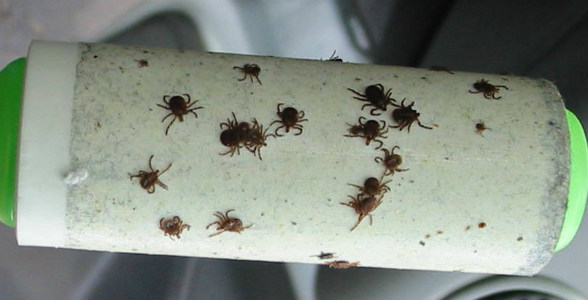
Lint roller and essential oil

In order to use this tip, you will need a roller and some essential oils. The lint roller should use adhesive layers. Take it with you when you’re going outside and roll it on your clothing every once in a while. You might be surprised with what you pick up in a very short amount of time.

Simple Tip To Keep Ticks Off Of You All Summer Long

Adding some essential oil may help to keep the ticks from climbing on you while you are outside. Spray the essential oil on your clothing and rub it into your skin and the ticks may just stay away. It also works for mosquitoes and black flies. It’s a good alternative to insect repellent and reduces your chemical exposure.

Here are 5 essential oils that repel bugs.

1. Lavender – This smells sweet to us but bugs absolutely hate it. It works on mosquitoes, flies and other insects.

2. PennyRoyal – this is a member of the mint family and it is toxic to insects.

3. Lemongrass – This essential oil comes from tropical lemongrass and has a citrusy sent. It is a natural flea and tick repellent and can be sprayed directly on the skin.

4. Eucalyptus – use this alone or along with citronella oil to keep bugs away. According to the Journal of medical entomology, Eucalyptus extract can reduce tick bites and infections.

5. Lemon – some lemon essential oil can work against fleas and other bugs. Slightly dilute it and spray it on your clothing and skin.

Be sure to share this with your friends.

 
via

Joke Of The Day: A New Career

 Jokes  Comments Off on Joke Of The Day: A New Career
Mar 272017
 
Joke Of The Day: A New Career A gynecologist had become so fed up with malpractice insurance and paperwork that he finally burned out.

Hoping to try another career where skillful hands would be beneficial, he decided to become an auto mechanic. He went to the local technical college, signed up for classes, attended diligently, and learned all he could.

When the time for the practical exam approached, the gynecologist prepared carefully for weeks and completed the exam with tremendous skill. When the results came back, he was surprised to find that he had obtained a score of 150%.

Fearing an error, he called the instructor, saying, “I don’t want to appear ungrateful for such an outstanding result, but I wonder if there is an error in the grade?”

The instructor said, “During the exam, you took the engine apart perfectly, which was worth 50% of the total mark. You put the engine back together again perfectly, which is also worth 50% of the mark. This equaled an A”. After a pause, the instructor added, “I gave you an extra 50% because you did it all through the muffler, which I’ve never seen done in my entire career.”