
Hold your mouse over for the answer.
as cold as death,
never thirsty,
ever drinking,
when tired, never winking.
An amazing picture capturing nature’s life and death struggle.
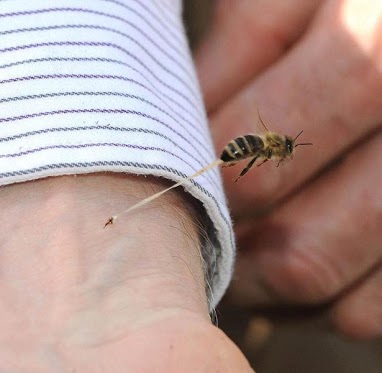
If you’ve ever wondered why honeybees tend to die after stinging someone, this picture says it all. In an incredible capture by Kathy Keatley Garvey, a UC Davis Communications Specialist in the Department of Enomology, we see a bee stinging a person’s arm and then attempting to fly away as the stinger remains lodged in the victim. That trail of goo you see? It’s actually the bee’s abdominal tissue. The remarkable capture netted Garvey the first-place gold feature photo award in an Association for Communication Excellence competition.On the fortunate timing, Garvey said she was walking with a friend and a bee came close to him and started buzzing in a high-pitch. She said that’s normally a telltale sign that a bee’s about to sting, so she readied her camera and snapped four photos.
[youtube]http://youtu.be/FNBZ_g_nuLI[/youtube]
What happens if you inhale Sulfur Hexafluoride (SF6)? As this Chemistry teacher explains, the heavy molecules of gas slow the vibrations of the vocal cord, decreasing pitch quite dramatically. A good illustration of Grahams Law which states that effusion of a gas is inversely proportional to the square root of the mass of its particles.
[youtube]http://youtu.be/8B9rDZZaKs8[/youtube]