Deadly Conventional Weapon of the Day: The ‘Bunker Buster’ Bomb

 Amusing  Comments Off on Deadly Conventional Weapon of the Day: The ‘Bunker Buster’ Bomb
Dec 312008


The ‘bunker buster’ bomb: The British military first conceived of steel-nosed bombs that dropped heavily and quickly enough to penetrate underground targets.

During the first Persian Gulf War, the U.S. military quickly rigged together similar weapons to attack Iraqi facilities, and then spent the next decade perfecting the concept.

Today’s bunker busters are usually laser-guided missiles, either rocket powered or artillery fired.

“Instead of hitting the top [of the target] and exploding like a regular bomb, it will literally punch a hole through and then explode inside,” explains Wright. “It’s a very lethal weapon.”


Here is a video of an AGM-130 “Bunker Buster Bomb” It was dropped by a USAF F-15…

God Bless America again!

Courtesy Fox News

Deadly Conventional Weapon of the Day: The AC-130 Aerial Gunship

 Amusing  Comments Off on Deadly Conventional Weapon of the Day: The AC-130 Aerial Gunship
Dec 312008


The AC-130 aerial gunship: This comes in two forms, the AC-130H “Spectre” and the more heavily armed AC-130U “Spooky,” both flown by the U.S. Air Force. Versions of the AC-130 were first deployed during the Vietnam War.

It’s designed to hit targets on the ground or at sea, firing Gatling guns and howitzers fore, aft and to the side. The AC-130’s weakness is that it flies “low and slow,” making it vulnerable to surface-to-air or air-to-air missiles.

“It can do a lot of damage,” explains the Pentagon’s Lt. Col. Mark Wright. “It’s got a 75-millimeter cannon that can blow through buildings, vehicles. It’s designed for taking out protective cover. … The combination is very lethal — it’s a very feared weapons system.”


AC-130 Gunship – “Puff the Magic Dragon”

AC-130 Gunship takes out Taliban fighters and various terrorists at Afghanistan location while avoiding mosque.

God Bless America again!

Courtesy Fox News

U.S. Military Designing Flying Robots Disguised as Insects

 Amusing  Comments Off on U.S. Military Designing Flying Robots Disguised as Insects
Nov 242008


While Iran is still trying to figure out 1940’s atomic technology the US has flying robot insects. God Bless America!

I can just hear the wacky paranoid leftist loonies now complaining that these will be used to spy on American citizens. What do they have to hide anyway?

U.S. develops tiny flying robot spies


If only we could be a fly on the wall when our enemies are plotting to attack us. Better yet, what if that fly could record voices, transmit video and even fire tiny weapons?

That kind of James Bond-style fantasy is actually on the drawing board. U.S. military engineers are trying to design flying robots disguised as insects that could one day spy on enemies and conduct dangerous missions without risking lives.

“The way we envision it is, there would be a bunch of these sent out in a swarm,” said Greg Parker, who helps lead the research project at Wright-Patterson Air Force Base in Dayton. “If we know there’s a possibility of bad guys in a certain building, how do we find out? We think this would fill that void.”

In essence, the research seeks to miniaturize the Unmanned Aerial Vehicle drones used in Iraq and Afghanistan for surveillance and reconnaissance.

The next generation of drones, called Micro Aerial Vehicles, or MAVs, could be as tiny as bumblebees and capable of flying undetected into buildings, where they could photograph, record, and even attack insurgents and terrorists.

By identifying and assaulting adversaries more precisely, the robots would also help reduce or avoid civilian casualties, the military says.

Parker and his colleagues plan to start by developing a bird-sized robot as soon as 2015, followed by the insect-sized models by 2030.

The vehicles could be useful on battlefields where the biggest challenge is collecting reliable intelligence about enemies.

“If we could get inside the buildings and inside the rooms where their activities are unfolding, we would be able to get the kind of intelligence we need to shut them down,” said Loren Thompson, a defense analyst with the Lexington Institute in Arlington, Va.

Philip Coyle, senior adviser with the Center for Defense Information in Washington D.C., said a major hurdle would be enabling the vehicles to carry the weight of cameras and microphones.

“If you make the robot so small that it’s like a bumblebee and then you ask the bumblebee to carry a video camera and everything else, it may not be able to get off the ground,” Coyle said.

Parker envisions the bird-sized vehicles as being able to spy on adversaries by flying into cities and perching on building ledges or power lines. The vehicles would have flappable wings as a disguise but use a separate propulsion system to fly.

“We think the flapping is more so people don’t notice it,” he said. “They think it’s a bird.”

Unlike the bird-sized vehicles, the insect-sized ones would actually use flappable wings to fly, Parker said.

He said engineers want to build a vehicle with a 1-inch wingspan, possibly made of an elastic material. The vehicle would have sensors to help avoid slamming into buildings or other objects.

Existing airborne robots are flown by a ground-based pilot, but the smaller versions would fly independently, relying on preprogrammed instructions.

Parker said the tiny vehicles should also be able to withstand bumps.

“If you look at insects, they can bounce off of walls and keep flying,” he said. “You can’t do that with a big airplane, but I don’t see any reason we can’t do that with a small one.”

An Air Force video describing the vehicles said they could possibly carry chemicals or explosives for use in attacks.

Once prototypes are developed, they will be flight-tested in a new building at Wright-Patterson dubbed the “micro aviary” for Micro Air Vehicle Integration Application Research Institute.

“This type of technology is really the wave of the future,” Thompson said. “More and more military research is going into things that are small, that are precise and that are extremely focused on particular types of missions or activities.”


Who The Heck Was Kilroy?

 Amusing, Information  Comments Off on Who The Heck Was Kilroy?
Feb 092008
 

In 1946 the American Transit Association, through its radio program, ‘Speak to America,’ sponsored a nationwide contest to find the REAL Kilroy, offering a prize of a real trolley car to the person who could prove himself to be the genuine article. Almost 40 men stepped forward to make that claim, but only James Kilroy from Halifax, Massachusetts had evidence of his identity.

Kilroy was a 46-year old shipyard worker during the war. He worked as a checker at the Fore River Shipyard in Quincy. His job was to go around and check on the number of rivets completed. Riveters were on piecework and got paid by the rivet.

Kilroy would count a block of rivets and put a check mark in semi-waxed lumber chalk, so the rivets wouldn’t be counted twice. When Kilroy went off duty, the riveters would erase the mark.

Later on, an off-shift inspector would come through and count the rivets a second time, resulting in double pay for the riveters.

One day Kilroy’s boss called him into his office. The foreman was upset about all the wages being paid to riveters, and asked him to investigate. It was then that he realized what had been going on.

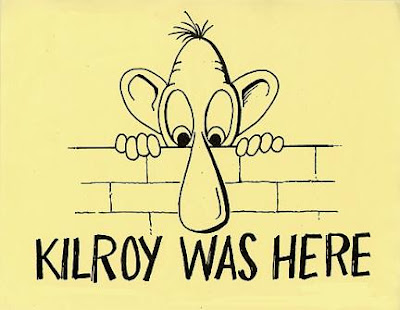
The tight spaces he had to crawl in to check the rivets didn’t lend themselves to lugging around a paint can and brush, so Kilroy decided to stick with the waxy chalk. He continued to put his checkmark on each job he inspected, but added KILROY WAS HERE in king-sized letters next to the check, and eventually added the sketch of the chap with the long nose peering over the fence and that became part of the Kilroy message. Once he did that, the riveters stopped trying to wipe away his marks.

Ordinarily the rivets and chalk marks would have been covered up with paint. With war on, however, ships were leaving the Quincy Yard so fast that there wasn’t time to paint them.

As a result, Kilroy’s inspection ‘trademark’ was seen by thousands of servicemen who boarded the troopships the yard produced. His message apparently rang a bell with the servicemen, because they picked it up and spread it all over Europe and the South Pacific. Before the war’s end, ‘Kilroy’ had been here, there, and everywhere on the long haul to Berlin and Tokyo.

To the unfortunate troops outbound in those ships, however, he was a complete mystery; all they knew for sure was that some jerk named Kilroy had ‘been there first.’ As a joke, U.S. servicemen began placing g the graffiti wherever they landed, claiming it was already there when they arrived.

Kilroy became the U.S. super-GI who had always ‘already been’ wherever GIs went. It became a challenge to place the logo in the most unlikely places imaginable (it is said to be atop Mt. Everest, the Statue of Liberty, the underside of the Arch De Triumphe, and even scrawled in the dust on the moon.)

And as the war went on, the legend grew. Underwater demolition teams routinely sneaked ashore on Japanese-held islands in the Pacific to map the terrain for the coming invasions by U.S. troops (and thus, presumably, were the first GI’s there). On one occasion, however, they reported seeing enemy troops painting over the Kilroy logo! In 1945, an outhouse was built for the exclusive use of Roosvelt, Stalin, and Churchill at the Potsdam conference.

To help prove his authenticity in 1946, James Kilroy brought along officials from the shipyard and some of the riveters. He won the trolley car, which he gave it to his nine children as a Christmas gift and set it up as a playhouse in the Kilroy front yard in Halifax, Massachusetts.