The Acts Of Their Parents
Political, View Point
Comments Off on The Acts Of Their Parents
May 022019
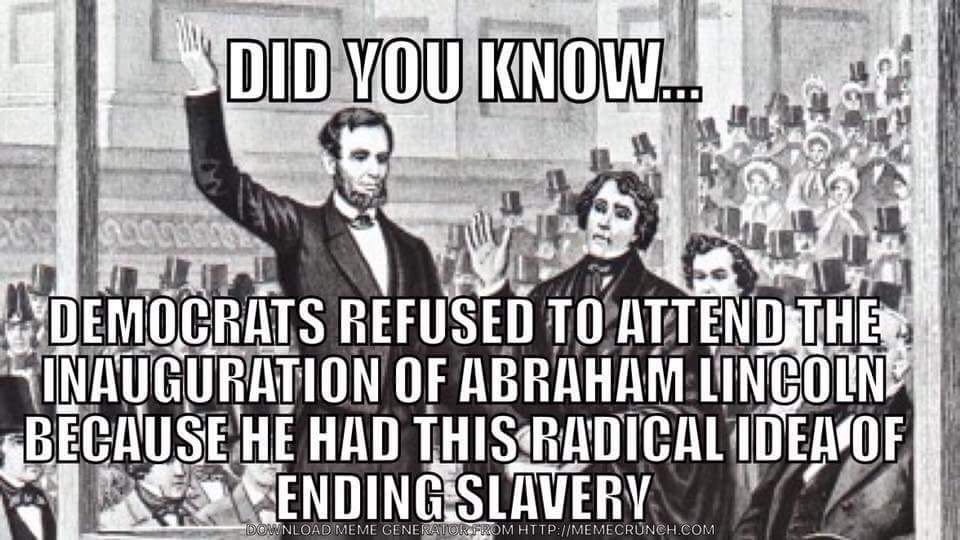
The first inauguration of Abraham Lincoln as the 16th President of the United States was held on March 4, 1861, on the East Portico of the United States Capitol in Washington, D.C.. The inauguration marked the commencement of the first term of Abraham Lincoln as President and the only term of Hannibal Hamlin as Vice President. The presidential oath of office was administered to Lincoln by Roger B. Taney, Chief Justice of the United States.
This was the first time Lincoln appeared in public with a beard, which he had begun growing after being elected president, in response to a written request by 11-year-old Grace Bedell. This effectively made him the first President to have any facial hair beyond sideburns.
On Inauguration Day, Lincoln’s procession to the Capitol was surrounded by heavily armed cavalry and infantry, providing an unprecedented amount of protection for the President-elect as the nation stood on the brink of war. During the 16 weeks between Lincoln’s victory in the 1860 presidential election and Inauguration Day, seven slave states had declared their secession from the Union and formed the Confederate States of America.
Train ride to Washington
An entourage of family and friends left Springfield, Illinois with Lincoln on February 11 to travel by train to Washington, D.C. for the inauguration. This group including his wife, three sons, and brother-in-law, as well as John G. Nicolay, John M. Hay, Ward Hill Lamon, David Davis, Norman B. Judd, and Edwin Vose Sumner.
For the next ten days, he traveled widely throughout the country, with stops in Indianapolis, Columbus, Pittsburgh, Cleveland, Buffalo, Albany, New York City, and south to Philadelphia, where on the afternoon of February 21, he pulled into Kensington Station. Lincoln took an open carriage to the Continental Hotel, with almost 100,000 spectators waiting to catch a glimpse of the President-elect. There he met Mayor Alexander Henry, and delivered some remarks to the crowd outside from a hotel balcony. Lincoln continued on to Harrisburg. Then, because of an alleged assassination conspiracy, Lincoln traveled through Baltimore, Maryland on a special train in the middle of the night before finally completing his journey in Washington.

What you never learned in History class.
The history of the African slave trade into the Americas is well-documented as well as largely taught in American schools today.
However, as John Martin of the Montreal-based Center for Research and Globalization points out in his article ‘The Irish Slave Trade – The Forgotten ‘White’ Slaves,’ it was not just Africans who were traded as slaves.
Indeed, the Irish have a gruesome history of being traded as slaves as well, and subjected to similar and sometimes worse treatment than their African contemporaries of the time.
Strangely though, the history of Irish and ‘white’ slavery is by and large ignored in the American educational curriculum today.
In his article, John Martin writes “The Irish slave trade began when James II sold 30,000 Irish prisoners as slaves to the New World. His Proclamation of 1625 required Irish political prisoners be sent overseas and sold to English settlers in the West Indies. By the mid 1600s, the Irish were the main slaves sold to Antigua and Montserrat. At that time, 70 percent of the total population of Montserrat were Irish slaves.”
“Ireland quickly became the biggest source of human livestock for English merchants. The majority of the early slaves to the New World were actually white.”
Martin writes how at the hands of the British, the Irish population plummeted due to the slave trade of the 17th century.
“During the 1650s, over 100,000 Irish children between the ages of 10 and 14 were taken from their parents and sold as slaves in the West Indies, Virginia and New England. In this decade, 52,000 Irish (mostly women and children) were sold to Barbados and Virginia. Another 30,000 Irish men and women were also transported and sold to the highest bidder. In 1656, [Oliver] Cromwell ordered that 2000 Irish children be taken to Jamaica and sold as slaves to English settlers.”
Martin goes on to explain that for some reason, the Irish slaves are often remembered as ‘indentured servants.’ However, in most cases during the 17th and 18th centuries, they were no more than “human cattle.”
“…the African slave trade was just beginning during this same period,” writes Martin. “It is well recorded that African slaves, not tainted with the stain of the hated Catholic theology and more expensive to purchase, were often treated far better than their Irish counterparts.”
During the late 1600s, writes Martin, African slaves were far more expensive than their Irish counterparts – Africans would sell for around 50 sterling while Irish were often no more than 5 sterling.
The Irish were further exploited when the British began to “breed” Irish women – or girls, sometimes as young as 12 – with African males.
“These new “mulatto” slaves brought a higher price than Irish livestock and, likewise, enabled the settlers to save money rather than purchase new African slaves. This practice of breeding Irish females with African men went on for several decades and was so widespread that, in 1681, legislation was passed “forbidding the practice of mating Irish slave women to African slave men for the purpose of producing slaves for sale.” In short, it was stopped only because it interfered with the profits of a large slave transport company.
Martin concludes, “In 1839, Britain finally decided on it’s own to end its participation in Satan’s highway to hell and stopped transporting slaves. While their decision did not stop pirates from doing what they desired, the new law slowly concluded THIS chapter of nightmarish Irish misery.”