Democrats and Republicans? Two wings of the same bird, flapping for the elite. They bicker on TV, but rubber-stamp endless debt, endless wars, endless corporate welfare. Your vote’s just confetti in their game. The house always wins. Open your eyes.
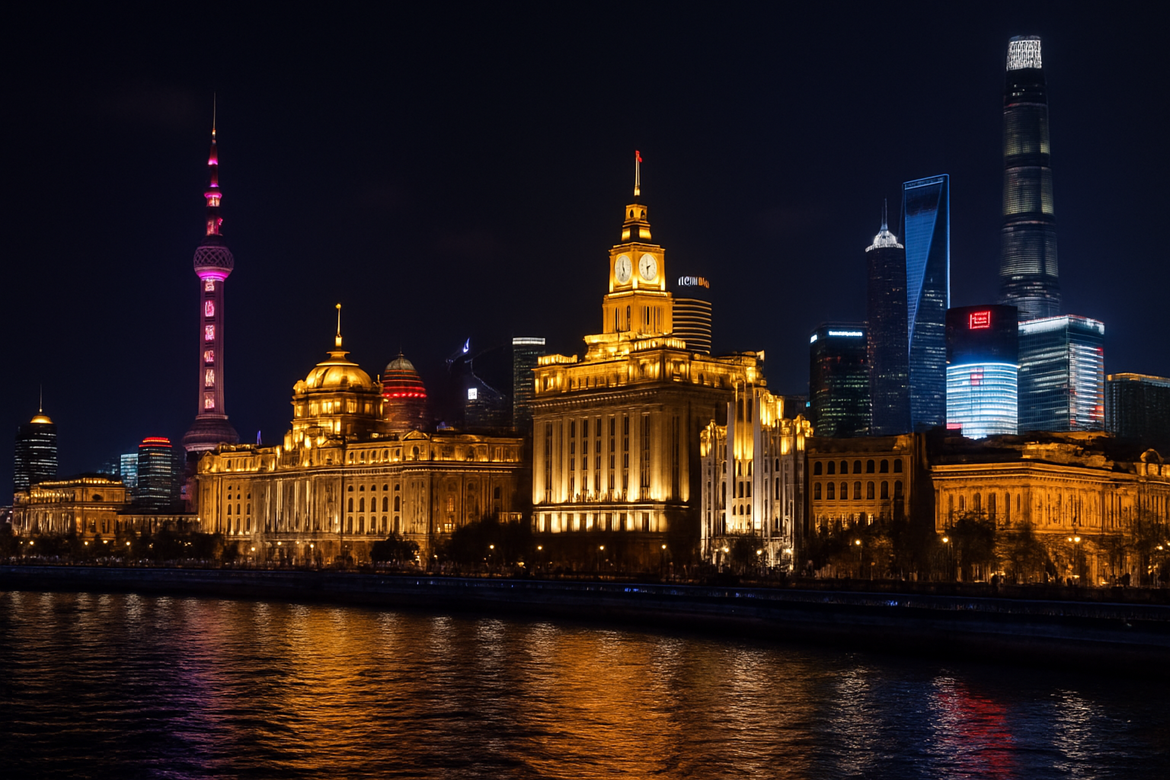
The same waterfront where the Green Gang once ruled is now lined with global banks.
The skyline of Shanghai glitters at night like a promise. Towers of glass and steel rise where opium warehouses once stood. The Huangpu River cuts through the city, carrying tankers and yachts instead of gunboats and smugglers. Yet behind the new prosperity, behind the slogans of progress and rejuvenation, the logic that built modern China has not changed. It still runs on deals made in the dark, alliances forged in secrecy, and loyalty bought with favors rather than earned through trust.
This is not a story about ideology. It is a story about power.
Power that learned to survive by adapting, concealing, and infecting everything it touched.
Power that began in the smoke-filled gambling dens of old Shanghai and found its way into the corridors of global finance.
This series, The Red Syndicate, investigates how organized crime, political ambition, and state authority intertwined to form a single system that endures to this day. It is a history of how China’s criminal underworld became the blueprint for its political one, and how that model spread its influence far beyond China’s borders.
To understand how the present works, we must first understand the city that invented it.
A century ago, Shanghai was the world’s most profitable city and also one of its most corrupt. Western colonial powers ran the foreign concessions. Chinese warlords ruled the countryside. Between them stretched a network of secret societies and business syndicates that handled everything the officials could not or would not control. The Green Gang was the most powerful of them all.
Its leaders financed newspapers, operated banks, and supplied drugs and entertainment to both colonials and nationalists. They also financed political movements, quietly deciding who would rise and who would vanish. In 1927, they helped Chiang Kai-shek destroy the Communist movement in Shanghai, proving that whoever controlled the streets controlled the nation.
Those years built a template for how Chinese politics would function: alliances between officials, businessmen, and enforcers. Transactions instead of laws. Loyalty instead of accountability. That fusion of power and profit was never dismantled. It was perfected.
When the Communists eventually took power, they promised to eradicate the corruption that had consumed the old order. They executed gang bosses, nationalized opium trade routes, and declared that the people now owned the state.
But the habits of the old world survived. Networks of loyalty and exchange adapted to the new ideology. The same secrecy, discipline, and mutual dependence that once bound the Green Gang’s members now bound Party cadres. What had been a criminal hierarchy became a political one. The result was not a clean break with corruption but a rebranding of it.
Power in China remained personal, not institutional. The tools of control were the same: favors, money, and fear. The only difference was the flag that flew above the system.
Today, the mechanisms of influence operate on a global scale. The structures that once confined themselves to Shanghai’s underworld now extend through corporations, investment vehicles, and diplomatic networks. China’s rapid economic rise did not erase its past. It scaled it.
Modern power brokers do not wear gang colors or carry pistols. They manage conglomerates, control access to markets, and reward loyalty with contracts and promotions. Corruption has become more sophisticated but no less pervasive. The same logic that allowed the Green Gang to thrive under foreign empires now allows state-linked enterprises to thrive within global capitalism.
Every empire needs intermediaries, and every intermediary learns how to extract a price.
The syndicate no longer traffics in opium but in influence. It moves through boardrooms and ministries instead of brothels and gambling halls. The currency has changed from silver to equity, from bribes to partnerships. Yet the pattern remains identical: control the flow of money, suppress dissent, and reward obedience.
This investigation is not about assigning blame to one nation. It is about recognizing how systems of corruption cross borders and ideologies. When money becomes the measure of power, morality becomes negotiable everywhere.
Western democracies that once lectured others on transparency now find themselves dependent on Chinese capital, technology, and markets. Elite networks that were once patriotic have become transnational, bound not by ideology but by profit. The methods that began in Shanghai’s backrooms now shape boardrooms from London to Los Angeles.
Understanding this history is not an act of hostility. It is an act of clarity. Every nation builds its myths, but beneath those myths are transactions, and beneath the transactions are relationships that decide who prospers and who disappears.
The Red Syndicate is built on documented evidence, not speculation. Each chapter draws from declassified intelligence reports, academic research, police archives, financial disclosures, and eyewitness accounts from the 19th century to the present. Every claim can be traced to its source. The purpose is not to sensationalize, but to connect the patterns that history keeps repeating.
The series will move chronologically and thematically. It begins in 1920s Shanghai, tracing the Green Gang’s empire and its alliances with political power. It will then follow how those networks evolved under Mao’s revolution, how they adapted to the economic reforms of the late 20th century, and how they operate today through a mixture of ideology, surveillance, and wealth.
Each post will be written as a standalone exposé but also as part of a larger mosaic. Taken together, they will reveal how China’s fusion of state and underworld became both a domestic strategy and an exportable model.
Power never disappears; it only changes form. The criminal syndicates of the past taught the modern state how to operate behind a façade of legitimacy. In return, the state gave those syndicates new life under different names. This partnership between political authority and illicit profit has shaped not only China’s development but the rules of global influence.
Ignoring this history allows it to continue. Understanding it exposes how deeply corruption has been woven into the machinery of modern power.
The story of the Red Syndicate is not just a story about China. It is a mirror held up to every system that mistakes prosperity for virtue and control for stability.
If you walk along the Bund at night, the same river that once carried opium ships now reflects the lights of global finance. The faces in the towers have changed, but the architecture of power beneath them has not. It still rewards obedience, punishes transparency, and thrives on silence.
Shanghai taught the world a lesson a century ago: control the underworld, and you control everything above it. That truth built an empire once. It may be building another now.
Part 1 – Shanghai: The Birthplace of the Red Underworld
A deep look at how one city became the crucible where organized crime, nationalism, and revolution fused into a single system that would shape China for generations.
The Red Syndicate is an ongoing investigative series that explores the shadow networks which shaped modern China, where revolutionary zeal met organized crime and power was brokered through loyalty, money, and fear.
Drawing on declassified archives, historical research, and firsthand accounts, the series traces how Shanghai’s criminal empires, political movements, and elite corruption intertwined to build a system that still echoes through global power today.