
Tip Of The Day: Being Followed
Information
Comments Off on Tip Of The Day: Being Followed
Feb 252017
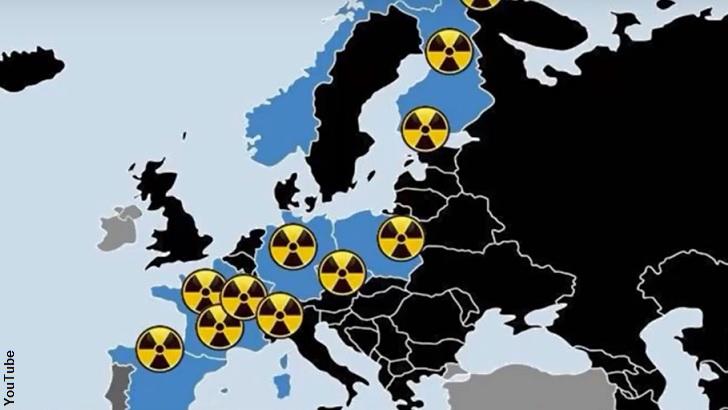
A baffling bloom of radiation detected spreading throughout Europe earlier this year has stumped scientists and spawned sinister conspiracy theories.
The ‘cloud’ of Iodine-131 first appeared near the border of Norway and Russia a few weeks ago and was subsequently spotted by a number of nearby countries, including France and Finland.
Authorities say that it appeared to be an isolated incident as radiation levels returned to normal shortly thereafter.
That said, the cause of the event remains a mystery, which has led some to propose the troubling theory that the radiation came from a clandestine nuclear test by Russia.
Others have expressed concerns that the radiation may be come from some kind of nuclear incident that is being kept secret.
The enlisting of a specialized US Air Force jet designed to ‘sniff’ radiation levels has only fueled the conspiratorial speculation that something nefarious may have occurred.
However, experts are attempting to quell such concerns and explain that since Iodine-131 was the sole radioactive substance detected, the origin of the bloom was probably an inadvertent leak at a pharmaceutical plant.
Their reasoning is that Iodine-131 is used in some cancer medications produced in the region and a similar spike in 2011 was eventually traced back to such a facility.
And so, while mysterious radiation coming from the border of Russia is understandably worrisome in these chaotic times, it would appear the bloom is the merely the product of bad medicine making.
Small amounts of nuclear radiation spread across Europe last month, and no one can figure out why.
First detected over the Norway-Russia border in January, the radioactive Iodine-131 bloom was then found over several European countries, and while unsubstantiated rumors of nuclear testing by Russia have been cropping up, officials say it’s most likely linked to an unreported pharmaceutical mishap.
While the radiation spike happened in January, officials in Finland and France have only just gone public with information on the incident, announcing that after the spike was detected in Norway, it appeared in Finland, Poland, Czechia (Czech Republic), Germany, France and Spain, until the end of January.
When asked why Norway didn’t inform the public last month, when it was the first to detect the radiation in its northernmost county, Finnmark, Astrid Liland from the Norwegian Radiation Protection Authority told the Barents Observer:
“The measurements at Svanhovd in January were very, very low. So were the measurements made in neighbouring countries, like Finland. The levels raise no concern for humans or the environment. Therefore, we believe this had no news value.”
As France’s nuclear safety authority, the IRSN, announced last week, the actual amount of radioactive Iodine-131 in Europe’s ground-level atmosphere in January “raise no health concerns”, and has since returned to normal.
But what’s most disconcerting about the event isn’t the level of radiation that spread through Europe – it’s the fact that no one can say what actually happened.
What we do know is that Iodine-131 has a half-life of just eight days, so detecting it in the atmosphere is proof of a recent release.“The release was probably of recent origin. Further than this, it is impossible to speculate,” Brian Gornall from Britain’s Society for Radiological Protection told Ben Sullivan at Motherboard.
Right now, the best bet is that the origin of the radioactive Iodine-131 is somewhere in Eastern Europe – something that conspiracy theorists have latched onto as evidence that Russia performed a nuclear test in the Arctic.
But there is no evidence of this taking place, and the fact that only Iodine-131 – and no other radioactive substances – were detected strongly suggests this is not the answer.
“It was rough weather in the period when the measurements were made, so we can’t trace the release back to a particular location. Measurements from several places in Europe might indicate it comes from Eastern Europe,” Liland told the Barents Observer.
Based on the particular isotope, experts are saying it’s far more likely that the radiation spike is the result of some kind of pharmaceutical factory leak, seeing as Iodine-131 is used widely in treating certain types of cancer.
“Since only Iodine-131 was measured, and no other radioactive substances, we think it originates from a pharmaceutical company producing radioactive drugs,” Liland told Motherboard. “Iodine-131 is used for treatment of cancer.”
And, oddly enough, the case for pharmaceuticals being behind the mess has a surprisingly similar parallel to back it up – an almost identical event occurred in 2011, when low levels of radioactive Iodine-131 were detected in several European countries for a few weeks.
At the time of the announcement, officials were also at a loss to explain the spike in Iodine-131, but quickly ruled out a link to nuclear power plants.
“If it came from a reactor we would find other elements in the air,” Didier Champion, then head of environment and intervention at the IRSN, told Reuters in 2011.
Interestingly, a paper came out just last week confirming that the source of the 2011 Iodine-131 leak was a faulty filter system at the Institute of Isotopes Ltd in Budapest, Hungary, which produces a wide variety of radioactive isotopes for medical treatment and research.
The investigation is still ongoing for the 2017 leak, with the US Air Force deploying its WC-135 nuclear explosion ‘sniffer’ aircraft to the UK last week to help narrow down the source.
Hopefully researchers can nail down what exactly happened here, so factory owners – if they are to blame this time around – can ensure these kinds of leaks don’t continue.
Because while both events posed no health risk to humans, it’s really not something any manufacturer should be risking.
The prime element of social control is the strategy of distraction consisting of deviating the public attention from the important problems and from the mutations decided by the political and economic elites by means of the flooding technique or the continuous inundation of distractions and insignificant information.
The strategy of distraction is equally indispensable to prevent the public from getting interested in the essential knowledge in areas of science, economy, psychology, neurology and cybernetics.
“To maintain the public attention distracted, away form the true social problems, captivated by subjects of no real importance. To maintain the public busy, busy, without any time to think; going back to the farm with the other animals.”
This method is also known as “problem-reaction-solution”. It creates a problem, a foreseen “situation” to provoke a certain reaction in the public in order to make this one the demanding force of measures that are desired to be accepted.For example: to let urban violence develop and intensify, or to organize bloody terrorist attempts in order for the public to demand laws of security or police-oriented ones in detriment of freedom. Or also: to create an economic crisis to make accepted the backward movement of social rights and the breaking down of public services as a necessary evil.
To make accepted an unacceptable measure it is sufficient to apply it progressively, in a “degraded” manner, over a duration of 10 years. It is in this way that radically new socio-economic conditions have been imposed during the years 1980 to 1990. Massive unemployment, lacking, flexibility, relocation, salaries that no longer secure a decent income, so many changes that would have provoked a revolution should they be abruptly applied.
Another way of making accepted an unpopular decision is to present it as “painful but necessary”, obtaining the agreement of the public in the moment for the future application. It is easier to accept a future sacrifice than an immediate one. Firstly, because the effort is not deployed immediately.Next, because the public, the people, have always the tendency to naïvely hope that “all will go better tomorrow” and that the demanded sacrifice may be avoided. Anyway, this allows more time for the public to be accustomed to the idea and to accept it with resignation when the moment comes. Recent example: the move to the Euro and the loss of their economic and monetary sovereignty have been accepted by the European countries from 1994 to 1995 for their application in the year 2001. Another example: the multilateral agreements ofALCA (or FTAA) that the United States have imposed in the year 2001 to the countries of all the American continent (Central and South America) in spite of their reticence, conceding an application and the coming into force in the year 2005.
The majority of the publicity “spots” addresses the public at large with the use of a discourse, arguments, personages, and a tone particularly infantile, many times near the weak, as if the spectator were a child of younger age or a mental handicapped. The more it intends to seek the deception of the spectator or listener, the more it is its tendency to adopt an infantile tone. Why? If it is addressed to a person as if he or she had 12 year of age, then, by reason of suggestion, he or she would also have, with a certain probability, a response or reaction that is lacking of a critical sense same as is the case of a person of 12 years of age.”
To make use of the emotional aspect is a classic technique for making a short-circuit to the rational analysis, and hence to the critical sense of individuals. Besides, the utilization of the emotional registry allows us to open an access door to the unconscious to implant or to insert ideas, wishes, fears or worries, pulsations, or to induce behaviors.
To make it in a way that the public is unable to comprehend the technologies and the methods utilized for their control and slavery. “The quality of the education given to the lower social classes must be the poorest or the most mediocre possible, in a way that the breach of ignorance that isolates the lower classes from the upper social classes must be and remain incomprehensible to the lower social classes.”
To promote in the public the idea that being stupid, vulgar and uneducated is “cool”.
To make the individual believe that he himself is the only responsible for his misfortune, the cause of the insufficiency of his intelligence, of his capacities, or his efforts. Thus, instead of rebelling against the economic system, the individual self-devaluates and self-blames, which generates a depressive state, one of its effects is the inhibition of action. And without action, there is no revolution!
In the course of the last 50 years, the accelerated advances of science have generated a growing breach between the knowledge of the public and that one possessed and utilized by the leading elites. Thanks to biology, neurology and applied psychology, the “system” has achieved an advanced knowledge of the human being, both physically and psychologically. The system has been able to know the common individual better than what the individual know about himself. This means that in the majority of cases, the system possesses a greater control and a greater power over individuals than what individuals have over themselves.
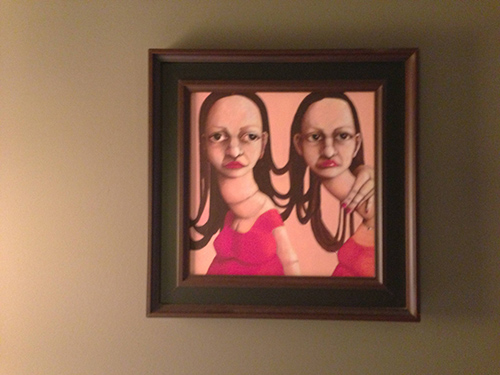 A very creepy painting above the bed depicting two girls with dead eyes and deformed, elongated necks.
Hotel ZaZa is a stylish inn located in Houston, Texas. While the hotel is known for its luxurious suites, a recent post on Reddit revealed the existence of the mysterious “Room 322”. This room it is not advertised on the hotel’s website and, in short, is the definition of creepy. This is what the Redditor posted:
stay here frequently when on business. Hotel was booked solid and my colleague managed to score a room unplanned. We all had normal zaza style rooms (swank) and he ended up in this goth dungeon closet.
Seriously- the room had a chain holding the bed to wall, pictures of skulls and a creepy, incongruous portrait of an old man. Room was about 1/3 the normal size with the furniture blocking part of the TV, bed and window.
We asked about it at the front desk and the clerk looked it up and said ” that room isn’t supposed to be rented.’ and immediately moved him.
– Source: Reddit
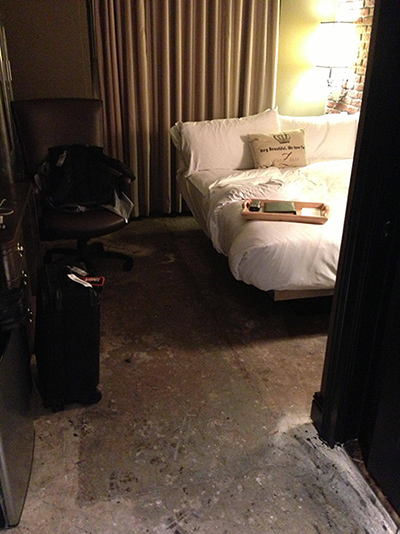
Unlike any other room in the hotel, the floor is cold, hard, dirty concrete.
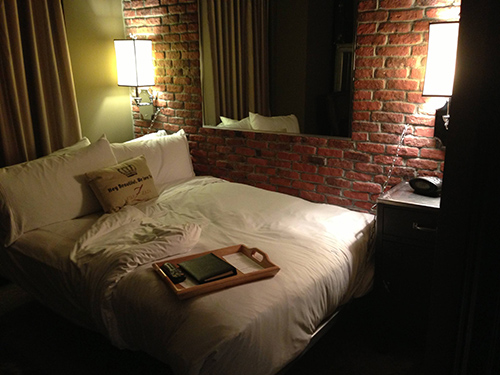
The room is about a third of the size of other rooms in the hotel and is the only one with brick walls. The mirror is embedded in the brick wall, leading some to believe that it is actually a two-way mirror…
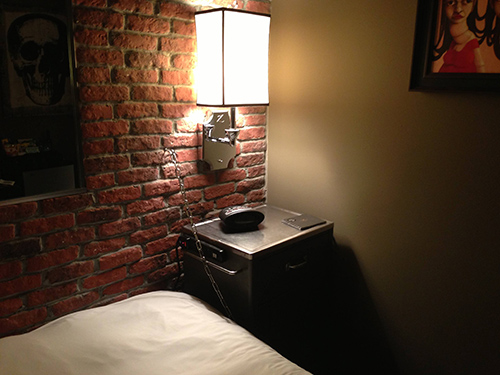
The bed is chained to the wall. Why?
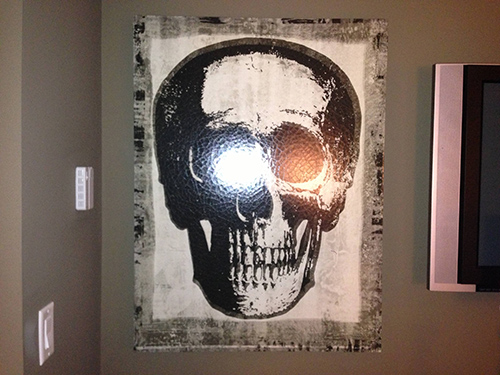
Skull frame on the wall. Rather appropriate since 322 is the Skull and Bones’ sacred number.
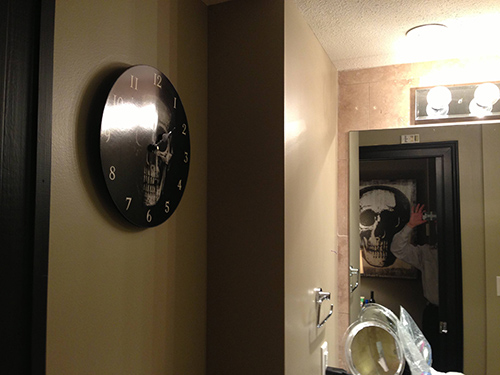
A Skull clock hanges on the wall.
Those that are aware of the occult elite’s symbolism know that 322 is the “sacred” number of the Skull & Bones secret society (to which belong the likes of George W. Bush, George Bush Sr. and John Kerry).

Official Skull and Bones logo prominently featuring the number 322.

Another creepy image above the bed of a guy with huge eyes. He doesn’t look nice at all.
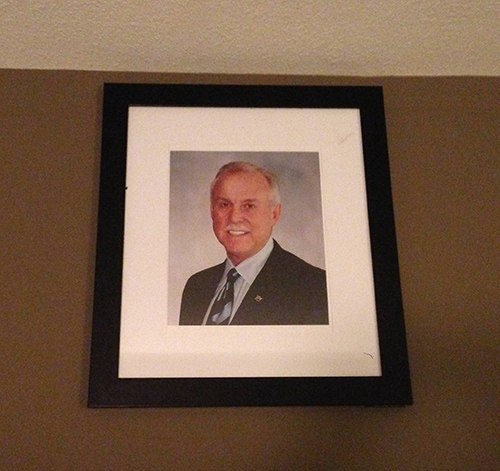
Overseeing the room is the picture of a suited man. Apparently, it is Jay Comeaux, President of Stanford Group Company. Why is this random elite guy on the wall? Does he have something to do with the Skull and Bones?
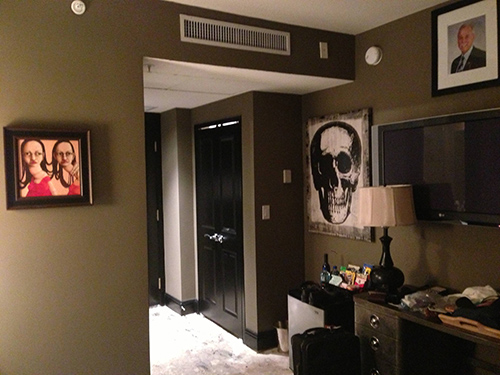
This looks like the perfect place to traumatize someone.
When the story came out, people from the hotel’s PR responded that room 322 was a theme room entitled “Hard Times” and was meant to recreate a “prison experience”. This room is however not advertised anywhere and, as some people noted, there is nothing in that room that really recalls a “prison experience”. Do jail cells have huge mirrors, brick walls and frames of skulls, weird deformed faces and company CEOs on walls? Not really.
Another strange fact, a year before this story came out, a book author posted on her blog a little something about room 322 as well. This is what she wrote about it:
“When I checked into Houston’s Hotel ZaZa at midnight on Thursday night, there was some confusion. My first room was a themed room, known as the Hard Times room; this skull was on the wall. A few minutes after I got there, the front desk called up and said they had to move me; the people at the front desk were deeply upset at the thought of me being stuck in this room.”
– Source: Pop Culture Nerd
Apparently, hotel staff do not want everyday visitors to stay in that room. Is this room called “Hard Times” because it is used for occult elite trauma-inducing rituals?

 for that special someone.