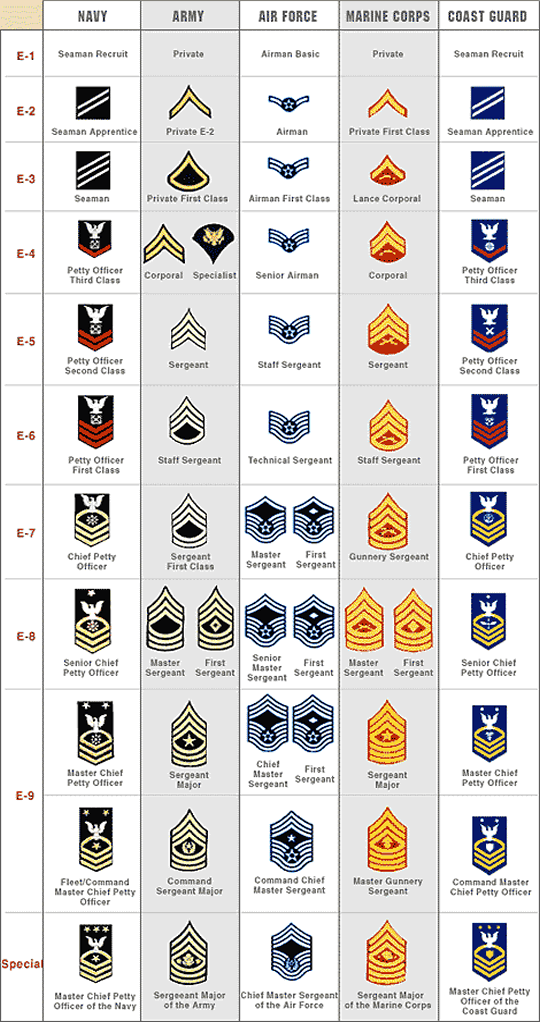
The Difference Between Memorial Day And Veterans Day

 Information, Political  Comments Off on The Difference Between Memorial Day And Veterans Day
May 292017
 

The Difference Between Memorial Day And Veterans Day Explained

The Difference Between Memorial Day And Veterans Day

What is the difference between Memorial Day and Veterans Day? People often confuse the two remembrances, both reserved to honor military personnel but with some nuances between the two.

The Department of Veterans Affairs clarifies the confusion on its website

“Many people confuse Memorial Day and Veterans Day,” military officials wrote on the agency’s home page. “Memorial Day is a day for remembering and honoring military personnel who died in the service of their country, particularly those who died in battle or as a result of wounds sustained in battle.

Veterans Day is all-inclusive — honoring all veterans, either dead or living — but intended as a day to literally thank military personnel for their service to country.

“While those who died are also remembered, Veterans Day is the day set aside to thank and honor ALL those who served honorably in the military – in wartime or peacetime,” officials write. “In fact, Veterans Day is largely intended to thank LIVING veterans for their service, to acknowledge that their contributions to our national security are appreciated, and to underscore the fact that all those who served – not only those who died – have sacrificed and done their duty.”

The history of both days of observance are also markedly different. While Memorial Day dates its origins to the period following the Civil War, Veterans Day has its roots in the early part of the 20th century.

“Originally known as Decoration Day, it originated in the years following the Civil War and became an official federal holiday in 1971,” the History Channel explains in detailing the origins of Memorial Day. “Many Americans observe Memorial Day by visiting cemeteries or memorials, holding family gatherings and participating in parades. Unofficially, at least, it marks the beginning of summer.”

Conversely, Veterans Day traces its history in the days following the end of World War I, according to the Department of Veterans Affairs.

“World War I – known at the time as “The Great War” – officially ended when the Treaty of Versailles was signed on June 28, 1919, in the Palace of Versailles outside the town of Versailles, France,” agency officials explain. “However, fighting ceased seven months earlier when an armistice, or temporary cessation of hostilities, between the Allied nations and Germany went into effect on the eleventh hour of the eleventh day of the eleventh month.”

The numerical significance of that cessation gives rise to the date of Nov. 11, 1918, being generally regarded as the end of “the war to end all wars.” Sadly, there have been wars since — including the ongoing fight against terrorism that has the distinction of being the longest-running war in U.S. history.

And what is the significance of the red poppies that some people wear each Memorial Day?

Another difference between both days is the wearing of poppies on Memorial Day. Why are red poppies worn?

“The wearing of poppies in honor of America’s war dead is traditionally done on Memorial Day, not Veterans Day,” officials of the U.S. Department of Veterans Affairs say. “The practice of wearing of poppies takes its origin from the poem in In Flanders Fields, written in 1915 by John McCrae.”

Those wishing to don red poppies for use on Memorial Day can contact various veterans service organizations, including the Veterans of Foreign Wars of the United States (VFW) or the American Legion. These and other veterans organizations distribute poppies annually on Memorial Day.

“You can find veterans groups in the Veterans Service Organization link on VA’s Veterans Day web page,” the agency writes. “Veterans groups in your area can be found in your local phone book. Look in the yellow pages under “Veterans and Military Organizations” or a similar heading.”

Come November, Veterans Day offers another chance to honor those who serve. The U.S. Department of Veterans Affairs offers free posters for those wishing to honor military personnel on that day. Poster requests are fulfilled until the inventory is exhausted. People also can download or print their own poster from the Veterans Day Poster Gallery.


The South Pole Of Jupiter

 Information  Comments Off on The South Pole Of Jupiter
May 282017
 
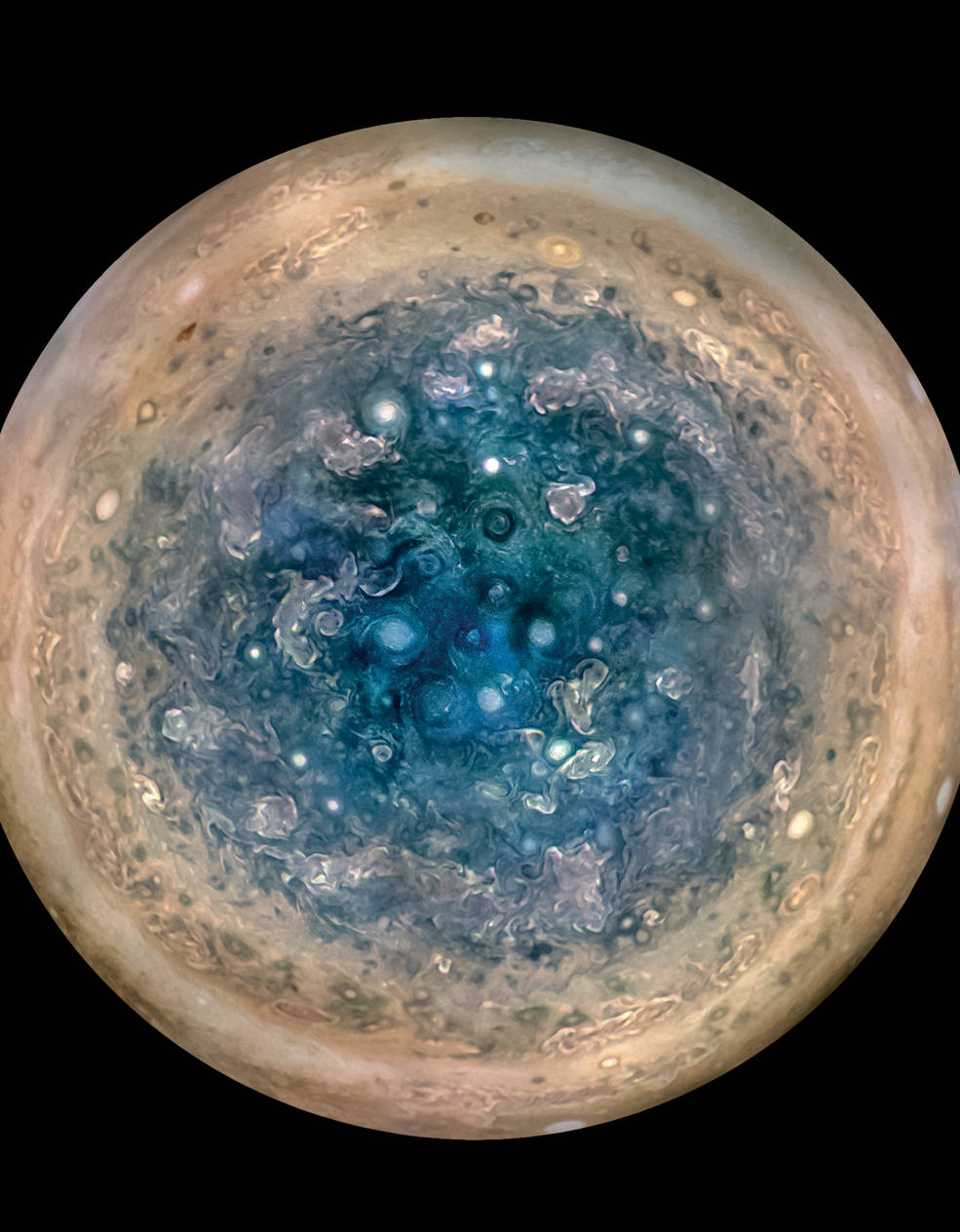
Jupiter's South Pole

Credits: NASA/JPL-Caltech/SwRI/MSSS/Betsy Asher Hall/Gervasio Robles

NASA’s Juno probe entered orbit around Jupiter a year ago, and has been gathering data ever since. Now the space agency is releasing spectacular images, such as this one showing Juptier’s south pole. It is a composite of several images, and shows multiple cyclones up to 600 miles in diameter raging around the pole.

From NASA:
Early science results from NASA’s Juno mission to Jupiter portray the largest planet in our solar system as a complex, gigantic, turbulent world, with Earth-sized polar cyclones, plunging storm systems that travel deep into the heart of the gas giant, and a mammoth, lumpy magnetic field that may indicate it was generated closer to the planet’s surface than previously thought.

“We are excited to share these early discoveries, which help us better understand what makes Jupiter so fascinating,” said Diane Brown, Juno program executive at NASA Headquarters in Washington. “It was a long trip to get to Jupiter, but these first results already demonstrate it was well worth the journey.”

Juno launched on Aug. 5, 2011, entering Jupiter’s orbit on July 4, 2016. The findings from the first data-collection pass, which flew within about 2,600 miles (4,200 kilometers) of Jupiter’s swirling cloud tops on Aug. 27, are being published this week in two papers in the journal Science, as well as 44 papers in Geophysical Research Letters.

“We knew, going in, that Jupiter would throw us some curves,” said Scott Bolton, Juno principal investigator from the Southwest Research Institute in San Antonio. “But now that we are here we are finding that Jupiter can throw the heat, as well as knuckleballs and sliders. There is so much going on here that we didn’t expect that we have had to take a step back and begin to rethink of this as a whole new Jupiter.”

Among the findings that challenge assumptions are those provided by Juno’s imager, JunoCam. The images show both of Jupiter’s poles are covered in Earth-sized swirling storms that are densely clustered and rubbing together.

“We’re puzzled as to how they could be formed, how stable the configuration is, and why Jupiter’s north pole doesn’t look like the south pole,” said Bolton. “We’re questioning whether this is a dynamic system, and are we seeing just one stage, and over the next year, we’re going to watch it disappear, or is this a stable configuration and these storms are circulating around one another?”

Another surprise comes from Juno’s Microwave Radiometer (MWR), which samples the thermal microwave radiation from Jupiter’s atmosphere, from the top of the ammonia clouds to deep within its atmosphere. The MWR data indicates that Jupiter’s iconic belts and zones are mysterious, with the belt near the equator penetrating all the way down, while the belts and zones at other latitudes seem to evolve to other structures. The data suggest the ammonia is quite variable and continues to increase as far down as we can see with MWR, which is a few hundred miles or kilometers.

Prior to the Juno mission, it was known that Jupiter had the most intense magnetic field in the solar system. Measurements of the massive planet’s magnetosphere, from Juno’s magnetometer investigation (MAG), indicate that Jupiter’s magnetic field is even stronger than models expected, and more irregular in shape. MAG data indicates the magnetic field greatly exceeded expectations at 7.766 Gauss, about 10 times stronger than the strongest magnetic field found on Earth.

“Juno is giving us a view of the magnetic field close to Jupiter that we’ve never had before,” said Jack Connerney, Juno deputy principal investigator and the lead for the mission’s magnetic field investigation at NASA’s Goddard Space Flight Center in Greenbelt, Maryland. “Already we see that the magnetic field looks lumpy: it is stronger in some places and weaker in others. This uneven distribution suggests that the field might be generated by dynamo action closer to the surface, above the layer of metallic hydrogen. Every flyby we execute gets us closer to determining where and how Jupiter’s dynamo works.”

Juno also is designed to study the polar magnetosphere and the origin of Jupiter’s powerful auroras—its northern and southern lights. These auroral emissions are caused by particles that pick up energy, slamming into atmospheric molecules. Juno’s initial observations indicate that the process seems to work differently at Jupiter than at Earth.

Juno is in a polar orbit around Jupiter, and the majority of each orbit is spent well away from the gas giant. But, once every 53 days, its trajectory approaches Jupiter from above its north pole, where it begins a two-hour transit (from pole to pole) flying north to south with its eight science instruments collecting data and its JunoCam public outreach camera snapping pictures. The download of six megabytes of data collected during the transit can take 1.5 days.

“Every 53 days, we go screaming by Jupiter, get doused by a fire hose of Jovian science, and there is always something new,” said Bolton. “On our next flyby on July 11, we will fly directly over one of the most iconic features in the entire solar system — one that every school kid knows — Jupiter’s Great Red Spot. If anybody is going to get to the bottom of what is going on below those mammoth swirling crimson cloud tops, it’s Juno and her cloud-piercing science instruments.”

NASA’s Jet Propulsion Laboratory in Pasadena, California, manages the Juno mission for NASA. The principal investigator is Scott Bolton of the Southwest Research Institute in San Antonio. The Juno mission is part of the New Frontiers Program managed by NASA’s Marshall Space Flight Center in Huntsville, Alabama, for the agency’s Science Mission Directorate. Lockheed Martin Space Systems, in Denver, built the spacecraft.

More information on the Juno mission is available at:

https://www.nasa.gov/juno

http://missionjuno.org

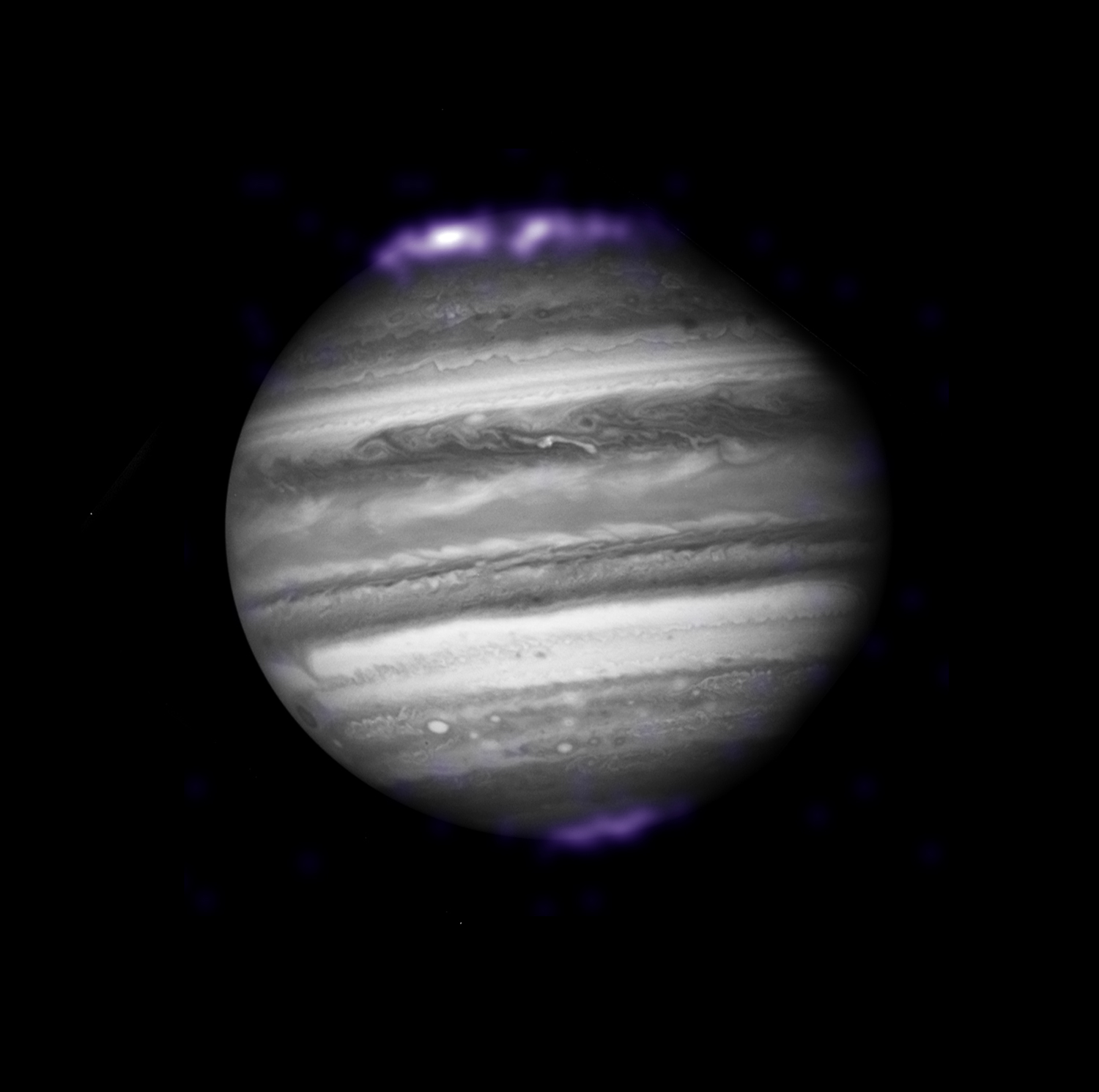
As the New Horizons spacecraft approached Jupiter en route to Pluto in February 2007, Chandra took exposures of the gas giant. In this composite image, Chandra data from three separate observations were combined, and then superimposed on an optical image of Jupiter from the Hubble Space Telescope. The purpose of the Chandra observations is to study the powerful X-ray auroras observed near the poles of Jupiter.


Related:

The Hollow Earth: The Greatest Geographical Discovery In History Made By Admiral Richard E. Byrd


via