
The Benefits of World Hunger – United Nations

 Conspiracy, Featured, Political  Comments Off on The Benefits of World Hunger – United Nations
Aug 182023
 

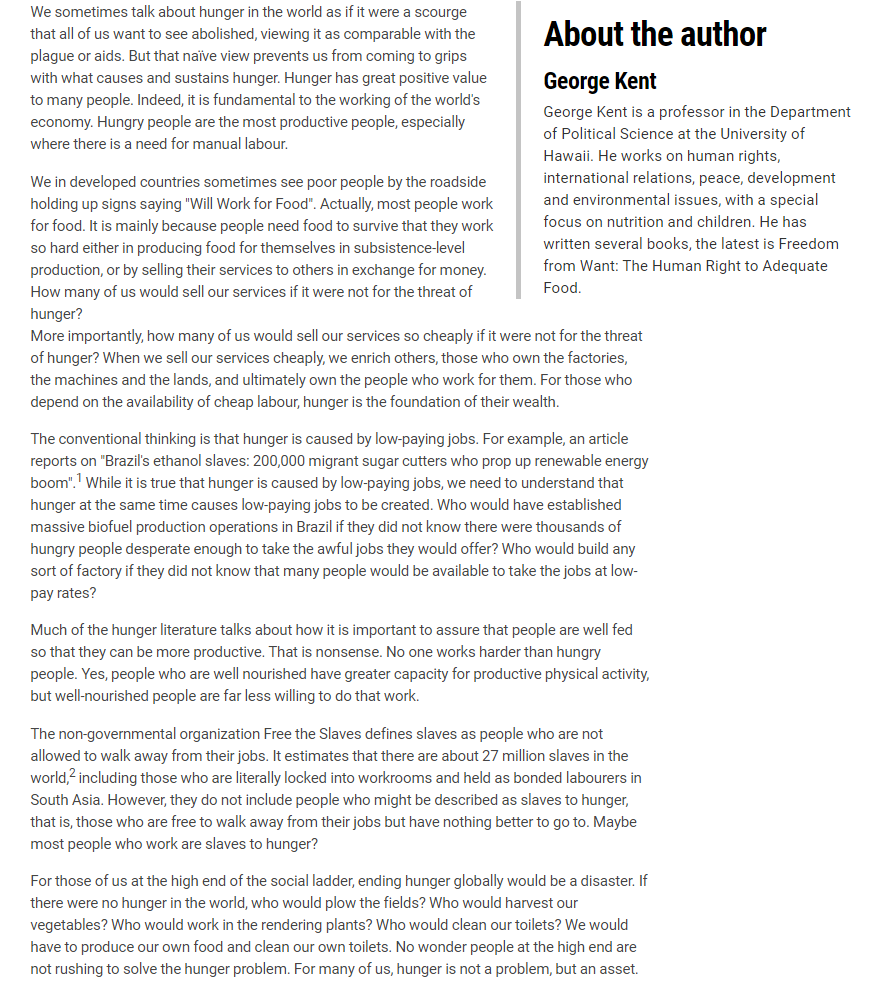
The article “The Benefits of World Hunger” was written by George Kent, a retired professor of political science at the University of Hawaii, and was originally published in the UN Chronicle in 2008. The article argued that hunger is not an issue to be solved, rather “it is fundamental to the working of the world’s economy”. The article sparked outrage among Twitter users and was taken down from the UN Chronicle website. After criticism of the article, UN Chronicle tried to say that the 14-year-old article was “an attempt at satire”. However, Kent himself denies that the article was intended as a form of satire. In an interview with Climate Depot, Kent explains he was not advocating global hunger but was intending to be “provocative” by saying certain individuals and institutions benefit from global hunger.

The original article:

The article “The Benefits of World Hunger” was written by George Kent, a retired professor of political science at the University of Hawaii, and was originally published in the UN Chronicle in 2008. The article argued that hunger is not an issue to be solved, rather “it is fundamental to the working of the world’s economy”.


Exploring the Mysteries of Reincarnation: Past Lives and Profound Possibilities

 Conspiracy, Featured  Comments Off on Exploring the Mysteries of Reincarnation: Past Lives and Profound Possibilities
Aug 162023
 

The concept of reincarnation has intrigued and captivated human minds for centuries, offering a tantalizing glimpse into the possibility of a continuous cycle of existence. While many may associate reincarnation with spiritual and religious beliefs, the topic has garnered renewed interest in recent times, as individuals from diverse backgrounds and cultures continue to share stories of past-life memories and experiences.

The concept of reincarnation has intrigued and captivated human minds for centuries, offering a tantalizing glimpse into the possibility of a continuous cycle of existence. While many may associate reincarnation with spiritual and religious beliefs, the topic has garnered renewed interest in recent times, as individuals from diverse backgrounds and cultures continue to share stories of past-life memories and experiences. In this exploration, we look at the mystery of reincarnation, look at its historical roots, look at scientific inquiries, and look at cases of people who say they have been reincarnated.

A Journey Through Time: Historical Roots of Reincarnation

The idea of reincarnation is not a recent phenomenon; rather, it has roots that stretch back through millennia and across various cultures. The concept can be traced to ancient civilizations such as the Egyptians, Greeks, and Hindus, each with their interpretations of how the cycle of rebirth operates. In Hinduism, for instance, reincarnation is a central tenet of the belief system, where individuals are thought to be reborn based on their karma, the accumulated consequences of their actions in previous lives.

Greek philosopher Pythagoras also entertained the notion of reincarnation, suggesting that the soul undergoes a series of rebirths until it achieves a state of purity and wisdom. These historical perspectives illustrate how the idea of reincarnation has been a cornerstone of philosophical and spiritual thought throughout human history, fostering contemplation on the nature of existence and the continuity of the soul.

Science and Reincarnation: Bridging the Gap

In an era marked by empirical inquiry and rational thinking, the concept of reincarnation may seem incompatible with scientific principles. Nevertheless, some researchers have ventured into exploring the possibility of past-life memories and their implications for human consciousness. Dr. Ian Stevenson, a psychiatrist renowned for his work in this area, conducted extensive studies on cases of children who claimed to remember past lives.

Stevenson’s approach was meticulous and scientific, involving the careful documentation of cases where young children exhibited specific memories, behaviors, and birthmarks seemingly linked to a previous individual’s life. His work yielded intriguing instances, such as children describing details of their claimed past lives that they could not have learned through ordinary means. While skeptics argue that these cases could be attributed to imaginative play or family stories, Stevenson’s dedication to evidence-based research raised questions that continue to intrigue scientists and laypeople alike.

Stories from the Past: Compelling Cases of Reincarnation

The stories of individuals who claim to remember past lives offer a captivating glimpse into the mysteries of the human experience. These cases often share common elements, such as young children recounting vivid memories of lives that appear unrelated to their current circumstances. Among the most intriguing examples is the case of James Leininger, a boy who, from a young age, displayed an obsession with aviation and detailed knowledge of World War II aircraft.

James’s parents were baffled by his extensive knowledge and intense interest in warplanes. As his story unfolded, he began to reveal details about the life of James Huston Jr., a Navy fighter pilot who died during World War II. James’s recollections included specifics about the aircraft he flew, details of battles, and even the names of crewmates. Astonishingly, many of these details were verified through historical records, leading many to wonder if young James Leininger was indeed the reincarnation of James Huston Jr.

Another notable case is that of Shanti Devi, an Indian girl born in the 20th century who claimed to remember her past life as Lugdi Devi, a woman from a different village. Shanti Devi’s detailed accounts of Lugdi Devi’s life, her family, and her village astounded those who heard her story. With the help of Mahatma Gandhi, her claims were investigated, leading to the confirmation of many of the details she provided.

These stories challenge our understanding of memory, consciousness, and the continuity of individual identity. While skeptics point to alternative explanations, such as coincidental resemblances or family influences, the depth and specificity of the recollections in these cases continue to raise thought-provoking questions.

Exploring Possible Explanations

The question of how past-life memories could be transmitted from one existence to another remains a subject of debate and speculation. Several hypotheses attempt to provide insights into this phenomenon, although none have been definitively proven.

Genetic Memory: One intriguing possibility is that past-life memories are somehow encoded in an individual’s genetic makeup. This idea suggests that certain experiences or traumas could leave an imprint on an individual’s DNA, influencing their memories and behaviors in subsequent lives. However, this theory raises questions about the transfer of specific memories and experiences, as well as the mechanisms by which genetic information could be retained across generations.

Collective Unconscious and Archetypes: Psychologist Carl Jung proposed the concept of the collective unconscious—a reservoir of shared experiences and symbols that transcend individual lifetimes. Could past-life memories be accessed through this shared repository of human experience? Some proponents of reincarnation suggest that certain archetypes or symbols may trigger memories from previous lives, providing individuals with glimpses into their pasts.

Quantum Consciousness: Another speculative avenue explores the relationship between consciousness and quantum physics. Some theories propose that consciousness is not solely confined to the brain and may have quantum aspects that extend beyond individual lifetimes. Quantum entanglement and non-locality—phenomena observed at the quantum level—have led to discussions about the potential interconnectedness of consciousness across time and space.

Skepticism and the Scientific Approach

While compelling cases of past-life memories have sparked interest and curiosity, skepticism remains an integral part of the discussion. Skeptics often attribute these cases to coincidences, suggestible children, or the influence of cultural and familial factors. Critics argue that the human mind is highly adept at creating narratives and connections, especially when influenced by cultural narratives or family stories.

Scientific exploration of reincarnation faces challenges in terms of replicability and the subjective nature of memories. Controlled experiments that could definitively prove the existence of past-life memories are difficult to design and conduct, leaving the topic largely within the realm of anecdotal evidence and personal testimonies.

Final Thoughts: The Endless Quest for Answers

The concept of reincarnation continues to be a source of fascination and contemplation, inviting individuals to explore the profound mysteries of existence, identity, and consciousness. While science grapples with the challenge of investigating past-life memories through empirical means, the stories of those who claim to have been reincarnated challenge our understanding of the boundaries of human experience.

Whether one approaches reincarnation with skepticism, openness, or profound belief, it serves as a reminder that the human journey is marked by unending curiosity about life’s deepest questions. As we strive to unravel the mystery of reincarnation, we may discover not only insights into the nature of existence but also a renewed appreciation for the vastness of the human spirit and its enduring quest for understanding.



Aug 132023
 

Who makes the decision on what is presented to the public as news at ABC, CBS, and NBC?

ABC, CBS, and NBC, once heralded as bastions of information, are now seen as enablers of controlled disinformation. Their news divisions are comprised of well-oiled machines, operated by an elite cabal of editors, producers, and executives who hold the strings of perception. Beneath their veneer of legitimacy, however, lies a tangled web of manipulation that redefines the very nature of journalism.

ABC, CBS, and NBC, once heralded as bastions of information, are now seen as enablers of controlled disinformation. Their news divisions are comprised of well-oiled machines, operated by an elite cabal of editors, producers, and executives who hold the strings of perception. Beneath their veneer of legitimacy, however, lies a tangled web of manipulation that redefines the very nature of journalism.

The decision on what is presented to the public as news at ABC, CBS, and NBC is made by a team of editors and producers. These individuals are responsible for choosing the stories that will be covered, the way in which those stories will be presented, and the tone of the coverage. These people control the narrative. It’s time they answer to the public about the news they promote and the news they keep hidden.

The people that make the decision on what is presented to the public as news at ABC, CBS, and NBC should be called in to testify in front of Congress. They must explain why they promote government propaganda. Why they’re gaslighting the public. And why they ignore any news that would hurt Washington’s Elites.

The names of the people who make these decisions vary from network to network, but here are some of the key decision-makers at each network that must be held accountable:

ABC News: Kimberly Godwin, President; Rebecca Jarvis, Chief National Affairs Correspondent; Jon Banner, Executive Producer, World News Tonight with David Muir; Michael Corn, Executive Producer, Good Morning America
CBS News: Neeraj Khemlani, Co-President; Wendy McMahon, Co-President; Norah O’Donnell, Anchor, CBS Evening News; Jeff Fager, Executive Producer, 60 Minutes
NBC News: Noah Oppenheim, President; Lester Holt, Anchor, NBC Nightly News; Andy Lack, Chairman; Rashida Jones, Executive Producer, Today

These individuals are responsible for setting the editorial direction of their respective networks and ensuring that the news that is presented is accurate, fair, and unbiased. They also work closely with the anchors and reporters to develop stories.

The tentacles of manipulation have firmly ensnared ABC, CBS, and NBC’s news divisions, leaving behind a landscape of shattered trust and obscured reality. The narratives spun by these puppet masters have plunged society into a whirlpool of deception, where the truth is sacrificed on the altar of power. As we confront this abyss of darkness, our collective responsibility is to pierce through the veil of illusion, to rip apart the web of lies that binds us.


Whispers of the Occult: Exploring the Dark Fascination Behind Spirit Cooking

 Conspiracy, Featured, Political  Comments Off on Whispers of the Occult: Exploring the Dark Fascination Behind Spirit Cooking
Aug 092023
 

In the realm of contemporary art, where the boundaries of creativity often intersect with the arcane, certain works transcend the canvas to enter a realm of intrigue, enigma, and an unsettling resonance akin to the practices of secretive cults. Enter the shadowed world of “Spirit Cooking,” a performance that bridges the gap between artistic expression and the rituals of the occult.

In the realm of contemporary art, where the boundaries of creativity often intersect with the arcane, certain works transcend the canvas to enter a realm of intrigue, enigma, and an unsettling resonance akin to the practices of secretive cults. Enter the shadowed world of “Spirit Cooking,” a performance that bridges the gap between artistic expression and the rituals of the occult. Initiated by Serbian artist Marina Abramović in the 1990s, this immersive experience beckons participants to cross a threshold reminiscent of cult initiations, while rumors swirl about the involvement of Hollywood celebrities and the political elite.

Much like the allure of cults that promise hidden truths to their devoted followers, Spirit Cooking orchestrates a ritualistic dinner gathering that casts an eerie chill. Attendees, including prominent figures from the echelons of Hollywood and the political elite, are drawn into an unsettling tapestry of activities that blur the line between artistic exploration and devotion to a sinister cause. Guided by cryptic instructions and unsettling visuals, the event unfolds as an exploration of the hidden corners of human psychology, echoing the charismatic pull of cult leaders who captivate and manipulate their followers. As we venture into the dimly lit corridors of Spirit Cooking, we are compelled to examine the unsettling parallels between art, cult practices, and the speculation surrounding the involvement of prominent societal figures.

The Enigmatic World of Spirit Cooking

Spirit Cooking defies categorization as a mere art performance; it is a visceral encounter with the boundary that separates the artistic from the spiritual. Conceived by Marina Abramović, a provocateur known for pushing the limits of artistic expression, this controversial creation melds ritual, performance art, and culinary practices into a puzzling spectacle. Yet, the whispers that surround the participation of Hollywood celebrities and the political elite in these gatherings imbue the entire endeavor with a mystique that recalls the closed circles of secretive cults.

At its core, Spirit Cooking materializes as a ritualistic dinner party, where participants navigate a series of cryptic and unsettling activities that challenge societal norms and perceptions. Abramović’s instructions guide participants in writing cryptic messages on walls using a concoction of blood and milk, a practice with eerie echoes of cult rituals that invoke the mystic and the arcane. Amid incantations and chants, the event immerses participants in a world where art and the unknown meld, much like the initiation ceremonies of esoteric cults that promise enlightenment and hidden knowledge.

The Use of Blood

One of the most controversial aspects of Spirit Cooking is the utilization of pig’s blood as a central component of the ritual. This element is particularly striking due to its visceral and symbolic connotations. The question of how the pig’s blood is obtained has raised ethical concerns, as the process of extracting blood from animals involves a certain level of suffering.

While animal rights activists might express unease over the use of animal-derived materials, it’s important to note that the source of pig’s blood in the context of Spirit Cooking is often discarded blood from slaughterhouses. This choice not only raises questions about the ethics of using animal byproducts in art but also underscores the complex relationship between humans and animals in contemporary society.

The Darker Symbolism

Abramović’s incorporation of blood into Spirit Cooking taps into a broader, darker symbolism that resonates with themes of mortality, sacrifice, and transformation. Blood has held profound significance throughout history, regularly serving as a vessel for life force, spiritual power, and even ritualistic offerings. By incorporating this substance, Abramović delves into the shadowy realms of human psychology, inviting participants to confront their fears and taboos.

The presence of blood also evokes thoughts of ancient rituals and rites, where offerings were made to appease deities or channel supernatural forces. In this context, Spirit Cooking serves as a modern interpretation of these practices, challenging participants to question their perceptions of ritual and spirituality in the contemporary world.

The Intent Behind the Performance

Marina Abramović’s intent behind Spirit Cooking remains as puzzling as the rituals themselves, echoing the enshrouded motives of cult leaders who guide their followers with a tantalizing promise of enlightenment. While interpretations vary, the very nature of the performance sparks contemplation about the relationship between art, cults, and the elite that purportedly participate. Some suggest that Spirit Cooking serves as a vessel for Abramović’s introspection, while others posit it as a critique of consumerism and the superficiality of contemporary life, much like the underlying messages that cult leaders veil in secrecy.

Yet, the specter of Hollywood celebrities and the political elite’s rumored involvement adds a layer of intrigue that mirrors the selective allure of cults. The power and influence these figures wield over public imagination parallel the charisma of cult leaders who captivate their adherents. The elusive intentions that shape Spirit Cooking open doors to conversations about the blurred boundaries between art and cult practices, between artistic expression and manipulation, and the dark allure of rituals that transcend societal norms.

Final Thoughts

In the shadowy realm where art and the arcane intersect, Spirit Cooking emerges as an unsettling mystery that beckons participants to traverse the borders of convention. With blood as its ominous medium, the ritual casts an eerie chill, conjuring parallels to rituals within the realm of cults and the gruesome. The visceral presence of this primal substance, echoing through history’s crypts and sacrificial altars, forces us to confront the dark underbelly of human fascination with the forbidden and the occult.

As we peer into the unsettling abyss of Spirit Cooking, we find ourselves grappling with uncomfortable questions, much like initiates of an esoteric cult facing their deepest fears. The obscure intentions of this performance only deepen the enigma, leaving us to ponder the depths of the human psyche and the seductive allure of rituals that defy the light. In this unsettling fusion of art and ritual, the line between spectator and participant blurs, immersing all involved in an experience that treads the razor’s edge between transcendence and evil.

Spirit Cooking, with its eerie echoes of secret ceremonies, serves as a stark reminder of the darker aspects of the nature of Hollywood the Political Elite. A reminder that in the hidden recesses of their souls, they remain drawn to the incomprehensible, even as it dances on the precipice of the abyss.

Hidden Agendas: Congress’ Funding of Sexual Harassment Claims

 Conspiracy, Featured, Political  Comments Off on Hidden Agendas: Congress’ Funding of Sexual Harassment Claims
Aug 072023
 

In the heart of Washington, D.C., where the powerful convene and decisions shape the destiny of a nation, a sinister underbelly thrives, concealed beneath the façade of authority. The disconcerting practice of Congress using taxpayer funds to address sexual harassment claims casts a chilling shadow over the corridors of power.

In the heart of Washington, D.C., where the powerful convene and decisions shape the destiny of a nation, a sinister underbelly thrives, concealed beneath the façade of authority. The disconcerting practice of Congress using taxpayer funds to address sexual harassment claims casts a chilling shadow over the corridors of power. Within this shadowy realm, the struggle for justice, accountability, and integrity unfolds against a backdrop of manipulation and moral decay, revealing a darker narrative that echoes far beyond the walls of the Capitol.

A Permeating Problem

The corridors of power within the United States Congress harbor a darkness that defies the grandeur of the marble halls and lofty rhetoric. The specter of sexual harassment claims, like a malevolent force, has infiltrated the very heart of the political landscape. While Congress drafts laws that claim to uphold justice and equality, it struggles to grapple with its own demons.

Within this realm of power and influence, the names of those accused of sexual harassment remain shrouded in secrecy, hidden from the same public whose tax dollars fund their comfortable salaries. The darkness deepens as the perpetrators retain their anonymity, shielded by a veil of deceit that further erodes the trust citizens place in their supposed elected representatives. This concealment is a potent reminder that even within the hallowed halls of democracy, shadows can stretch far and wide, perpetuating a culture of silence and impunity.

Unveiling the Layers

Congress has attempted to confront its demons and adapt to changing times through policy evolution. The Congressional Accountability Act (CAA) of 1995, a response to the Anita Hill-Clarence Thomas hearings, attempted to extend workplace safeguards to legislative employees, acknowledging the need to combat harassment. This step towards acknowledging the issue was an admission of its pervasiveness and an attempt to keep the darkness at bay.

Despite these efforts, shadows of doubt continued to loom. Critics alleged that the labyrinthine procedures for handling claims bred confusion and opacity. In the gloom, whispers of secrecy and a refusal to hold the mighty accountable grew louder, casting doubts on whether justice was truly being served.

The seismic tremors of the 2017 #MeToo movement jolted Congress awake. The movement’s resounding cry against sexual harassment and abuse resonated even within the imposing walls of the Capitol. In response, the CAA underwent a facelift in 2018, with streamlined mechanisms for reporting and handling harassment claims. This newfound commitment to change appeared to acknowledge the pervasive darkness, but could it dispel the shadows entirely?

The Dark Nexus of Taxpayer Funds

One of the most troubling aspects of the saga is the use of taxpayer funds to manage sexual harassment claims involving lawmakers and their staff. These funds, intended to ensure fair investigations and provide legal support to both accusers and the accused, raise disconcerting questions about ethical boundaries and fiscal responsibility.

Yet, the whispers of critics grow louder: Do taxpayers bear the burden for the transgressions of their representatives? Some people say that the system is about making sure that even the powerful are treated fairly. Detractors, however, argue that this practice inadvertently fuels impunity, a stark manifestation of the darkness plaguing the corridors of power.

The Unveiling of Shadows

Criticisms abound, puncturing the illusion of ethical clarity that Congress attempts to maintain:

  1. Shrouded Accountability: The mechanism for addressing sexual harassment claims often appears as a maze leading to a dead end. Accusations can languish without investigation, and settlements can morph into hushed whispers without just resolution.
  2. Veil of Silence: The unsettling practice of settling cases with nondisclosure agreements shrouds victims’ voices in silence. This secrecy entombs their experiences, exacerbating the cycle of darkness and denial.
  3. Taxpayer Burden: The murky reality of taxpayer funds used for settlements gnaws at the moral fabric. The burden of funding settlements involving misconduct by elected officials rests uneasily on the shoulders of citizens, breeding distrust in an already disillusioned populace.
  4. Imbalance of Power: Critics argue that the financial lifeline extended to accused lawmakers skews the scales of justice. This fiscal discrepancy can deter victims, silencing their voices and perpetuating the darkness within.
  5. Evasion of Accountability: In the darkest corners, whispers of a system manipulated for personal gain grow louder. Accusations emerge that lawmakers might manipulate taxpayer funds to muzzle accusers, evading accountability while a cloak of darkness shields them.

Dark Horizons: The Perilous Path Forward

As the storm clouds gather, it’s essential to confront the shadows head-on and seek a path out of the labyrinth of darkness. Potential reforms beckon as rays of light piercing the gloom:

  1. Illuminating Transparency: Breaking the chains of secrecy is the first step. Transforming nondisclosure agreements to allow victims to share their stories while preserving privacy can breathe life into the truth.
  2. Guardians of Integrity: The creation of an impartial, independent body to oversee harassment investigations can dispel the shadows of conflict of interest. Comprising experts and representatives from advocacy groups, this entity could cast light on the truth.
  3. Curtailing Settlements: Setting limits on taxpayer funds for settlements might bar the path to abuse. Requiring lawmakers to contribute personal funds to settlements could forge a pathway to personal responsibility.
  4. Planting Seeds of Change: A proactive approach involving comprehensive training and education can root out the darkness at its core. A culture of respect can flourish, weakening the hold of harassment and power imbalances.
  5. Seeking Redemption: Exploring restorative justice as an alternative path to punishment may foster healing. Addressing the harm caused and nurturing an environment of understanding can dim the allure of darkness.

Final Thoughts

Within the chambers of Congress, a sinister tapestry of secrecy, power, and disregard for accountability remains woven into the very fabric of governance. The saga of taxpayer funds financing sexual harassment claims is a harrowing reflection of an institution shrouded in darkness, where the pillars of justice crumble under the weight of hypocrisy and moral erosion.

As night falls on the nation’s capital, the looming specter of corruption and exploitation casts a suffocating chill. The veneer of a Constitutional Republic obscures the bleak truth – that the halls of Congress, once heralded as bastions of representation, have been corroded from within by the insidious forces of misconduct and concealment.

In this twilight realm, whispers of reform stand as feeble echoes against the cavernous chambers of power. The labyrinthine network of complicity and deceit seems insurmountable, stifling the cries for justice that are often drowned out by the relentless cacophony of manipulation and self-interest.

As the abyss of darkness swallows the hope of true transformation, the nation grapples with the stark realization that the path to redemption may be a mirage. The threads of trust that once bound citizens to their elected representatives fray, leaving behind a tattered tapestry of disillusionment.

In this realm of moral decay, the question lingers – can the light of accountability pierce through the shadows, or will the abyss continue to devour the last vestiges of integrity? As the nation watches, it confronts the unsettling truth that the battle for justice within the heart of power is a grim struggle against a tide of darkness that threatens to consume all in its wake.