
The Dumbest Deaths In Recorded History

 Amusing, Information  Comments Off on The Dumbest Deaths In Recorded History
Jan 242017
 

The Dumbest Deaths in Recorded HistoryAttila the Hun:
One of the most notorious villains in history, Attila’s army had conquered all of Asia by 450 AD-from Mongolia to the edge of the Russian Empire-by destroying villages and pillaging the countryside.
How he died: He got a nosebleed on his wedding night.
In 453 AD, Attila married a young girl named Ildico. Despite his reputation for ferocity on the battlefield, he tended to eat and drink lightly during large banquets. On his wedding night, however, he really cut loose, gorging himself on food and drink. Sometime during the night he suffered a nosebleed, but was too drunk to notice. He drowned in his own blood and was found dead the next morning.

Tycho Brahe:
An important Danish astronomer of the 16th century. His ground breaking research allowed Sir Isaac Newton to come up with the theory of gravity.
How he died: Didn’t get to the bathroom in time.
In the 16th century, it was considered an insult to leave a banquet table before the meal was over. Brahe, known to drink excessively, had a bladder condition-but failed to relieve himself before the banquet started. He made matters worse by drinking too much at dinner, and was too polite to ask to be excused. His bladder finally burst, killing him slowly and painfully over the next 11 days.

Horace Wells:
Pioneered the use of anesthesia in the 1840s
How he died: Used anesthetics to commit suicide.
While experimenting with various gases during his anesthesia research, Wells became addicted to chloroform. In 1848 he was arrested for spraying two women with sulfuric acid. In a letter he wrote from jail, he blamed chloroform for his problems, claiming that he’d gotten high before the attack. Four days later he was found dead in his cell. He’d anaesthetized himself with chloroform and slashed open his thigh with a razor.

Francis Bacon:
One of the most influential minds of the late 16th century. A statesman, a philosopher, a writer, and a scientist, he was even rumored to have written some of Shakespeare’s plays.
How he died: Stuffing snow into a chicken
One afternoon in 1625, Bacon was watching a snowstorm and was struck by the wondrous notion that maybe snow could be used to preserve meat in the same way that salt was used. Determined to find out, he purchased a chicken from a nearby village, killed it, and then, standing outside in the snow, attempted to stuff the chicken full of snow to freeze it. The chicken never froze, but Bacon did.

Jerome Irving Rodale:
Founding father of the organic food movement, creator of “Organic Farming and Gardening” magazine, and founder of Rodale Press, a major publishing corporation.
How he died: On the “Dick Cavett Show”, while discussing the benefits of organic foods.
Rodale, who bragged “I’m going to live to be 100 unless I’m run down by a sugar-crazed taxi driver,” was only 72 when he appeared on the “Dick Cavett Show” in January 1971. Part way through the interview, he dropped dead in his chair. Cause of death: heart attack. The show was never aired.

Aeschylus:
A Greek playwright back in 500 BC. Many historians consider him the father of Greek tragedies.
How he died: An eagle dropped a tortoise on his head
According to legend, eagles picked up tortoises and attempt to crack them open by dropping them on rocks. An eagle mistook Aeschylus’ head for a rock (he was bald) and dropped it on him instead.

Jim Fixx:
Author of the best selling “Complete Book of Running,” which started the jogging craze of the 1970s.
How he died: A heart attack….while jogging
Fixx was visiting Greensboro, Vermont when he walked out of his house and began jogging. He’d only gone a short distance when he had a massive coronary. His autopsy revealed that one of his coronary arteries was 99% clogged, another was 80% obstructed, and a third was 70% blocked….and that Fixx had had three other attacks in the weeks prior to his death.

 

The Average Military Man

 Amusing  Comments Off on The Average Military Man
Jan 222017
 

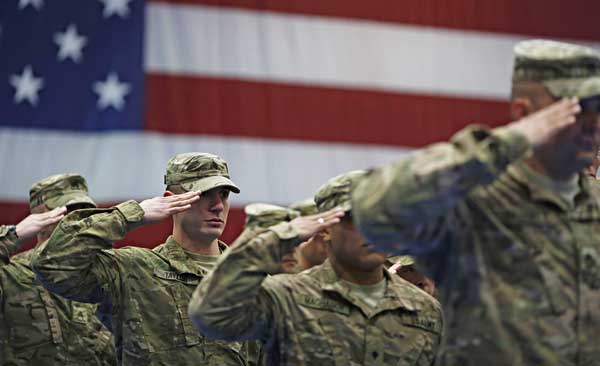
The Average Military Man

The average age of the military man is 19 years.

He is a short-haired, tight-muscled kid who, under normal circumstances is considered by society as half man, half boy. Not yet dry behind the ears, not old enough to buy a beer, but old enough to die for his country.

He never really cared much for work and he would rather wax his own car than wash his father’s; but he has never collected unemployment either.

He’s a recent High School graduate; he was probably an average student, pursued some form of sport activities, drives a ten-year old jalopy, and has a steady girlfriend that either broke up with him when he left, or swears to be waiting when he returns from half a world away.

He listens to rock and roll or hip-hop or rap or jazz or swing and 155mm Howitzers.

He is 10 or 15 pounds lighter now than when he was at home because he is working or fighting from before dawn to well after dusk.

He has trouble spelling, thus letter writing is a pain for him, but he can field strip a rifle in 30 seconds and reassemble it in less time in the dark.

He can recite to you the nomenclature of a machine gun or grenade launcher and use either one effectively if he must.

He digs foxholes and latrines and can apply first aid like a professional.

He can march until he is told to stop or stop until he is told to march.

He obeys orders instantly and without hesitation, but he is not without spirit or individual dignity.

He is self-sufficient. He has two sets of fatigues: he washes one and wears the other. He keeps his canteens full and his feet dry.

He sometimes forgets to brush his teeth, but never to clean his rifle.

He can cook his own meals, mend his own clothes, and fix his own hurts. If you’re thirsty, he’ll share his water with you; if you are hungry, his food.

He’ll even split his ammunition with you in the midst of battle when you run low.

He has learned to use his hands like weapons and weapons like they were his hands. He can save your life – or take it, because that is his job.

He will often do twice the work of a civilian, draw half the pay and still find ironic humor in it all. He has seen more suffering and death then he should have in his short lifetime.

He has stood atop mountains of dead bodies, and helped to create them.

He has wept in public and in private, for friends who have fallen in combat and is unashamed.

He feels every note of the National Anthem vibrate through his body while at rigid attention, while tempering the burning desire to ‘square-away’ those around him who haven’t bothered to stand, remove their hat, or even stop talking. In an odd twist, day in and day out, far from home, he defends their right to be disrespectful.

Just as did his Father, Grandfather, and Great-grandfather, he is paying the price for our freedom.

Beardless or not, he is not a boy.

He is the American Fighting Man that has kept this country free for over 200 years.

He has asked nothing in return, except our friendship and understanding.

Remember him, always, for he has earned our respect and admiration with his blood.


How An Igloo Keeps You Warm

 Amusing, Information  Comments Off on How An Igloo Keeps You Warm
Jan 192017
 

If you ever find yourself stranded in the snowy Arctic (or bored in Minecraft), you’re gonna need to know how to build an igloo. But how can building a house made of ice keep you warm? The science behind building an igloo is the same reason that otters and reindeer don’t freeze to death!

The principle behind an igloo is hidden in the material it’s constructed out of. Igloos are normally built from compressed snow, which is sawn into blocks, and then these blocks are stacked around a hole, which is dug out after the blocks have been set. Solid ice is a poor insulator, when compared to compressed snow. The snow has many many more air pockets per cubic foot, and is also lighter. Also, igloos do not have flat bottoms. The inside of the igloo is tiered, or terraced, the uppermost level being where the people sleep, the middle is where the fire is and the work takes place, and the bottom level actually is a “cold sump”. The principle is that all the coldest air from inside the igloo runs downward off the terraces and collects in the bottom, thus allowing the upper portions to stay warmer.

The entrance for the igloo is usually at the bottom, and includes at least one right angle, which keeps the high winds from blowing straight into the igloo and chilling the residents or blowing out the fire. They also all have a small hole on the top that keeps the smoke from building up inside the igloo. All of these factors take advantage of underlying physics, and the temperature inside an igloo is likely to be 20 degrees or so, while the outside temperature in northern regions can drop down to -50 degree Fahrenheit during the daytime. 20 degrees may not be what some consider to be comfortable, but a 70 degree difference is certainly welcome somewhere so cold.

Source…