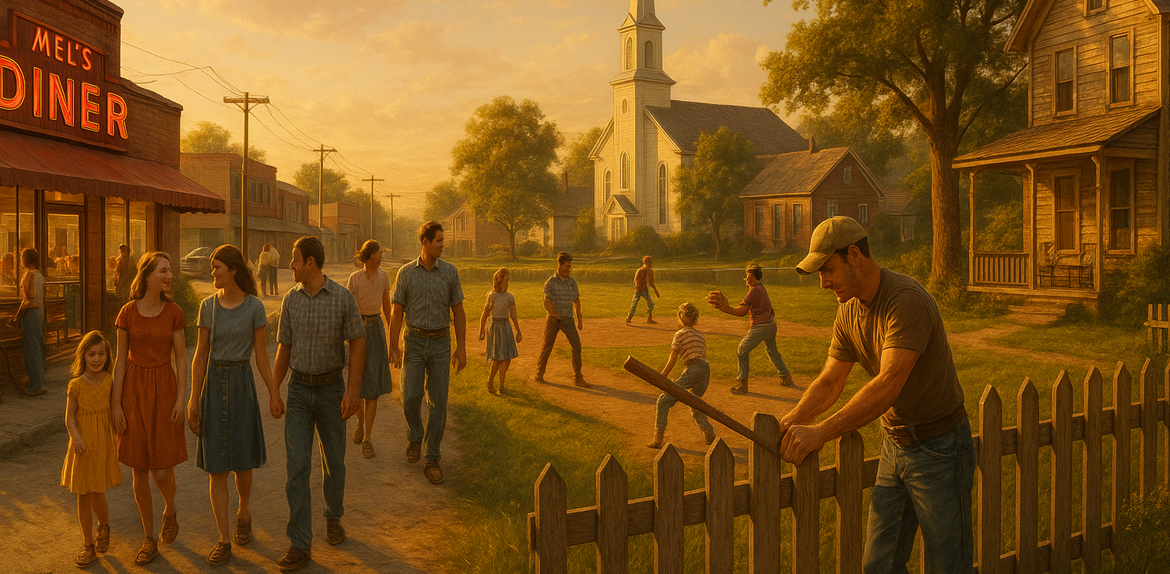
There’s a story we don’t hear enough in America. It’s not about billionaires launching rockets, Silicon Valley geniuses redefining reality, or celebrities setting trends. It’s about the woman stocking shelves at the local grocery store at dawn, the father coaching Little League after a 10-hour shift, the neighbor who fixes your fence without asking for anything in return. This is the story of the ordinary American—the heartbeat of a nation that often forgets to listen to its own pulse.
In a world obsessed with fame, wealth, and disruption, there’s something radical about choosing a life rooted in family, faith, and community. It’s a choice that doesn’t generate headlines, but it’s the foundation of what makes this country work. Let’s talk about why that matters.
Family: The First School of Love
Families are messy. They’re loud at Thanksgiving, stubborn in disagreements, and occasionally dysfunctional. But they’re also where we learn the basics of being human: kindness, sacrifice, and how to forgive. The ordinary American doesn’t post parenting highlights on social media or write books about “life hacks” for perfect households. Instead, they show up—day after day—to pack lunches, help with homework, and sit through school plays where the dialogue is barely audible.
Working-class parents might not have the resources to enroll their kids in elite extracurriculars or hire tutors, but they pass down something more valuable: resilience. A child who watches their parents navigate layoffs, illnesses, or car repairs with quiet determination learns that life isn’t about avoiding storms but learning to dance in the rain. These families don’t chase perfection. They chase connection.
Faith: The Anchor in Chaotic Times
For many ordinary Americans, faith isn’t about dogma or politics. It’s a quiet conversation with God during a morning commute, a casserole brought to a grieving neighbor, or the humility of admitting you don’t have all the answers. Churches, mosques, synagogues, and community centers become spaces where people gather not just to pray, but to rebuild.
After factory closures in the Midwest, it was church food pantries that kept families fed. When floods wiped out homes in Louisiana, it was faith groups that arrived first with chainsaws and blankets. This kind of faith doesn’t demand attention. It doesn’t trend on X (formerly known as Twitter). It simply acts—not out of self-righteousness, but because helping others is woven into the fabric of daily life.
Local Life: The Anti-Algorithm World
Walk into a small-town diner, and you’ll see a different kind of networking. The waitress remembers your order, the farmer at the next booth complains about crop prices, and the mechanic at the counter argues about last night’s game. These spaces operate on trust, not apps. Need a loaner tractor? Your word is enough. Looking for a job? Someone’s cousin knows a guy.
Tech giants promise to “connect the world,” but ordinary Americans know connection isn’t about faster Wi-Fi. It’s about showing up for the same summer parade every year, even when it’s scorching hot. It’s about the librarian who notices a kid checking out books on coding and quietly slips them a scholarship application. Local life thrives on eye contact, handshake deals, and the patience to listen to stories that don’t fit into 280 characters.
The Danger of worshiping “Exceptional”
Celebrity culture tells us ordinary is a synonym for “failure.” Billionaires preach that if you’re not changing the world, you’re wasting your life. But what if the goal Isn’t to be exceptional? What if it’s to be good?
Teachers shaping minds in underfunded schools, nurses working double shifts, truckers moving goods through blizzards—these people don’t have time to optimize their “personal brand.” They’re too busy keeping the lights on. Yet without them, the “exceptional” wouldn’t exist. No entrepreneur can code without electricity. No influencer can post without roads to deliver their gadgets. The irony is that the ones labeled “ordinary” make the extraordinary possible.
The Everyday Rebellion
Choosing a simple life is an act of defiance now. It means rejecting the lie that value is tied to productivity, clout, or net worth. It means sitting on a porch swing instead of scrolling through screens, prioritizing bedtime stories over “hustle culture,” and measuring success in board games played, not milestones unlocked.
The ordinary American isn’t naïve. They see the fractures in the system—the rising costs, the polarized politics, the sense that the future is slipping away. But they also possess a stubborn hope. They believe in fixing what’s broken instead of abandoning it, in planting trees they’ll never sit under, in fighting for a country that hasn’t always fought for them.
Heroes Without Capes
Let’s stop calling them “ordinary.” There’s nothing ordinary about a single mother working two jobs to send her kids to college, a volunteer firefighter rushing into a burning house, or a veteran organizing a neighborhood cleanup. These are small acts of courage that don’t go viral—but they hold communities together.
The media rarely celebrates these stories because they’re “unremarkable” on the surface. But dig deeper, and you’ll find a truth that outshines any celebrity headline: The backbone of America isn’t innovation or glamour. It’s the quiet, unyielding love of people who’ve decided that showing up is enough.
A Future Built on Humility
Maybe it’s time to redefine progress. Instead of chasing utopian tech fantasies or toxic fame, what if we embraced the wisdom of those who live simply? The ordinary American understands that life isn’t a ladder to climb but a garden to tend—patiently, together, with mud on your hands and grace in your heart.
This isn’t a rejection of ambition. It’s a plea for balance. For every teenager coding in a garage, there should be a mentor teaching them ethics. For every trillion-dollar AI project, there should be a community center teaching kids to read. Progress without humanity is just noise.
The Call to See Each Other
The next time you drive past a picket fence, a weathered barn, or a sidewalk chalk drawing, slow down. Remember that behind every “ordinary” façade is a life as complex and vibrant as your own. The American experiment only works if we stop shouting over each other and start listening—to the stories in line at the gas station, the laughter at a backyard barbecue, the quiet prayers of a grandmother in a half-empty choir loft.
Celebrity cultures rise and fall. Tech empires crumble. But the ordinary American endures. And in that endurance, there’s a beauty worth celebrating—no hashtags required.
Sorry, the comment form is closed at this time.