Obama Is Not Seeking “Legacy”

 Political  Comments Off on Obama Is Not Seeking “Legacy”
Dec 172015
 

Obama Is Not Seeking Legacy
History will affirm Obama as this county’s worst president!

Sylvia ThompsonBarack Obama is not seeking “legacy”

By Sylvia Thompson

To the many gullible souls out there who truly think that Barack Obama is “legacy building” in his all-out assault on America, I implore you to bow out of the conversation because you are not seeing clearly.

The term legacy carries positive connotations of something bequeath that is to the receiver’s benefit. Everything that Barack Obama does is calculated to destroy America, which he despises. This man no more cares about legacy than he fears being properly prosecuted by the white political leaders whose responsibility it is to remove him from office.

I focus on white leaders, because whites are still in the majority and they fill the majority of political offices. If the majority of political operatives were of some other ethnicity, I would lodge my complaint against that group. Ethnicity is an issue only because Obama is half-black and he uses that fact to intimidate guilt-conflicted white people. Otherwise, he would have been impeached and likely in prison for treason by now.

Barack Obama’s sole aim has been, since he first entered politics and continues as he winds down this presidency, the complete destruction of America as it was founded.

It is an insult to the intelligence of all Americans who must listen to elitist pundits on Fox news and elsewhere, and political drones in either party endeavor to make Obama’s behavior fit a pattern of normalcy. Attributing his destructive policies to “legacy building” is either self-delusion on the part of the people who make that claim or cowardliness.

This is my take.

Obama’s nuclear deal with Iran has nothing to do with legacy but rather to enable a Muslim nation to wage nuclear war with America and Israel – the two nations that he most despises. Does anyone wonder why Russians praise Vladimir Putin despite what the rest of the world might think of him? Putin cares about his country, that’s why.

Obama despises the American military because traditionally it has been a mainstay of America’s strength, and our strength infuriates him.

Imposition of a polluting homosexual, anti-Christian agenda upon the military ranks destroys unit cohesion and literally terrorizes male members with the prospect of sodomy rape. Such rapes have increased since the forcing of open homosexuality in the ranks, against the will of a majority of members I might add. Couple that with an infiltration of women, for whom all standards of strength must be reduced, and Obama attains his goal of emasculating and demoralizing the forces.

He could not care less about a legacy of making the forces more diverse. Besides, President Truman diversified the military as much as it should be when he integrated it. Obama’s objective is its destruction.

Obama reopened relations with Cuba because Cuba is Communist. Legacy is not his concern here either, but rather to scuttle America’s attempts to keep Communist influence out of the Americas. That Cuba has major issues with human rights does not matter. Like his Marxist African father before him, he despises the West and all that it represents.

Obama lawlessly declares open borders and amnesty for illegal aliens, because he wants to overrun America with third-world people who bring little more than dependency with them. This tactic not only does not ensure a legacy, but rather it guarantees the eventual conversion of America itself into third-world status, if it is allowed to continue.

Bill Clinton started the travesty of increasing the numbers of third-world immigrants at the expense of culturally more suited immigrants from European and European-influenced nations, but Obama has taken the trend to lawless, destructive extremes. He is fully aware that many of these invaders have no intention of assimilating.

It is only the outcry of a majority of Americans that holds back this hateful invasion scheme, and Donald Trump’s entry onto the political scene to oppose that scheme is a saving grace for our nation.

These are but a few instances of behavior that display the loathsome character of Barack Hussein Obama. And he is allowed to roam freely through the American landscape poisoning and polluting as he goes, sure in the realization that no one will stop him because he is “black.”

The day that we no longer have to hear the prattle about his “legacy building” will not be soon enough for me.

Many, many Americans are thoroughly fed up with Barack Obama and the spineless crop of political leaders who ignore his criminality. It is yet unknown whether Republicans will ever garner the backbone to become a true opposition party and hold him accountable. Promising signs are the House conservatives’ getting rid of establishment types John Boehner and Kevin McCarthy as House Speaker and Speaker hopeful, respectively, and Donald Trump’s entry into the 2016 presidential race with enough money and testicular fortitude to tell the Establishment and the Left where to shove it.

Should these positive trends not continue and the 2016 election cycle yield no movement to counter all the harm that Barack Obama has done to this nation, I think there will be massive disruption. Those folks in the National Rifle Association ads currently running on television seem very serious to me, and that is a good thing.

© Sylvia Thompson

 
H/T Joe Kidd
History Of U.S. Immigration Policies

 Cartoons, Information, Political  Comments Off on History Of U.S. Immigration Policies
Dec 162015
 
History Of U.S. Immigration Policies

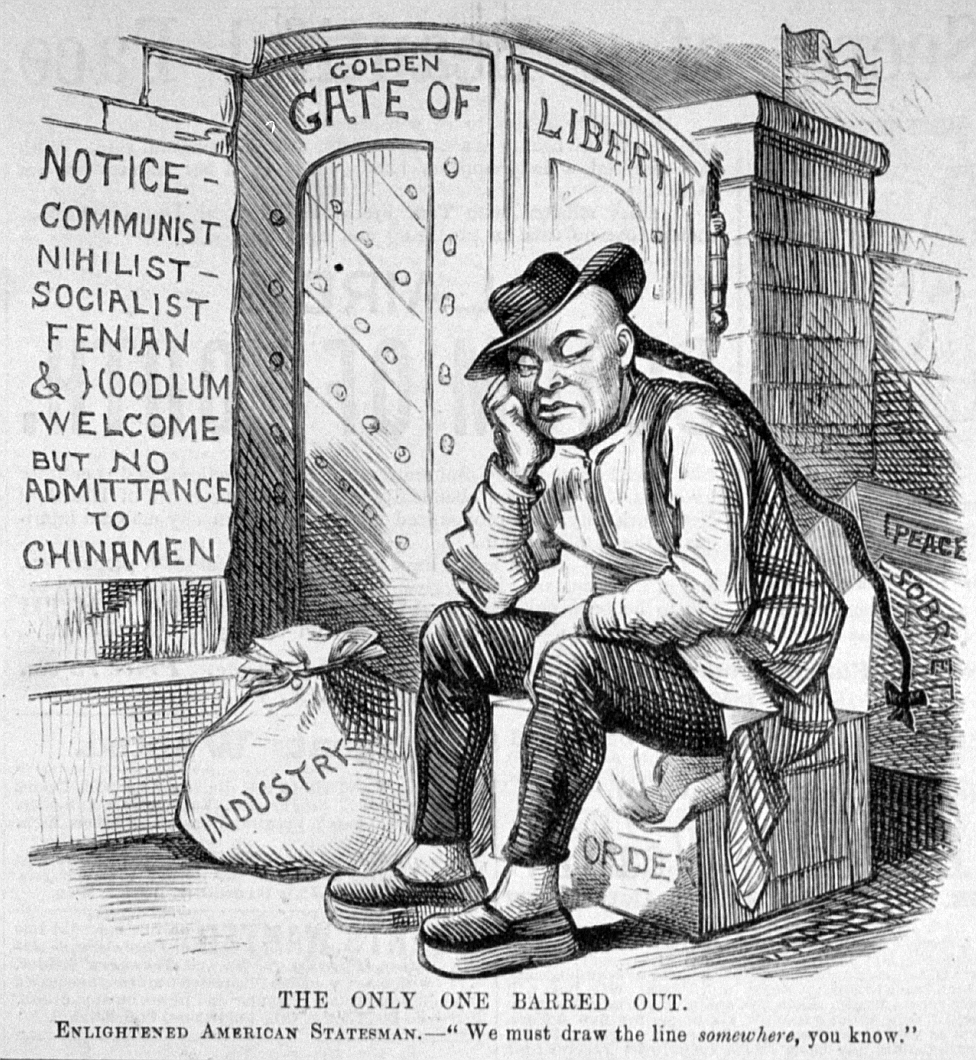
A political cartoon from 1882, showing a Chinese man being barred entry to the “Golden Gate of Liberty”. The caption reads, “We must draw the line somewhere, you know.”

History of U.S. Immigration Policies

Outlined below are thumbnail sketches of immigration-related legislation adopted between 1790 and 1990. More detailed information on the most recent legislative changes, beginning in 1952, are also available separately.

1790

In an area previously controlled by individual states, an act was adopted that established a uniform rule for naturalization by setting the residence requirement at two years.

1819

Congress enacted the first significant federal legislation relating specifically to immigration. Among its provisions, it: (1) established the continuing reporting of immigration to the United States; and (2) set specific sustenance rules for passengers of ships leaving U.S. ports for Europe.

1864

Congress first centralized control over immigration under the Secretary of State with a Commissioner. The importation of contract laborers was legalized in this legislation.

1875

Direct federal regulation of immigration was established by a law that prohibited entry of prostitutes and convicts.

1882

The Chinese exclusion law curbed Chinese immigration. Also excluded were persons convicted of political offenses, lunatics, idiots, and persons likely to become public charges. The law placed a head tax on each immigrant.

1885

Admission of contract laborers was banned.

1888

Provisions were adopted–the first since 1798–to provide for expulsion of aliens.

1891

The Bureau of Immigration was established under the Treasury Department to federally administer all immigration laws (except the Chinese Exclusion Act).

1903

Immigration law was consolidated. Polygamists and political radicals were added to the exclusion list.

1906

Procedural safeguards for naturalization were enacted. Knowledge of English was made a basic requirement.

1907

A bill increased the head tax on immigrants, and added people with physical or mental defects or tuberculosis and children unaccompanied by parents to the exclusion list. Japanese immigration became restricted.

1917

Added to the exclusion list were illiterates, persons of psychopathic inferiority, men as well as women entering for immoral purposes, alcoholics, stowaways, and vagrants.

1921

The first quantitative immigration law was adopted. It set temporary annual quotas according to nationality. A book review of Not Like Us: Immigrants and Minorities in America, 1890-1924, which discusses this period is available here.

1924

The first permanent immigration quota law established a preference quota system, nonquota status, and consular control system. It also established the Border Patrol.

1929

The annual quotas of the 1924 Act were made permanent.

1943

Legislation provided for the importation of agricultural workers from North, South, and Central America–the basis of the “Bracero Program.” At the same time the Chinese exclusion laws were repealed.

1946

Procedures were adopted to facilitate immigration of foreign-born wives, fiance(e)s, husbands, and children of U.S. armed forces personnel.

1948

The first U.S. policy was adopted for admitting persons fleeing persecution. It permitted 205,000 refugees to enter the United States over two years (later increased to 415,000).

1950

The grounds for exclusion and deportation of subversives were expanded. All aliens were required to report their address annually.

1952

The multiple laws which governed immigration and naturalization to that time were brought into one comprehensive statute. It (1) reaffirmed the national origins quota system, (2) limited immigration from the Eastern Hemisphere while leaving the Western Hemisphere unrestricted, (3) established preferences for skilled workers and relatives of U.S. citizens and permanent resident aliens; and (4) tightened security and screening standards and procedures.

1953

The 1948 law was increased to admit over 200,000 refugees above the existing limit.

1965

The national origins quota system was abolished. But still maintained was the principle of numerical restriction by establishing 170,000 Hemispheric and 20,000 per country ceilings and a seven-category preference system (favoring close relatives of U.S. citizens and permanent resident aliens, those with needed occupational skills, and refugees) for the Eastern Hemisphere and a separate 120,000 ceiling for the Western Hemisphere.

1976

The 20,000 per-country immigration ceilings and the preference system became applied to Western-Hemisphere countries. The separate Hemispheric ceilings were maintained.

1978

The separate ceilings for Eastern and Western Hemispheric immigration were combined into one world-wide limit of 290,000.

1980

The Refugee Act removed refugees as a preference category and established clear criteria and procedures for their admission. It also reduced the world-wide ceiling for immigrants from 290,000 to 270,000.

1986

The Immigration Reform and Control Act (IRCA) was a comprehensive reform effort. It (1) legalized aliens who had resided in the United States in an unlawful status since January 1, 1982, (2) established sanctions prohibiting employers from hiring, recruiting, ar referring for a fee aliens known to be unauthorized to work in the United States, (3) created a new classification of temporary agricultural worker and provided for the legalization of certain such workers; and (4) established a visa waiver pilot program allowing the admission of certain nonimmigrants without visas.
Separate legislation stipulated that the status of immigrants whose status was based on a marriage be conditional for two years, and that they must apply for permanent status within 90 days after their second year anniversary.

1989

A bill adjusted from temporary to permanent status certain nonimmigrants who were employed in the United States as registered nurses for at least three years and met established certification standards.

1990

Comprehensive immigration legislation provided for (1) increased total immigration under an overall flexible cap of 675,000 immigrants beginning in fiscal year 1995, preceded by a 700,000 level during fiscal years 1992 through 1994, (2) created separate admission categories for family-sponsored, employment-based, and diversity immigrants, (3) revised all grounds for exclusion and deportation, significantly rewriting the political and ideological grounds and repealing some grounds for exclusion, (4) authorized the Attorney General to grant temporary protected status to undocumented alien nationals of designated countries subject to armed conflict or natural disasters, and designated such status for Salvadorans, (5) revised and established new non-immigrant admission categories, (6) revised and extended through fiscal year 1994 the Visa Waiver Program, (7) revised naturalization authority and requirements, and (8) revised enforcement activities.

Source…