Picture Of The Day
Amusing
Comments Off on Picture Of The Day
Sep 212010
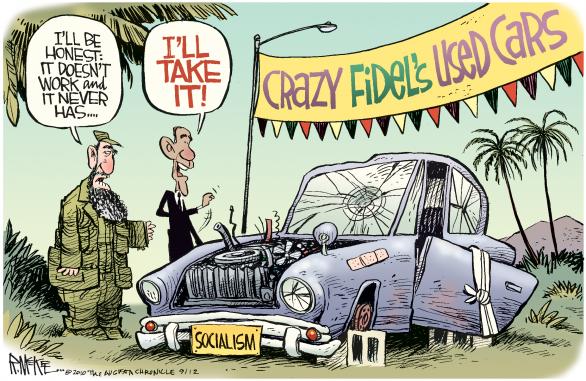
Quick somebody tell the Kenyan. Hello… paging Comrade Obama!
Cuba announced on Monday it would lay off “at least” half a million state workers over the next six months and simultaneously allow more jobs to be created in the private sector as the socialist economy struggles to get back on its feet.
The plan announced in state media confirms that President Raul Castro is following through on his pledge to shed some one million state jobs, a full fifth of the official workforce — but in a shorter timeframe than initially anticipated.
“Our state cannot and should not continue maintaining companies, productive entities and services with inflated payrolls and losses that damage our economy and result counterproductive, create bad habits and distort workers’ conduct,” the CTC, Cuba’s official labor union, said in newspapers.
Castro had announced layoffs in August, but said they would occur over the next five years.
At the time, he said the government “agreed to broaden the exercise of self employment and its use as another alternative for the employment of those excess workers.”
The drastic and unprecedented economic changes have many Cubans worried that jobs they had long taken for granted under the Communist government will no longer be guaranteed.
Others are hopeful that they will have more freedom to set prices and earn more than the average state wage of $20 a month.
The state currently controls more than 90 percent of the economy, running everything from ice cream parlors and gas stations to factories and scientific laboratories. Traditionally independent professions, such as carpenters, plumbers and shoe repairmen, are also employed by the state.
State media on Monday did not give details about where private enterprise would be allowed to grow or which sectors would suffer layoffs, but did talk about which areas are still strategic.
“Within the state sector, it will only be possible to fill the jobs that are indispensable in areas where historically the labor force is insufficient, like agriculture, construction, teachers, police, industrial workers and others.”
The announcement avoided the word “private,” but said alternative forms of employment to be allowed included renting or borrowing state-owned facilities, cooperatives and self employment and that “hundreds of thousands of workers” would find jobs outside of the state sector over the next few years.
Castro has launched a few, small free-market reforms since taking over from his brother Fidel Castro in 2006.
In April, for example, barbershops were handed over to employees, who pay rent and tax but charge what they want. Licenses have also been granted to private taxis.
For a couple of years, fallow land in the countryside has been turned over to private farmers. The more they produce, the more they earn.
Dinesh D’Souza’s insight into the mind of Barack Hussein Obama may be the key to the danger this president poses to our national security.
Barack Obama is the most antibusiness president in a generation, perhaps in American history. Thanks to him the era of big government is back. Obama runs up taxpayer debt not in the billions but in the trillions. He has expanded the federal government’s control over home mortgages, investment banking, health care, autos and energy. The Weekly Standard summarizes Obama’s approach as omnipotence at home, impotence abroad.
The President’s actions are so bizarre that they mystify his critics and supporters alike. Consider this headline from the Aug. 18, 2009 issue of the Wall Street Journal: “Obama Underwrites Offshore Drilling.” Did you read that correctly? You did. The Administration supports offshore drilling–but drilling off the shores of Brazil. With Obama’s backing, the U.S. Export-Import Bank offered $2 billion in loans and guarantees to Brazil’s state-owned oil company Petrobras to finance exploration in the Santos Basin near Rio de Janeiro–not so the oil ends up in the U.S. He is funding Brazilian exploration so that the oil can stay in Brazil.
More strange behavior: Obama’s June 15, 2010 speech in response to the Gulf oil spill focused not on cleanup strategies but rather on the fact that Americans “consume more than 20% of the world’s oil but have less than 2% of the world’s resources.” Obama railed on about “America’s century-long addiction to fossil fuels.” What does any of this have to do with the oil spill? Would the calamity have been less of a problem if America consumed a mere 10% of the world’s resources?
The oddities go on and on. Obama’s Administration has declared that even banks that want to repay their bailout money may be refused permission to do so. Only after the Obama team cleared a bank through the Fed’s “stress test” was it eligible to give taxpayers their money back. Even then, declared Treasury Secretary Tim Geithner, the Administration might force banks to keep the money.
The President continues to push for stimulus even though hundreds of billions of dollars in such funds seem to have done little. The unemployment rate when Obama took office in January 2009 was 7.7%; now it is 9.5%. Yet he wants to spend even more and is determined to foist the entire bill on Americans making $250,000 a year or more. The rich, Obama insists, aren’t paying their “fair share.” This by itself seems odd given that the top 1% of Americans pay 40% of all federal income taxes; the next 9% of income earners pay another 30%. So the top 10% pays 70% of the taxes; the bottom 40% pays close to nothing. This does indeed seem unfair–to the rich.
Obama’s foreign policy is no less strange. He supports a $100 million mosque scheduled to be built near the site where terrorists in the name of Islam brought down the World Trade Center. Obama’s rationale, that “our commitment to religious freedom must be unshakable,” seems utterly irrelevant to the issue of why the proposed Cordoba House should be constructed at Ground Zero.
Recently the London Times reported that the Obama Administration supported the conditional release of Abdel Baset al-Megrahi, the Lockerbie bomber convicted in connection with the deaths of 270 people, mostly Americans. This was an eye-opener because when Scotland released Megrahi from prison and sent him home to Libya in August 2009, the Obama Administration publicly and appropriately complained. The Times, however, obtained a letter the Obama Administration sent to Scotland a week before the event in which it said that releasing Megrahi on “compassionate grounds” was acceptable as long as he was kept in Scotland and would be “far preferable” to sending him back to Libya. Scottish officials interpreted this to mean that U.S. objections to Megrahi’s release were “half-hearted.” They released him to his home country, where he lives today as a free man.
One more anomaly: A few months ago nasa Chief Charles Bolden announced that from now on the primary mission of America’s space agency would be to improve relations with the Muslim world. Come again? Bolden said he got the word directly from the President. “He wanted me to find a way to reach out to the Muslim world and engage much more with dominantly Muslim nations to help them feel good about their historic contribution to science and math and engineering.” Bolden added that the International Space Station was a model for nasa’s future, since it was not just a U.S. operation but included the Russians and the Chinese. Obama’s redirection of the agency caused consternation among former astronauts like Neil Armstrong and John Glenn, and even among the President’s supporters: Most people think of nasa’s job as one of landing on the moon and Mars and exploring other faraway destinations. Sure, we are for Islamic self-esteem, but what on earth was Obama up to here?
Theories abound to explain the President’s goals and actions. Critics in the business community–including some Obama voters who now have buyer’s remorse–tend to focus on two main themes. The first is that Obama is clueless about business. The second is that Obama is a socialist–not an out-and-out Marxist, but something of a European-style socialist, with a penchant for leveling and government redistribution.