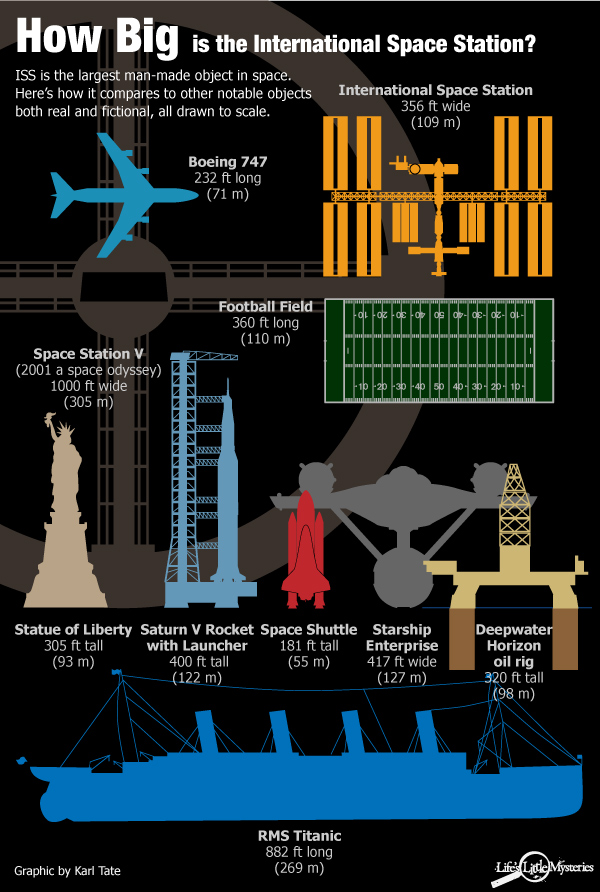
The largest spacecraft ever built, the ISS is also the world’s most expensive single object, costing upwards of 100 billion dollars, according to the Government Accountability Office.
The dimensions of the completed ISS research facility will be approximately 356 feet (109 meters) by 240 feet (73 meters), or slightly larger than a football field. When completed, the ISS will weigh around 450 tons (408,000 kg), or 450 times the weight of an average car.
Amusing, InformationComments Off on Does the Food Taste the Same in Space?
May072013
In this Let’s Talk Science event with students from Airdrie, Alberta, Chris Hadfield describes how a person’s sense of taste changes in weightlessness. He then shares a collection of Canadian food brought to the Station on board SpaceX’s Dragon. Maple syrup in a tube, anyone?
InformationComments Off on Earthereal: International Space Station
Mar082013
Turn the sound up, the lights down, expand to full screen and Enjoy!
ARVE error: need id and provider
The International Space Station Expedition 30 crew shot some truly awe-inspiring time-lapse sequences flying over practically every square mile of the globe.
Time lapse sequences of photographs taken with a special low-light 4K-camera by the crew of expedition 28 & 29 onboard the International Space Station from August to October, 2011. All credit goes to them.
Shooting locations in order of appearance:
1. Aurora Borealis Pass over the United States at Night 2. Aurora Borealis and eastern United States at Night 3. Aurora Australis from Madagascar to southwest of Australia 4. Aurora Australis south of Australia 5. Northwest coast of United States to Central South America at Night 6. Aurora Australis from the Southern to the Northern Pacific Ocean 7. Halfway around the World 8. Night Pass over Central Africa and the Middle East 9. Evening Pass over the Sahara Desert and the Middle East 10. Pass over Canada and Central United States at Night 11. Pass over Southern California to Hudson Bay 12. Islands in the Philippine Sea at Night 13. Pass over Eastern Asia to Philippine Sea and Guam 14. Views of the Mideast at Night 15. Night Pass over Mediterranean Sea 16. Aurora Borealis and the United States at Night 17. Aurora Australis over Indian Ocean 18. Eastern Europe to Southeastern Asia at Night