Wikileaks reveals that the DNC and Hillary had a Pied Piper Strategy (use media contacts to promote Trump) for the 2016 election.
Man did it backfire spectacularly!
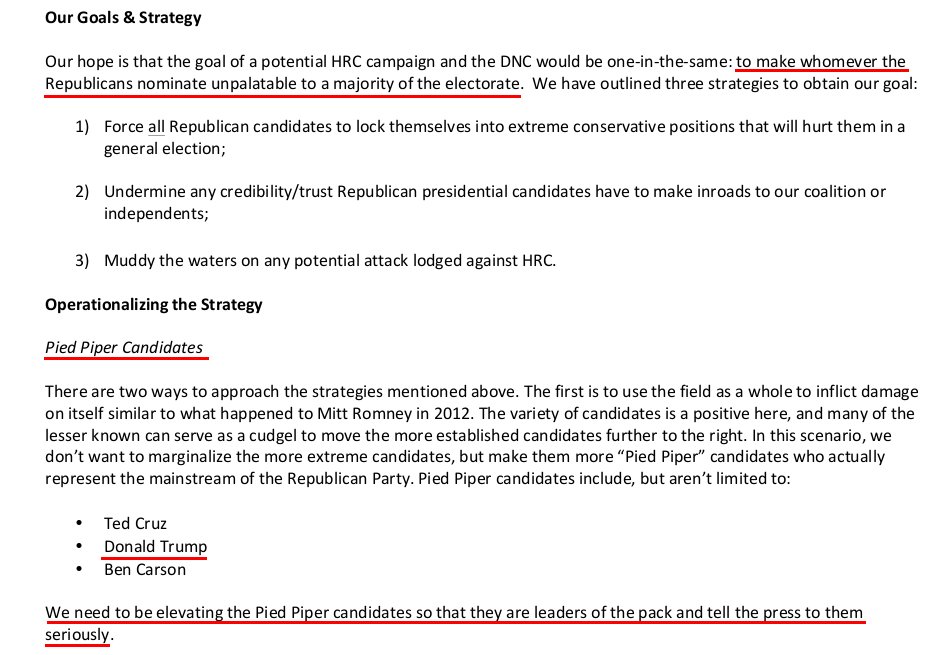
Wikileaks reveals that the DNC and Hillary had a Pied Piper Strategy (use media contacts to promote Trump) for the 2016 election.
Man did it backfire spectacularly!

If Hillary’s loss has you feeling disillusioned with American democracy, you may find yourself imagining a move to Canada.
After all, it’s a land where healthcare is free, people are friendly, and Prime Minister Justin Trudeau explains quantum computing just for laughs.
But actually becoming a citizen is tough: You need to live in Canada for at least six years, stay on your best behavior, and know a thing or two about the country you’ll soon call home.
For those who actually want to head up north, here’s how you move to Canada:
Preface: Make sure you’re not already a Canadian citizen.
Before you go through the hassle of applying for citizenship, take a short quiz to see if you may already be Canadian.The government outlines several caveats for being a citizen even if you weren’t born there, many of which depend on your parents’ citizenship. Maybe you secretly inherited their status at some point along the way.
Be at least 18 years old.
If you’re not a legal adult, you’ve got an uphill climb ahead of you.Minors need their parent or legal guardian to fill out the application for them; they need to be permanent residents in Canada (more on that later); and the parent must either be a citizen or applying to become one at the same time.
Or enter the pool for skilled immigrants.
Canada has a fast-track system for immigration called Express Entry. It’s how skilled workers transition into a role in the country.All applicants into Express Entry are given specific scores based on their specific talents and job prospects and then ranked with other applicants. Those at the top of the rankings are invited to become permanent residents.
Have a permanent residence in Canada.
To become a permanent resident, people can choose between several avenues. They can apply through the province of their choice, go down a special entrepreneur route, get help from a family member who lives in Canada, or go through Quebec, which has special immigration requirements.Permanent residents are entitled to healthcare coverage and can work, study, and travel anywhere in Canada. You just can’t vote, run for office, or hold some jobs with high security clearance.
Declare your intent to reside.
If you’re invited to become a permanent resident, you must confirm your plans to stay Canadian. The government defines permanent residence as living in Canada for at least two years in a five-year period. If you don’t spend that much time within the borders, you could lose your permanent residence status.If you don’t live in Canada, you must work outside Canada as a public official known as a Crown Servant or live abroad with certain family members who are Crown Servants.
Spend six years at that residence.
Permanent residents don’t always become citizens. The bar for citizenship is higher.If you’re living in Canada, you must have been a permanent resident and physically present in Canada for at least 1,460 days (four 365-day periods) in the six years immediately before the date of your application.
You must also be present for 183 days (half a year) during each of the four calendar years that are fully or partially within the six years before the application date.
In other words, your time in Canada needs to stay relatively consistent.
Provide your income tax filing.
Like the residence requirement, you must be able to provide four years’ worth of tax returns in the six-year period leading up to the date of your application.Basically, they want to see if your job is legit.
Speak English or French.
Along with dozens of other countries, Canada has two official languages: English and French.To become a citizen, you need to know just one. You don’t need to be fluent, just conversational enough to make small talk, give directions, use basic grammar, and know your vocab well enough to describe yourself.
You’ll send along written documents with your application, but a citizenship officer will make the final call whether your English or French is up to snuff.
Know a thing or two about Canada.
You should probably brush up on your Canadian history anyway, but the government also issues a formal quiz to applicants on the history, values, institutions, and symbols of Canada.You take the test if you’re between 16 and 64 years old. Typically, it’s a written test, but the citizenship officer may also ask questions orally.
There are no real surprises. Everything you’d need to know can be found here: Discover Canada: The Rights and Responsibilities of Citizenship.
Know why your application might get denied.
There are a number of reasons your past may prohibit you from becoming a Canadian citizen.For instance, the government looks down upon granting citizenship to people who have committed a crime within four years of submitting their application or are on trial for a crime.
It also specifies that people in prison can’t use their sentence toward becoming a permanent residence. (That doesn’t quite fit with the “intent to reside.”)
Invest in durable clothes for your local climate.
Canada is the second-largest country on earth, behind Russia. As such, there is no singular “Canadian climate,” even if people may think it’s just cold most of the time.Depending on how close you live to the British Columbia coast, for example, spring can begin as early as February and summer temperatures can rise into the 90s.
So if you’re looking for places to take up permanent residence, research what the weather’s like. You won’t waste money or space buying unnecessary items.
Take advantage of the customs of your new life.
Now that you’ve left your home country behind (and if you’re an American, abandoned the circus of presidential elections), embrace what makes Canada unique.Many Canadians express deep fondness for Tim Hortons, quirky slang, celebrity ambassadors, and hockey.
No one will expect you to dive headfirst into this new world, but if you want to become a genuine citizen, formal requirements are only the start.
An emotional moment in Hershey, PA.
Donald Trump stopped in the middle of his rally to let a grieving mother speak. She then tells the crowd how to ‘Honor’ her son.
The parents of Hugh “Riley” Rone took the stage at Trump event to speak about their deceased son’s support of the Republican nominee for president. Rone was killed in a motorcycle accident on the Garden State Parkway on May 31, 2016. The Rones are natives of South Amboy, NJ.
“These are incredible people,” Trump said as he called for the parents to join him on the stage. “Their son recently passed away in a horrible accident. He was the biggest supporter I had. Young guy. Beautiful guy. The most popular person there was. And he was just very special.”
“As much as some of you like Trump, I like you more than you like me if you want to know the truth. This boy was our biggest fan. He loved our country, believe me. He loved our country,” Trump told the rally-goers.
“Say a few words about our boy, okay,” Trump said as he embraced the mother of Riley Rone.
Barbara Zawistowski Rone, Riley’s mother, was invited on stage by Trump at a rally in Hershey, Penn. Friday night and gave an extremely moving and impassioned endorsement of the candidate in her son’s honor. Rone also spoke about how her son campaigned for Trump and of his attempts to convert friends to support the candidate.
“When there were 17, he said Mr. Trump is the nominee. When there was one nominee, Mr. Trump, Riley said Mr. Trump would be president,” Riley’s mother said.
“In Riley’s obituary, Mr. Trump was mentioned because Riley loved or loves Mr. Trump. His funeral was over 200 cars, he had very dedicated friends, there were signs, flags for Mr. Trump. Riley’s grave marker has Mr. Trump name on it and the Statue of Liberty because he loves America,” Mrs. Rone shared.
Rone’s mother noted a motorcycle group has pledged to donate a brick to the The Wall, if it gets built, in honor of her son. She also spoke about an emotional phone call she had with Trump where he said he would trade millions he owned if she could have her son back.
His friend wrote Trump a letter to get his attention, and it worked.
Riley Rone was a great young man. We will miss him dearly. pic.twitter.com/R0tm44nMao
— Donald J. Trump (@realDonaldTrump) June 11, 2016
Barbara Zawistowski Rone:
When Mr. Trump received the letter, he wrote us a very personal letter regarding family and Riley. We never expected to hear from Mr. Trump, we don’t know Mr. Trump, he does not know us. He does now.
Within weeks of the letter, we received a phone call from his office asking would we take a phone call from Mr. Trump. We were watching FOX News and Mr. Trump was in Florida. He was sweating profusely in an airport hangar complaining of 114 degree weather. We watched him leave the stage, and within minutes our phone rang. It was Mr. Trump. He is amazing. He spent a good amount of time on the phone and it was very personal, I will not share what said, but I will share that Mr. Trump said that if it costs millions, he would give everything he owned if it would bring my Riley back.
What kind of man is this? What kind of man who is running for the highest office in our land, the president of the United States– he takes out the time from his campaign to call us…
Now, all you mothers out there, I want you to put yourself in our shoes for one minute. You fathers, too. I want you to please, please vote for Mr. Donald Trump in my son’s honor.