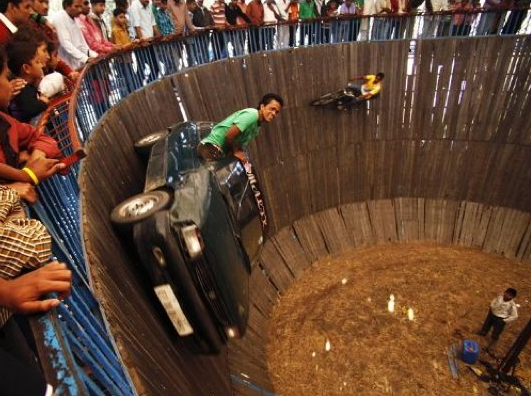
As seen above: Yikes.
What you see there is called the Muat Ka Kuan in Hindi, or, in English, the Well of Death (or sometimes, the Wall of Death). And yes, that’s a car in it. And yes, the car is driving on a vertical wall, perpendicular to the ground, defying gravity.
The way it works is simple, albeit too close to insane for most to try. Cars or motorcycles start at the well’s bottom, traveling counterclockwise while picking up speed. At the base of the well’s walls are inclines, and the drivers carefully (carefully!) make their ways up the ramps. As they accelerate, it becomes safe (relatively speaking) to enter the nearly vertical walls, as centripetal forces keeps their vehicles adhered to the sides and out of gravity’s — and harm’s — way.
In other words: Yikes.
The stunt has its origins in the United States. In the early 1900s, motorcyclists at Brooklyn’s Coney Island took to the boardwalk, climbing the walls of much less steep motordomes. The fad waned in the United States but not before it spread to Europe. If you are in the UK, you can still experience motorcycles (with their drivers decked out in helmets and safety pads) climbing near-vertical walls at traveling carnivals. But performers in India have taken the stunt to another extreme: cars scaling nearly 100 foot high walls as their drivers take to action without any safety precautions.
As for why local authorities allow the stunt? There actually have not been many efforts to regulate the Well, as exhibitors rarely suffer serious injuries.
More images (including a larger version of the one above) are available at All That’s Interesting.
Bonus fact: The Well of Death does not actually involve death, at least when done correctly. The same cannot be said for the Euthanasia Coaster, a project designed (but thankfully not built) by a PhD candidate at the Royal College of Art in London. The Coaster, seen here, has a huge lift followed by seven inversions of decreasing size. Taken together, it is designed to kill its passengers, as its name suggests. In theory, it would do so by denying oxygen to the passengers’ brains for a prolonged time, leading the passengers to black out and, ultimately, die while unconscious.
