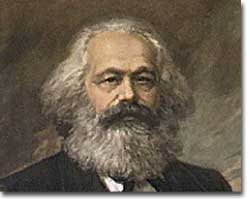
Karl Marx, German philosopher, economist, and revolutionary, laid the ideological groundwork for modern socialism and communism.
Karl Marx and Friedrich Engels turned the world upside down.
Until the publication of their 1848 Communist Manifesto, much of the western world followed a course where individuals owned private property, business enterprises, and the profits that resulted from wise investments. Marx and Engels pointed out the uneven distribution of wealth in the capitalist world and predicted a worldwide popular uprising to distribute wealth evenly. Ever since, nations have wrestled with which direction to turn their economies.
Capitalism
- Capitalism is based on private ownership of the means of production and on individual economic freedom. Most of the means of production, such as factories and businesses, are owned by private individuals and not by the government. Private owners make decisions about what and when to produce and how much products should cost. Other characteristics of capitalism include the following:
- Free competition. The basic rule of capitalism is that people should compete freely without interference from government or any other outside force. Capitalism assumes that the most deserving person will usually win. In theory, prices will be kept as low as possible because consumers will seek the best product for the least amount of money.
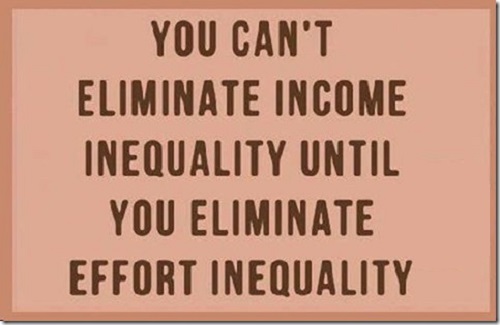
Image from Capitalism Magazine (http://www.CapitalismMagazine.com). Used with permission.
The antitrust lawsuit against Microsoft is one way that the government has tried to promote competition. Supporters of Microsoft say that forcing Microsoft to allow companies to bundle arch-rival Netscape’s web browser with Microsoft Windows is not unlike making Coca-Cola include a can of Pepsi in each six-pack it sells.
- Supply and demand. In a capitalist system prices are determined by how many products there are and how many people want them. When supplies increase, prices tend to drop. If prices drop, demand usually increases until supplies run out. Then prices will rise once more, but only as long as demand is high. These laws of supply and demand work in a cycle to control prices and keep them from getting too high or too low.
Communism
Karl Marx, the 19th century father of communism, was outraged by the growing gap between rich and poor. He saw capitalism as an outmoded economic system that exploited workers, which would eventually rise against the rich because the poor were so unfairly treated. Marx thought that the economic system of communism would replace capitalism. Communism is based on principles meant to correct the problems caused by capitalism.
The most important principle of communism is that no private ownership of property should be allowed. Marx believed that private ownership encouraged greed and motivated people to knock out the competition, no matter what the consequences. Property should be shared, and the people should ultimately control the economy. The government should exercise the control in the name of the people, at least in the transition between capitalism and communism. The goals are to eliminate the gap between the rich and poor and bring about economic equality.
Socialism
Socialism, like communism, calls for putting the major means of production in the hands of the people, either directly or through the government. Socialism also believes that wealth and income should be shared more equally among people. Socialists differ from communists in that they do not believe that the workers will overthrow capitalists suddenly and violently. Nor do they believe that all private property should be eliminated. Their main goal is to narrow, not totally eliminate, the gap between the rich and the poor. The government, they say, has a responsibility to redistribute wealth to make society more fair and just.
There is no purely capitalist or communist economy in the world today. The capitalist United States has a Social Security system and a government-owned postal service. Communist China now allows its citizens to keep some of the profits they earn. These categories are models designed to shed greater light on differing economic systems.
Source…
via