Take this along next time your in an older cemetery and decipher why people chose different symbols!
|
Gravestone Symbols
Information
Comments Off on Gravestone Symbols
Sep 292017
Take this along next time your in an older cemetery and decipher why people chose different symbols!
|
You’ve been munching on insect legs and heads for a long, long time.
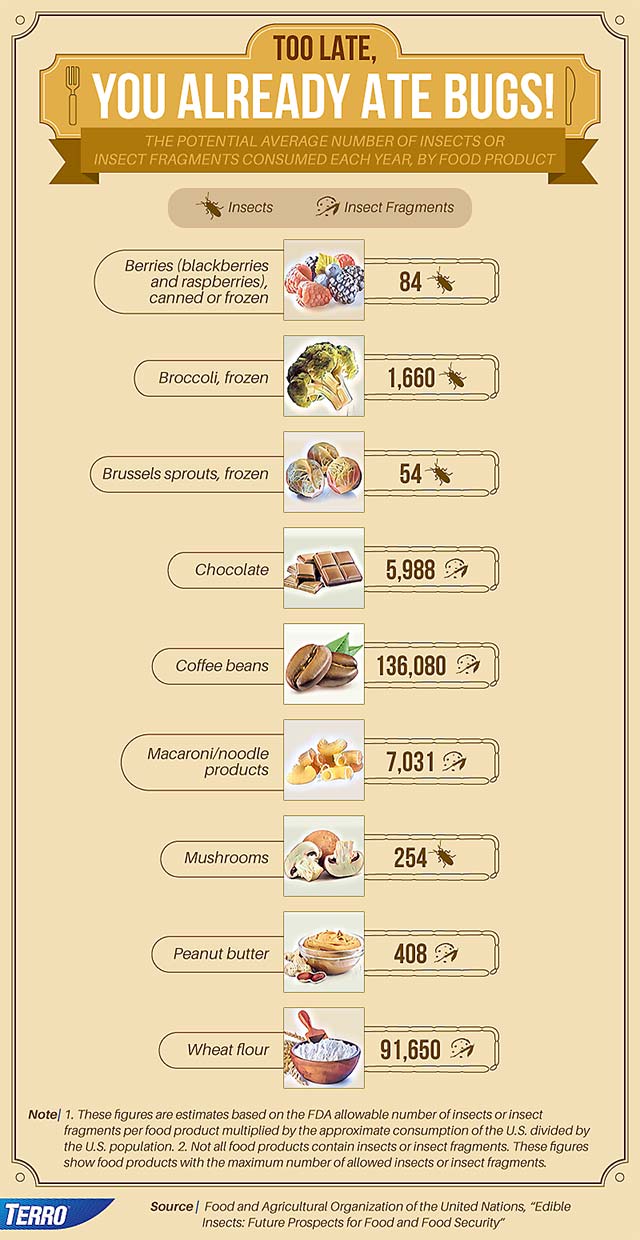
Are you brave enough to try roasted grasshoppers? It probably wouldn’t be your first meal that contains insects. Odds are, you’ve been eating bugs this whole time—and you just never knew it. Yep, you read that correctly. According to a new study by Terro, an ant and insect control company, bugs could be in your breakfast… or lunch… or dinner. After analyzing data from the FDA and FAO, Terro found that insect fragments are found in many of the foods that you’d buy at the grocery store (and it’s even legal!) The highlights? By Food and Drug Administration (FDA) standards, frozen broccoli can have 60 insects per 100 grams (about 1/2 cup), Terro reports. Technically, the average coffee drinker could consume almost 140,000 insect fragments per year. And beetles are the most popular insects eaten globally; they make up 31 percent of bug consumption. Sounds scary. But wait! Before you toss everything in your pantry, you’ll want to read the fine print. While the idea of an insect head squished inside your chocolate bar might be pretty gross, it’s totally harmless. The Food and Drug Administration (FDA) “allows for a small amount of insect material that is guaranteed safe for human consumption to pass into our food,” Terro writes. “Otherwise, resource costs would be too unmanageable to eliminate all defects from food production.” Not to mention it’s nearly impossible to remove every single bug from food grown on farms. Thankfully, there’s a lot of nutritional value in insects, too. Mealworms provide more protein than chicken or salmon, and crickets have almost as much iron as red beef, according to Terro’s research. So chow down—if you can stomach it! Read Terro’s charts above for even more fascinating facts about your insect consumption. And by the way, not to gross you out, but there might be fecal matter in your coffee. |
Your late-night eating could be giving you more than bad dreams: It may be wrecking your health.
The verdict is finally in on late-night snacking: After decades of scientific back and forth, new findings from researchers at the Perelman School of Medicine at the University of Pennsylvania suggests that restricting your eating to earlier in the day could be one of the most important healthy dieting tips you follow. The ongoing study, reported in a Penn University news release, found that compared to shutting down the kitchen in the early evening, raiding the fridge after hours negatively impacts your weight, fat metabolism, and markers for heart disease and diabetes. For two months, researchers asked nine healthy adults to eat three meals and two snacks daily between 8 a.m. and 7 p.m. The volunteers took a couple of weeks off from the study, then returned to follow a delayed-eating pattern that limited their meals and snacks between the hours of noon and 11 p.m. Analyzing changes in the participants’ weight, metabolism and calorie burn, the researchers found that when the group ate later in the day, their weight, insulin, fasting glucose, cholesterol, and triglyceride levels worsened. Also troubling was the volunteers hormonal shifts: The later eating shift led to delayed spikes in the appetite-stimulating hormone ghrelin, slowing the release of leptin, the hormone that signals fullness; the opposite was true for the daytime eating plan. The implication is that eating earlier in the day actually helps prevent eating late at night—a habit that appears to be really bad for you! “We know from our sleep-loss studies that when you’re sleep deprived, it negatively affects weight and metabolism in part due to late-night eating, but now these early findings, which control for sleep, give a more comprehensive picture of the benefits of eating earlier in the day,” says the study’s lead author Namni Goel, PhD. “Eating later can promote a negative profile of weight, energy, and hormone markers—such as higher glucose and insulin, which are implicated in diabetes, and cholesterol and triglycerides, which are linked with cardiovascular problems and other health conditions.” (And when it comes to what you eat, make sure you ditch these foods to keep your heart healthy.) |