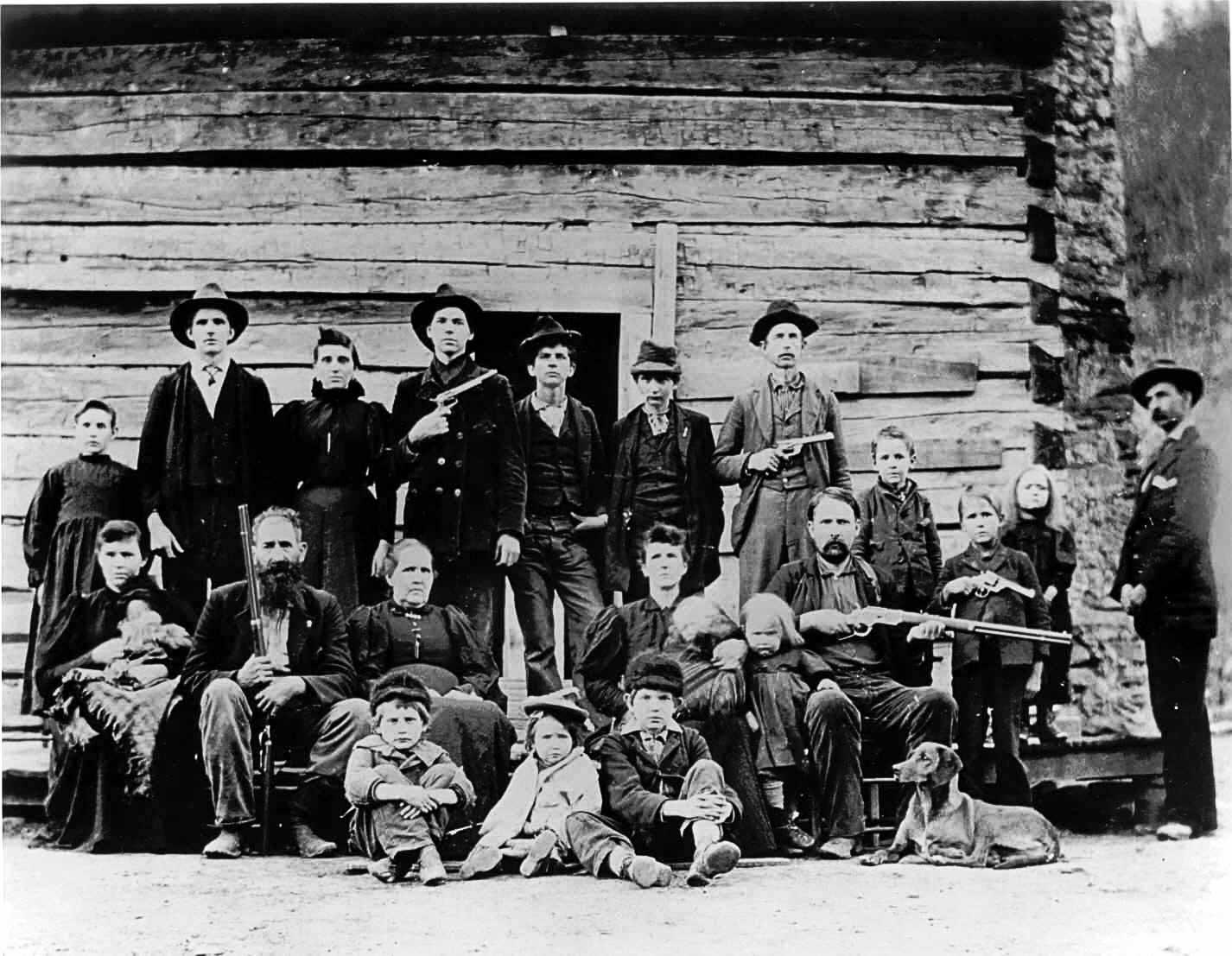
American History: Armed Hatfield Family

 Information  Comments Off on American History: Armed Hatfield Family
Dec 122015
 

HatfieldClan

Taken at Hatfield Family Farm, Tug Fork, Virginia USA in 1897.

The Hatfield McCoy feud lasted from 1863 until 1891 in West Virginia and Kentucky between two of the most infamous U.S. families; the Hatfields & the McCoys.

The Hatfield family was led by William Anderson Hatfield, nicknamed the “Devil Anse”, and Randolph McCoy, aka “Ole Ran’l”, led the McCoy family which emigrated from Ireland. The decades long family feud between the ‘haves’ (the Hatfields) and the ‘have-nots’ (the McCoys) began when Asa Harmon McCoy was murdered by “Devil Anse” Hatfield on January 7th, 1865. “Devil Anse” was evidently extremely upset that Asa had fought for the Union during the U.S. Civil War as the Harfield family had predominately fought for the Confederacy.

Photo of the Hatfield family clan taken in 1897.

Top row, from left to right:
Rosa Lee Hatfield (daughter of Anderson), Detroit ‘Troy’ Hatfield (son of Anderson), Betty Hatfield (Caldwell) (daughter of Anderson), Elias Hatfield (son of Anderson), Tom Chafin (nephew of William Anderson), Joe D. Hatfield (son of William Anderson), Ock Damron, Shephard Hatfield (son of Cap), Levicy Emma Hatfield (daughter of Cap), and Bill Border (store clerk).

Second row, from left to right:
Mrs. Mary Hensley-Simpkins-Howes (daughter of Anderson) with daughter Vici Simpkins, William Anderson ‘Devil Anse’ Hatfield, Levicy Chafin Hatfield (wife of Anderson), Nancy Elizabeth Hatfield (wife of Cap) with son Robert Elliott Hatfield, Louise Hatfield (daughter of Cap), Cap Hatfield, and Coleman Hatfield (son of Cap)

Front row, from left to right:
Tennyson ‘Tennis’ Hatfield (son of Anderson), Levicy Hatfield (daughter of Johnse), Willis Hatfield (son of Anderson), and ‘Watch’ or ‘Yellow Watch’ (‘Devil Anse’s’ coon and bear dog)
Source…


Mental Health Risks Associated With Meatless Diet

 Information  Comments Off on Mental Health Risks Associated With Meatless Diet
Dec 072015
 

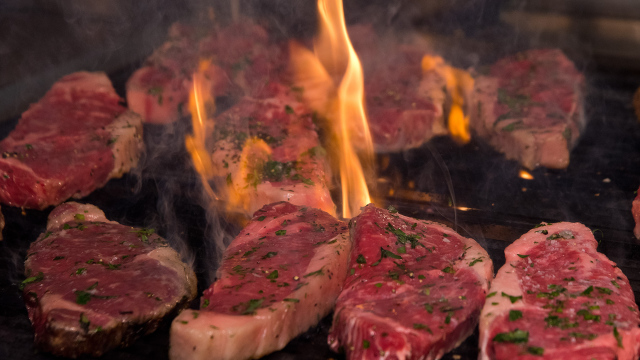
Mental Health Meatless Diet

SURGEON GENERAL’S WARNING: Lack of meat in your diet may lead to Liberalism, a kind of mental disorder that could lead you to act irrationally, lie, exaggerate, and blame inanimate objects.

Many Americans have turned to a vegetarian diet for many different reasons. Maybe you just think it will make you generally more healthy. Perhaps you want to trim a few pounds. Maybe you want to supplement your already healthy lifestyle.

However, will you be happier?

Some research suggests that the exact opposite is the truth and Women’s Health recently looked into some of the research and cautions people to be well aware of how going meatless can impact your mental health.

The article cites an Australian study from last year which found that vegetarians reported that they were less optimistic about their future more often than people who kept meat in their diets. That same study found that vegetarians were 18 percent more likely to report having depression and 28 percent more likely to experience panic attacks and anxiety.

The question that people considering a vegetarian diet have to consider is whether or not the gains outweigh the risks. Will the number drop on the scale be worth it in the long run if you feel more sluggish or anxious than usual?

While there might be some clear reasons to avoid meat, it has benefits as well that impact your mind and your mood.

B Vitamins, zinc, iron and tryptophan are all found in abundance in meat and are often time in low quantities, or missing altogether, in vegetarian diets.

Women’s Health suggests not quitting meat too suddenly. There is support for the notion that if you want to take on a meatless diet, you should do so in increments to allow for some meat eating while you gauge for yourself how your body is reacting to the new diet.

Source…


Hiroshima & Nagasaki: The Atom Strikes

 Information, Political  Comments Off on Hiroshima & Nagasaki: The Atom Strikes
Dec 062015
 

1946 HD Video Footage of Atomic Bomb Destruction: Hiroshima & Nagasaki.

HD remastered version of “The Atom Strikes” produced in 1945 about the bombings of Hiroshima and Nagasaki. The movie is made up of three 10 minute 35mm reels.

The atomic bombings of the cities of Hiroshima and Nagasaki in Japan were conducted by the United States during the final stages of World War II in August 1945. The two bombings were the first and remain the only use of nuclear weapons in warfare.

Following a firebombing campaign that destroyed many Japanese cities, the Allies prepared for a costly invasion of Japan. The war in Europe ended when Nazi Germany signed its instrument of surrender on May 8, 1945, but the Pacific War continued. Together with the United Kingdom and China, the United States called for the unconditional surrender of the Japanese armed forces in the Potsdam Declaration on July 26, 1945, threatening “prompt and utter destruction”.

By August 1945, the Allied Manhattan Project had successfully tested an atomic device and had produced weapons based on two alternate designs. The 509th Composite Group of the U.S. Army Air Forces was equipped with a Silverplate Boeing B-29 Superfortress that could deliver them from Tinian in the Mariana Islands. A uranium gun-type atomic bomb (Little Boy) was dropped on Hiroshima on August 6, 1945, followed by a plutonium implosion-type bomb (Fat Man) on the city of Nagasaki on August 9. Within the first two to four months of the bombings, the acute effects killed 90,000–166,000 people in Hiroshima and 60,000–80,000 in Nagasaki; roughly half of the deaths in each city occurred on the first day. During the following months, large numbers died from the effect of burns, radiation sickness, and other injuries, compounded by illness. In both cities, most of the dead were civilians, although Hiroshima had a sizeable garrison.

On August 15, just days after the bombing of Nagasaki and the Soviet Union’s declaration of war, Japan announced its surrender to the Allies. On September 2, it signed the instrument of surrender, ending World War II. The bombings’ role in Japan’s surrender and their ethical justification are still debated.

Hiroshima & Nagasaki: The Atom Strikes - The Atom Strikes Reel 1 Remastered
 

via

 
[AdSense-B]