Why Populism Isn’t Extremism — It’s Survival

 Conspiracy, Featured, Political  Comments Off on Why Populism Isn’t Extremism — It’s Survival
Oct 072025
 

Pushing back against smear labels
Why is the political class terrified of populism? It challenges their power structure. Explore the truth behind the name-calling.

You’ve seen it happen. Maybe it’s happened to you. A regular person, maybe a neighbor or a coworker, voices a simple concern. They worry that their job is being shipped overseas. They question why a border can’t be managed. They ask why the cost of a family dinner keeps rising while their paycheck stays the same.

Then, the label comes down. It’s not a discussion of their point. It’s a dismissal. They are called a “populist.” In the mouths of the talking heads on the nightly news, that word is never a compliment. It’s a synonym for extremist, for a rabble-rouser, for someone who is irrational and dangerous.

But have you ever stopped to ask why? Why is giving a voice to everyday concerns considered so threatening? I have. And after looking at the patterns, I believe the answer is simple. They call it extremism because they are terrified of what it really is: survival.

What They Mean When They Say “Populist”

Let’s decode the language. When a politician or a media personality uses the word “populist,” they are rarely describing a policy. They are slapping on a psychological label. They are trying to pathologize a very normal, very human reaction.

The official story is that populists are simplistic. They offer easy answers to complex problems. But think about that for a second. When your house is on fire, you don’t want a lecture on the complex chemistry of combustion. You want someone to point you to the water hose. The political class loves complexity because it gives them an excuse for inaction. It allows them to form committees, hire consultants, and do nothing while pretending to do everything.

Calling a movement “populist” is a way to avoid discussing the actual issues. It’s a magician’s trick. While you’re being lectured about your tone, your job, your community, and your children’s future are quietly changing without your consent. The label is the smoke screen.

The Survival Instinct They Want You to Ignore

Human beings have a brilliant, built-in early warning system. It’s called instinct. You feel it in your gut when something is wrong. For millions of people, that feeling has been going off like a fire alarm for years.

They feel it when they work forty hours a week but can no longer afford the life their parents had. They feel it when they look at their town’s main street and see shuttered stores. They feel it when they read a new law and can’t understand how it will help their family.

This isn’t extremism. This is the survival instinct of a community, of a people. It is the rational response of an organism that senses a threat. When a person stands up and says, “The trade deals are hurting us,” or “Our laws should be enforced,” they are not spreading hatred. They are diagnosing a problem. They are pointing to the source of the pain that everyone already feels. To call this extremism is to tell a person with a broken leg that their limp is an unacceptable form of walking.

The Real Elitism

There is a deep irony in all this. The very people who call populists “divisive” are the ones drawing the sharpest lines. They live in a handful of wealthy cities, attend the same universities, and speak in a language of insider jargon that is foreign to most of the country. They have one set of rules for themselves and their friends, and another set for everyone else.

Their vision for the world is one of managed decline for you and continued prosperity for them. They see national borders as a nuisance, but live in gated communities. They celebrate the global economy, but protect their own investments. When you challenge this arrangement, you are not challenging an idea. You are challenging a power structure. And that structure’s first line of defense is to give you a name. It is much easier than debating you on the merits.

They say you are being emotional. But what is more emotional than telling people their concerns are illegitimate? What is more emotional than fear-masking itself as superiority?

The Weaponization of “Extremism”

Let’s talk about the ultimate weapon in their arsenal: the E-word, “extremism.” This word has a specific, powerful purpose. It is designed to push dissent out of the circle of acceptable conversation. It is a political quarantine.

If you question the wisdom of endless foreign wars, you are an extremist. If you suggest that a country should control who enters it, you are an extremist. If you worry that your constitutional rights are being slowly eroded, you are an extremist. Notice a pattern? The goal is to make the foundational beliefs that built your nation sound radical and dangerous.

This isn’t an accident. It’s a strategy. By defining the boundaries of acceptable thought so narrowly, they can ignore the massive, growing discontent in the heart of the country. They can pretend that the rumbling they feel is just a minor tremor, and not the earthquake of millions of people who have simply had enough.

Taking Back the Conversation

So, what is the way forward? The first and most important step is to refuse the label. When someone calls you a populist or an extremist for caring about your community, do not get defensive. Instead, be curious. Ask a question.

Ask them: “Why is it extreme to want a good job and a safe neighborhood?” Ask them: “What is the non-extremist position on having our laws ignored?” Ask them: “Can you explain how my concern for the future is a threat?”

Force the conversation back to the substance. Shine a light on the name-calling for what it is: a cheap trick to avoid a real debate. The political class thrives in the dark, in the world of unspoken agreements and backroom deals. They cannot survive in the sunlight of open, honest discussion about what is actually happening to this country.

Your concerns are not extreme. They are evidence that you are awake. And an awake citizen is the most powerful force in any society. Don’t let them convince you otherwise. Your survival, and the survival of what you hold dear, depends on it.

Common Sense vs. The Political Class

 Conspiracy, Featured, Political  Comments Off on Common Sense vs. The Political Class
Sep 302025
 

A declaration of everyday values over elite theories
Your common sense is a superpower. Explore why the political elite's complex theories always fail and how to trust your own judgment again.

I want you to try a little thought experiment.

Think about the last time you had a major problem. Maybe your car broke down on a busy highway. Or your kitchen sink started leaking all over the floor. Perhaps a family member had a health scare.

What was the very first thing you did? You probably didn’t call a committee meeting. You didn’t form a focus group to study the problem for six months. You assessed the situation with your own eyes. You used your past experience. You made a practical decision based on what was right in front of you.

You used common sense.

It’s the most powerful, readily available tool we have. It’s the accumulated wisdom of generations, passed down through simple phrases like “don’t spend more than you earn” and “look both ways before you cross the street.” It’s not taught in fancy universities. It’s earned in the everyday business of living.

Now, I want you to think about a problem you hear discussed on the news every single day. Something big, like the economy, or border security, or the cost of healthcare.

Notice a difference? The solutions proposed are never simple. They are always incredibly complex, wrapped in layers of jargon, and require giving more power and money to the same people who have been managing the problem for decades. The results, predictably, are more debt, more confusion, and more division.

This isn’t an accident. It’s a sign of a deep fracture.

The Rise of the Professional Problem-Solvers

Somewhere along the way, we were sold a bill of goods. We were told that the challenges of modern life were too complicated for ordinary people to understand. We needed a special class of experts—a political class—to handle things for us.

These people live in a different world. Their success isn’t measured by whether the pothole on your street gets fixed. It’s measured by their ability to raise money, win elections, and craft policies that sound impressive in a speech. Their theories are tested not in the real world, but in polls and focus groups.

Their entire world is built on complexity. If a solution is simple and can be implemented by you and your neighbors, what purpose do they serve? Their job security depends on convincing you that you are not capable of handling your own affairs.

So, they take a common-sense idea—like “we should help people who fall on hard times”—and turn it into a thousand-page bill that no one has read, filled with rules that make no sense to the farmer, the shopkeeper, or the nurse. When the program fails to deliver, their answer is never to simplify it. It’s to add more rules, more offices, and more funding.

It’s a perfect self-perpetuating machine. Create a complex problem, offer a complex solution, and when the solution fails, demand more power to deal with the new problems you created.

The Reality Gap and Why It Keeps Growing

The political class lives inside a bubble. They travel between the same insulated circles—government buildings, think tanks, media studios—and talk only to each other. They become completely disconnected from the consequences of their decisions.

Let’s take a real-world example. A politician with a security detail votes for a law that makes it harder for law-abiding citizens to defend themselves. This makes sense in the theory-sphere of a committee room. But for the single mother living in a neighborhood where police response times are slow, it’s a terrifying and impractical decree. Her common sense tells her she needs a way to protect her family. His theory tells him he’s scoring points with a special interest group.

Another example: A regulator who has never run a business imposes a new rule that costs small companies thousands of dollars to comply with. For the regulator, it’s just another line in a regulation. For the bakery owner, it’s the difference between giving an employee a raise or shutting their doors.

The gap grows because feedback is broken. When a theory fails in the real world, the people in the bubble rarely feel the impact. You feel the impact. Your neighbors feel it. But the theorist just gets a disappointing report on a spreadsheet and starts designing the next theory.

Taking Back the Wheel

So, what do we do? The goal isn’t to become experts in their system. The goal is to trust our own judgment again. We need to relearn the habit of looking at a proposed “solution” and asking simple, common-sense questions.

Here are a few you can start with today.

First, “Does this sound like something that would work in my home?” If your teenager proposed a plan to manage the family budget that involved massive borrowing with no plan to pay it back, you’d shut it down immediately. Why should we accept it from people who claim to be managing the country’s budget?

Second, “Has anything like this been tried before?” This is where common sense meets history. If a government program has failed for fifty years, pouring more money into it isn’t a new idea. It’s insanity. Common sense tells us to try something different.

Third, and most importantly, “Who benefits?” When a new law or regulation is announced, follow the money. Does it make life easier and more affordable for you and your community? Or does it funnel power and contracts to a small group of well-connected insiders? The answer is almost always obvious if you dare to look.

The Power of the Everyday

The political class wants you to feel helpless. They want you to believe that only they can navigate the complex world they’ve created. But that is their greatest weakness. Their entire structure is built on sand because it is built against human nature.

Common sense is the kryptonite to their theory-based world. It can’t be debated in a way that makes them look smart. It’s blunt, honest, and real.

You already have everything you need to see through the noise. Trust the wisdom you use every day to raise your family, manage your money, and take care of your community. That wisdom didn’t come from a textbook. It came from life.

The next time a talking head on television tells you that a problem is too complex for you to understand, smile. They aren’t talking about the problem. They are talking about their solution. And your common sense is the one thing they are truly afraid of.

It’s time we started using it. Not in anger, but with the quiet confidence of people who know how to get things done.

The 2020 Election: The Facts They Don’t Want You to See

 Conspiracy, Featured, Political  Comments Off on The 2020 Election: The Facts They Don’t Want You to See
Sep 292025
 

The 2020 election had many red flags. Explore the timeline of strange events, cover-ups, and voting irregularities they dismissed.

Let’s be honest. You felt it. That nagging feeling in the back of your mind on election night that something was off. The strange pauses in the vote counting. The flood of headlines telling you everything was fine, to just move on.

What if that feeling was right?

I’m not here to tell you what to think. I’m here to ask the questions that have been swept under the rug. I’m here to look at the pieces that, when put together, form a picture that is deeply troubling for anyone who believes in a government of, by, and for the people.

The Midnight Vote Dumps

Remember watching the returns? In several key states, the counting just… stopped. Officials in places like Detroit and Philadelphia came on camera, looking tired, and said they were going home for the night. They told everyone to get some sleep.

But then, in the dead of night, something strange happened. Vote totals exploded in these specific cities, and the numbers were so one-sided it defied belief. We’re talking about massive batches of votes, all reported at once, with a nearly 100% rate for Joe Biden.

Think about that for a second. In a free country, with a diverse population, do you ever see 100% of any large group agree on anything? It doesn’t happen in your family. It doesn’t happen in your town. So how could it happen in a major American city? This wasn’t a slow and steady climb. It was a vertical spike. That kind of statistical anomaly is a red flag the size of a billboard. It tells you that the input isn’t natural. It’s manufactured.

The Curious Case of the Mail-In Ballots

Now, let’s talk about the mail. In 2020, the rules for voting were changed in unprecedented ways. Secretaries of state and courts, not your elected legislatures, made last-minute decisions that opened the door to mass, unsolicited mail-in voting.

This created a system ripe for confusion and, frankly, manipulation.

We were told there was no evidence of widespread problems. But how could they know? The system was brand new and full of holes.

Think about the chain of custody. A ballot leaves the election office. It goes to a house, maybe one where a former resident moved away years ago. It gets delivered to a mailbox, sitting unattended. Who fills it out? Who returns it? In many states, they removed the basic security step of requiring a signature to be verified against one on file.

They also created something called “ballot harvesting,” where political operatives can go and collect thousands of ballots from people. There is no official oversight. There’s no camera watching. What stops someone from gently suggesting how an elderly person should vote? Or from simply tossing a bundle of ballots they don’t like into a dumpster? The entire process was built on trust in a system that had proven itself untrustworthy.

The Hunter Biden Laptop Cover-Up

This is where the media and the government crossed a line from negligence to active participation.

Just weeks before the election, the New York Post broke a story about a laptop abandoned at a repair shop by Hunter Biden. The emails on that laptop were a bombshell. They suggested that Hunter Biden was selling access to his father, Joe Biden. They detailed meetings with business partners from Ukraine and China, with discussions about multi-million dollar deals.

But instead of investigating the story, the establishment media worked to discredit it. Fifty-one intelligence officials signed a letter claiming it had the classic earmarks of a Russian disinformation campaign. They had no proof. They just said it looked that way. Social media giants, primarily Facebook and Twitter, took the extraordinary step of blocking people from sharing the story or even sending it via private message.

Ask yourself: if the story was false, why not let it be published and debunked in the open? Why use the power of big tech and the shadow of intelligence agencies to suppress it? The act of silencing a story about a candidate’s family, just before an election, is a form of election interference. It prevented voters from having all the information. They decided what you were allowed to know.

The Standalone Voting Machines

This is where it gets technical, but stick with me. It’s important.

Machines counted the votes in many of the contested areas. These machines were not simple calculators. They were complex computers running software. And here’s the first problem: forensic audits found that many were connected to the internet.

Election officials in some areas swore they were not. But we have public records showing these machines had modems and connected to IP addresses. Why does a voting machine need to phone home? The very idea is a security nightmare.

Then there’s the software itself. It was a black box. Independent experts were not allowed to inspect the code to see how it worked. We’re just supposed to trust the company that made it. When affidavits from hundreds of poll watchers described suspicious activity, their testimony was dismissed. The machines were deemed reliable by the very people who bought them.

So, Where Do We Go From Here?

They tell you to “trust the process.” They say the courts looked at all this and found no evidence. But many cases were dismissed on technicalities, like “standing,” which just means the judge ruled the person suing didn’t have the right to sue. They never looked at the evidence itself.

This isn’t about Donald Trump or Joe Biden. This is about something much bigger. It’s about the integrity of the system itself. When you have a perfect storm of questionable mail-in ballots, suspect voting machines, and an active media cover-up of a story damaging to one candidate, how can anyone have confidence?

You are not a fool for wanting answers. You are a patriot.

Don’t let them shame you into silence. Talk to your neighbors. Look at the timelines and the data for yourself. Demand that your local election officials provide proof of their processes—hand counts, paper trails, and no internet-connected machines.

The truth about the 2020 election has been buried under a mountain of dismissals and censorship. But it has a way of coming out. It may take time, but people are waking up. This isn’t over. It’s just beginning. Your voice matters. Use it.

The New Aristocracy: How Politicians and Media Collude Against Us

 Conspiracy, Featured, Political  Comments Off on The New Aristocracy: How Politicians and Media Collude Against Us
Sep 232025
 

The New Aristocracy - Discover the uncomfortable truth about the cozy relationship between those in power and the news channels that are supposed to hold them accountable.

Let me ask you a question. Have you ever had a feeling, a deep gut instinct, that the game is rigged? Not just a little bit, but completely and totally stacked against you? You watch the news, you listen to the speeches, and it all sounds so reasonable. But then you look at your own life, at your bank account, at the struggles your family faces, and it just doesn’t add up.

There’s a reason for that disconnect. It’s because a new class of rulers has emerged. They don’t live in castles with moats. Their fortress is built on something far more powerful: information. They are the political elite and the big media bosses, and they live in a bubble so separate from our reality that they might as well be on another planet.

This isn’t about a secret handshake in a dark room. It’s about something more obvious and more dangerous: a shared reality. Their lives, their problems, their paychecks, and their perks are all tied together. They go to the same parties, their kids go to the same schools, and they all agree on the same basic ideas. Anyone outside that bubble, anyone who questions their shared story, is a threat. And threats must be managed.

The Echo Chamber Where Decisions Are Made

Imagine a small town where everyone knows each other. The mayor, the newspaper editor, the bank manager, and the school principal all live on the same street. They have barbecues together. They agree on what’s best for the town. Now, imagine that small town is the center of power for an entire country. That’s the bubble.

A politician leaves office and immediately gets a multi-million dollar job as a “news analyst” for the network that was supposedly holding them accountable. A news anchor has a brother-in-law who is a powerful senator. A tech giant who controls what we see online has weekly meetings with intelligence officials.

This isn’t a conspiracy; it’s a cocktail party. It’s a system of comfortable relationships. When you’re inside that bubble, your goal isn’t to find the truth. Your goal is to protect the bubble. To keep the system running smoothly for everyone inside it. The real news isn’t what they report. The real news is the silence—the stories they all agree, without ever saying it out loud, to ignore.

The Stage Play They Call the News

Think about the way news is presented. It’s not a calm discussion. It’s a performance. It’s designed to trigger your emotions—fear, anger, outrage. Why? Because a viewer who is emotional is not a viewer who is thinking critically.

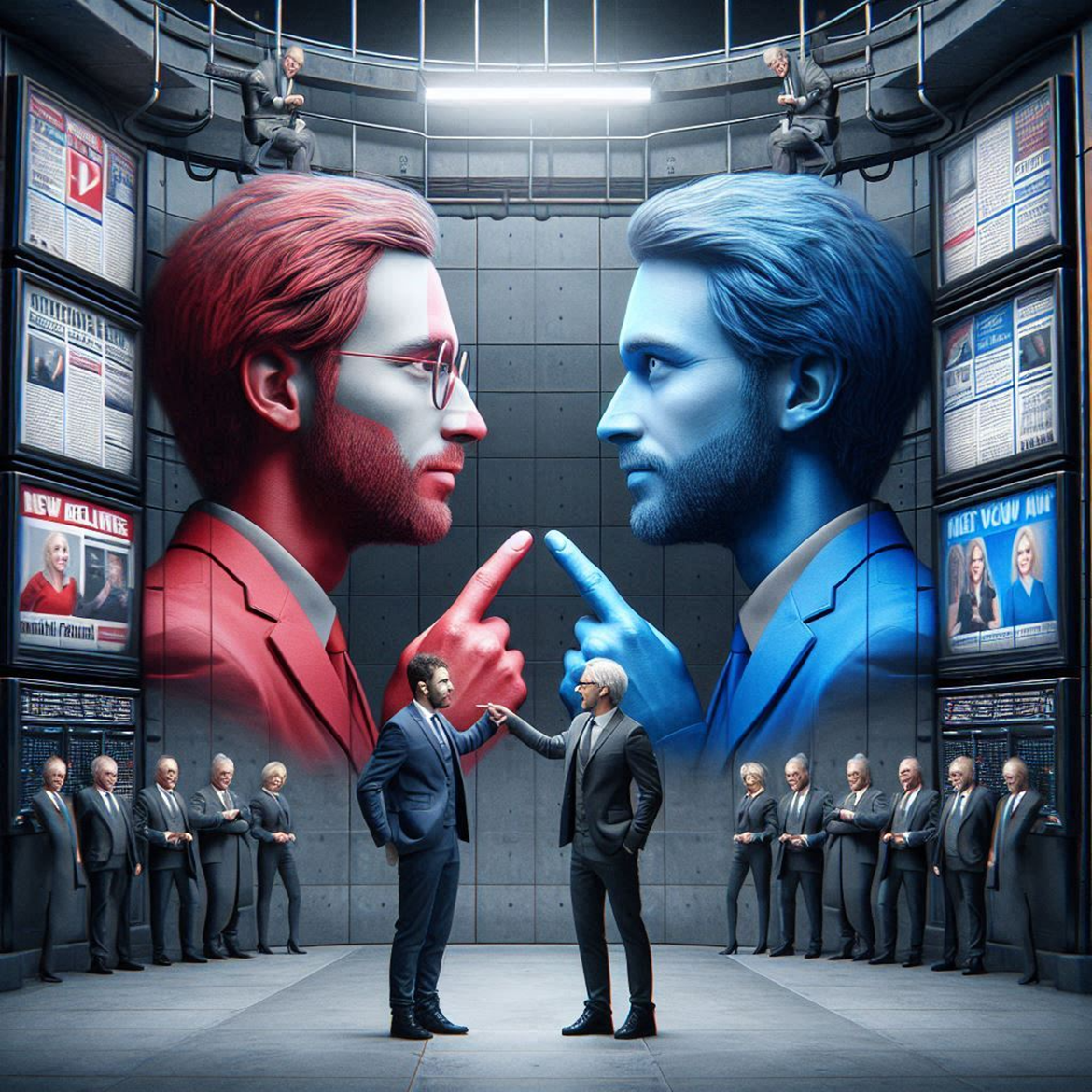
They present every issue as a screaming match between two extremes. You’re given two choices, both of which happen to fit neatly within the boundaries of what the bubble allows. It’s the illusion of choice. You’re so busy picking a side in their staged fight that you don’t notice both sides are funded by the same giant corporations. You don’t notice that no matter who “wins” the argument, the people in the bubble always win in real life.

Their job is to make you feel like you’re participating in a debate, when in reality, you’re just cheering for your assigned team. The actual decisions, the ones that affect your job and your freedom, were made long before the cameras ever turned on. The debate is a distraction. A magician’s trick. Look at the left hand arguing with the right hand, so you don’t see what I’m doing with the rope.

Follow the Money, It’s Not That Complicated

Let’s get brutally simple. People follow incentives. It’s human nature. So, what are the incentives for a major news network? Their money doesn’t come from you, the viewer. It comes from advertisers. Big corporations. Their goal is to deliver a large, predictable audience to those advertisers. They can’t afford to truly upset the established order because that’s where the money is.

And what about a politician? Their incentive is to get re-elected. That takes a mountain of cash. That cash comes from powerful donors, not from the average person sending in $20. Who do you think they will listen to? The person who funds their entire campaign, or the thousands of voices they never hear from?

The system is perfectly designed to make them serve the interests of the powerful. It’s not even about being evil or corrupt. It’s about the path of least resistance. Going along with the bubble is easy. It leads to book deals, speaking fees, and a comfortable life. Questioning it means being called names, losing access, and becoming an outsider. Most people choose the easy path.

So, What Can You Actually Do About It?

This isn’t about giving up. It’s about waking up. The first step is to realize that the official story is often just a sales pitch. Your mind is the battleground, and you have to defend it.

First, break your media diet. If you only watch one news channel, you’re eating mental junk food. Force yourself to read and watch sources from all over the map, especially the ones you disagree with. Don’t just consume the news; dissect it. Ask simple questions: Who benefits from me believing this? What are they not showing me? What is the other side of this story?

Second, think locally. The national stage is a manipulated drama. But your town council, your school board, your local community—that’s real. That’s where you can have a real impact. Go to a meeting. Ask a question. Run for a small office. This is how you build real power, from the ground up.

Finally, trust your own eyes. You don’t need a television host to tell you if your neighborhood is safe, if your job feels secure, or if your grocery bill is getting harder to pay. Your lived experience is data. It is evidence. Stop letting them tell you that your reality is wrong.

The walls of the bubble are invisible, but they are fragile. They are maintained by our attention and our belief. When we turn away, when we start to think for ourselves, the walls begin to crack. The most powerful weapon you have is your own doubt. Use it.

Why Both Parties Fear Ordinary Americans

 Conspiracy, Featured, Political  Comments Off on Why Both Parties Fear Ordinary Americans
Sep 162025
 

Exposing how the establishment survives by keeping people divided
Beyond Left vs. Right: Why fear unites the establishment? Discover how insecurity & division keep power concentrated despite election theatrics.

You ever get that feeling? Like something big is happening behind the scenes? Not necessarily aliens or secret societies (though, who knows, right?), but something closer to home. A system. A way, things just… stay the way they are, no matter how loud people yell. You see it every election season: the fever pitch, the blame game, the “other side” painted as demons. But take a step back. Notice the patterns. Notice how quickly the anger flares, then dies down once the votes are counted. Something feels… managed.

The Great Distraction Show

Think about where your attention gets pulled. Constant news alerts telling you to be furious. Political debates that feel more like reality TV brawls than serious discussions. Endless arguments online about things that feel huge at the moment but change nothing fundamental. Who owns the biggest microphones pushing this stuff? Where does the money really flow?

It’s almost like keeping us locked in a permanent state of outrage towards each other is the point. While we’re busy shouting across the aisle or clutching our pearls on social media, massive decisions get made. Think about it. Giant bills passing with little debate. Deals cut behind closed doors. Wealth shifting upwards at an insane pace. When was the last genuine debate on something that actually shifted power away from the powerful and towards regular folks? Feels elusive, doesn’t it?

The Engine Of Discontent: Why Everything Feels Harder Than It Should Be

Scratch beneath the current frictions. The real fuel for that simmering anger just below the surface? It’s not just politics. It’s stress. Real, grinding stress. Wages that haven’t kept up for decades. The constant fear of losing healthcare or a job. The impossible climb to afford a decent home or save for the future. That gnawing sense that the rules are rigged, that hard work doesn’t guarantee security anymore.

Now, here’s the key: this insecurity isn’t an accident. It’s baked into the structure. Think about it. People terrified of losing their jobs are less likely to make waves. Families struggling to pay bills have little time or energy to demand systemic change. When you’re living paycheck to paycheck, focused purely on survival, questioning the big picture becomes a luxury.

Both established parties benefit enormously from this environment. Their wealthy friends and donors thrive on cheap labor and unchallenged power. Angry, exhausted workers fighting amongst themselves over crumbs from the table? That keeps the whole machine humming along nicely. Addressing the real sources of economic stress – truly rewriting the rules – would upset that cozy arrangement. And that is what they genuinely fear: organized, rested, economically secure citizens demanding accountability and a fairer share.

The Perfect Illusion: Your Choices Are Fewer Than You Think

They present us with two sides: Team Red and Team Blue. Locked in an eternal battle. You must pick one. They fundraise off hating the other. Their media champions scream about the existential threat posed by “them.” It feels urgent, vital! Choosing the right team is paramount! But hold on… examine the record. Regardless of who holds the fancy titles in that big building in DC, does the core trajectory ever fundamentally shift? Does the overwhelming power concentrated among the extremely wealthy ever lessen? Does the influence of big industries wane meaningfully? Does spending on defense ever shrink?

Look closely. Notice how certain things remain strangely constant, like boulders in a rushing political stream. The core operational system – the rules governing markets, finance, and global power – remains largely untouched by the passionate theater of elections. Major shifts happen regardless of who holds power. It gives the appearance of fierce competition, of fundamental choice, but the outcome often favors the same entrenched players. Divided, we see each other as the enemy. United, we might start asking why those untouched boulders are really there and who put them there. That kind of united focus is deeply unsettling to those at the top.

The Real Threat: When People See Through The Game

Here’s the unspoken truth fueling everything: Stability for the status quo depends on these divisions. Think about moments of real, organic connection across the usual boundaries. Remember during the lockdowns how people started helping neighbors regardless of political signs in their yard? Remember the mutual aid networks that sprung up? Or when vast, diverse crowds demanded fundamental change on single issues?

In those brief moments, the carefully constructed walls start to crumble. People see a shared problem – maybe it’s a corrupt war, maybe it’s runaway greed crushing communities, maybe it’s blatant corruption – and the artificial political labels suddenly feel less important. They see the strings holding up the partisan puppets. This is when genuine fear sparks behind the scenes. Coordinated pressure from an united populace, however diverse their reasons, presents an uncontrollable chaos. They lose their ability to direct the narrative, to manage the anger.

Suddenly, the threat isn’t the “other side” you’ve been trained to hate; the threat becomes an awakened citizenry recognizing the real architects of their frustration. This awakening bypasses the control systems built over decades. That is the ultimate nightmare scenario for the political establishment and their backers. An unmanageable public focusing its energy upwards instead of sideways.

Finding The Exit Ramp: Cut Through The Noise

So, what can you do? It starts with recognizing the patterns. Ask yourself:

  • Who benefits most from my anger right now? Is it actually serving me, or does it just drain me while others profit?
  • Are my battles being chosen for me? Are the issues dominating the news cycle genuine priorities, or are they designed distractions?
  • Where do I see common ground? Look around your community. Where are people, regardless of politics, struggling with the exact same problems? Affordable housing? Crumbling infrastructure? Schools? Healthcare access?
  • Seek diverse perspectives outside the political headlines. Talk to people who see the world differently but focus on shared frustrations with the system itself. You might be shocked at the common ground.

Shift your energy. Instead of endlessly yelling into online partisan voids, focus locally where individual actions can actually ripple outwards. Organize a community clean-up. Join or start a food cooperative. Support local independent media asking hard questions about local power structures. Learn a practical skill and teach others. Build something tangible, face-to-face, with your neighbors.

Real power isn’t found in the loudest online mob chanting predictable slogans. Real power starts when people, fed up with the theater and the scarcity, start connecting, cooperating, and building local solutions independent of the permission of distant political machines. They’ve built an elaborate system to keep us managed. The crack in the wall starts when we stop accepting the divisions they sell us. When genuine connection between ordinary people happens, focused on shared reality, that is what truly shakes the foundation. That’s the awakening they work so hard, day after day, show after show, crisis after crisis, to prevent. See it. Name it. Then start building beyond it. That’s where the real control begins.