The Red Syndicate – Part 5
At a quiet marina in the Mediterranean, a new superyacht appeared one summer without fanfare. Its hull was painted a muted metallic gray. The crew spoke little and kept to themselves. The vessel’s beneficial owner was buried inside a maze of offshore companies registered in jurisdictions most people could not find on a map.
On the other side of the world, a modest apartment in a Chinese provincial city sat empty most of the year. Its listed owner was a retired factory manager with a small pension. In reality, the property had been bought with money routed through that same offshore maze, part of a portfolio that included luxury condominiums in Vancouver, office space in London, and a shopping mall project in Southeast Asia.
The paperwork made it look like a collection of unrelated investments. It was not. It was the visible edge of a hidden architecture.
The Red Syndicate had outgrown Shanghai, outgrown China’s borders, and moved into the bloodstream of global finance.
From Local Power to Global Reach
For decades, the fusion of political authority, business privilege, and underworld methods operated mostly within China. Local bosses, party cadres, and trusted entrepreneurs extracted value from land deals, state contracts, and gray markets. Their fortunes were significant, but their options were limited. Most wealth stayed inside the country, trapped in local currencies and real estate.
As China’s economy expanded and capital controls gradually loosened, the equation changed. New channels opened. Foreign banks set up branches. Global law firms arrived with thick manuals on cross-border investment. Countries across Asia, Africa, Europe, and Latin America courted Chinese capital to build ports, railways, and power plants.
The old habits adapted. Networks that had once smuggled contraband now smuggled money. The same mindset that had treated regulations as obstacles to be negotiated now applied itself to international law.
The syndicate did not need to send gangsters abroad. It sent companies and contracts instead.
The Offshore Escape Hatch
Inside China, political campaigns, policy shifts, and anti-corruption drives could threaten even well connected elites. A single investigation could freeze accounts, seize villas, and demote patrons. For those who had accumulated fortunes through their position, there was a clear incentive to move part of their wealth beyond domestic reach.
Offshore financial centers provided the perfect escape hatch. They offered:
- Companies that could be created in hours, with directors and shareholders hidden behind nominee services
- Bank accounts under foreign names
- Trusts that separated legal ownership from control
For some, these tools were used to plan legitimate investments. For others, they became instruments to launder bribes, kickbacks, and embezzled funds. Profits from inflated infrastructure contracts, “consulting fees” on arms deals, or protection payments from local businesses could be wired abroad, transformed into shares, bonds, or properties, and then quietly enjoyed.
This pattern was not unique to China. Elites from many countries engaged in similar practices. What made the Red Syndicate’s version distinctive was the way it linked official authority, party structure, and commercial entities into one fluid system.
In this system, a provincial official, a state owned enterprise executive, and a private real estate developer could jointly hold assets that existed nowhere on paper inside China. Their interests were protected not only by secrecy laws abroad but also by the political influence they still held at home.
Projects, Partners, and Quiet Leverage
As Chinese companies ventured abroad, they rarely traveled alone. They often arrived with financing from policy banks, diplomatic backing, and a narrative of mutual development. For many host countries, this offered advantages: new infrastructure, quick financing, and a partner that did not insist loudly on political conditions.
Inside some of these projects, however, the old syndicate logic reappeared.
In certain ports and industrial zones, local elites found that partnering with Chinese firms brought not just roads and jobs, but also new opportunities for corruption. Overpriced contracts, unexplained “service companies,” and side agreements opened channels for money to move in both directions.
A governor who steered a port concession toward a particular consortium might receive “consulting” income through a relative’s overseas firm. A minister might secure scholarships for his children or equity in a joint venture. The deals were wrapped in development language, but they operated in part as mechanisms of elite capture.
Beijing did not need to instruct every such arrangement. The system incentivized them. Chinese companies under pressure to win bids and complete projects learned quickly that working through local power brokers was often the fastest route. Local power brokers learned that cultivating ties with these companies and their patrons brought influence and wealth.
The effect was cumulative. Over time, networks formed that linked provincial officials and corporate managers in China with political families and business clans abroad. These were not mere business relationships. They were mutual dependencies made durable by secrecy.
The Diplomacy of Deals
In the past, ships and armies had carried imperial influence. Now, influence arrived through memoranda of understanding, infrastructure loans, and investment forums.
High level visits were often accompanied by delegations of state owned and private firms. Agreements were signed under chandeliers, photographed for front pages, and then handed to teams of lawyers and managers who would translate them into operational reality.
Within this process, some patterns echoed the underworld’s approach to negotiation:
- Relationships were personal, anchored in trusted intermediaries
- Information about key terms often stayed restricted to a small circle
- Conflicts were settled quietly, away from courts or public scrutiny
In some countries, parliamentarians and civil society groups complained that they had limited visibility into the details of long term agreements. In others, opposition politicians accused ruling parties of trading national assets for personal gain.
For the Red Syndicate’s operators, this environment felt familiar. They were accustomed to systems where power was negotiated, not codified, where contracts meant less than relationships, and where a discreet compromise could be more effective than a public dispute.
The result was a form of influence that did not need bases or treaties. It rested on a web of material interests that tied foreign elites to deals whose profitability depended on continued goodwill from Beijing and its corporate satellites.
Real Estate, Safe Havens, and Quiet Neighbors
In many global cities, an observer walking through certain neighborhoods could spot the footprint of this outward flow of wealth without seeing the story behind it.
Luxury apartments sat empty for months, blinds closed. Entire floors of new towers were owned by holding companies with nondescript names. Suburban mansions were purchased in cash by buyers who rarely appeared. Local residents speculated about the owners: tech executives, foreign dignitaries, lottery winners, or criminals.
In some cases, the beneficiaries were neither pure nor simple. They were individuals who occupied ambiguous positions at the intersection of state, business, and shadow networks. Their fortunes depended on a system that was entirely legal on the surface and deeply compromised beneath it.
Host countries often welcomed the inflow of capital, even when it distorted housing markets. Some reassured themselves that money was neutral. Yet neutrality ended where dependence began.
When significant portions of a city’s high end property sector, or a country’s debt, or a strategic port came under the control of entities tied to a foreign authoritarian system, local decision makers faced new incentives. Policies that might anger that system could carry hidden costs for the well connected.
The syndicate did not need to threaten anyone directly. It needed only to be present in the portfolios of those who shaped opinion and policy.
Information, Influence, and the Subtler Tools
The old underworld relied on bribery, coercion, and physical intimidation. The globalized version still used those tools in some corners, but it also developed subtler methods.
Chinese companies sponsored research institutes, think tank programs, and academic chairs abroad. These initiatives brought funding to cash strapped institutions, exchange opportunities to scholars, and prestige to university administrators. They sometimes also created pressure to avoid topics that could embarrass or anger their sponsors.
Media organizations accepted advertising contracts or content deals. Some signed partnerships with outlets linked to the Chinese state. In certain cases, critical reporting about sensitive topics began to shrink, replaced by neutral or positive coverage. Journalists who pushed further found their access curtailed or their editors hesitant.
Former diplomats and political figures joined boards or advisory councils of firms with significant Chinese exposure. Their presence offered legitimacy. Their networks offered access. Their compensation, while legal, created a conflict between personal interest and public duty.
This was not a conspiracy controlled from a single room. It was the natural outcome of a system where economic weight, political ambition, and carefully cultivated relationships converged. The Red Syndicate had learned that influence does not always require control. Sometimes it only requires that key players become accustomed to the idea that certain lines should not be crossed.
Reputation Laundering
One of the most striking features of the syndicate’s globalization was its hunger not only for assets but also for respectability.
Wealth generated in opaque environments sought cleansing in open ones. A business magnate with close ties to political power would endow scholarships, sponsor museums, donate to hospitals, and support cultural exchanges abroad. Foundations appeared under his family’s name, staffed by professionals fluent in the language of philanthropy.
At home, this figure might be known for ruthless land acquisitions or collusion with security services. Abroad, he appeared as a benefactor. Institutions that received his support rarely inquired deeply into the origin of the funds. Many did not want to know.
This laundering of reputation mirrored the laundering of money. It converted dubious capital into social capital. It also created defenders in foreign societies who were reluctant to see their patrons criticized or investigated.
In effect, the syndicate purchased fragments of the moral authority it lacked.
The Silent Vulnerability
For countries on the receiving end of this global expansion, the danger was not immediate collapse or open conquest. It was a gradual drift in the balance of incentives.
- When a politician’s family business relies on joint ventures with Chinese partners, how boldly will that politician criticize human rights abuses or security risks?
- When a major newspaper depends on advertising from companies tied to China’s market, how aggressively will it pursue investigations that could prompt retaliation?
- When a think tank’s budget leans heavily on foreign funding that prefers certain narratives, how balanced will its reports remain?
Democracies often assume that their openness and institutional checks are enough to prevent capture. The Red Syndicate’s spread tests that assumption. It exploits legal pathways, not illegal ones. It rewards silence, not explicit collaboration. It wraps itself in the language of investment, partnership, and shared growth.
By the time conflicts of interest become visible, patterns of dependence may already be entrenched.
Fragmentation and Competition Inside the Syndicate
From a distance, the system can look monolithic. Up close, it is anything but. Different factions, companies, and agencies compete for influence and profit. Local power brokers abroad play them against each other. Not every project succeeds. Not every actor is loyal. Some fall spectacularly from grace.
Anti-corruption campaigns inside China have swept up officials whose families parked wealth overseas. Investigations abroad have revealed bribe schemes involving Chinese firms and foreign counterparts. Each scandal exposes part of the network. Each cleanup operation functions like a violent audit, reshuffling who controls which channels.
Yet the overall architecture survives. Individual pieces are sacrificed to reassure the public or punish rivals. The code endures.
This adaptability makes the Red Syndicate hard to confront. It can present itself as investor, development partner, victim of bias, or champion of multipolarity, depending on the audience.
Why It Matters
The story of the syndicate’s global rise is not an argument against engagement with China or against trade itself. It is a warning about what happens when engagement occurs without transparency, accountability, or an honest assessment of power.
At the heart of this story lies a continuity that runs from the Green Gang’s control of Shanghai’s docks, through the Party’s mastery of secrecy and patronage, to the present web of offshore companies, influence networks, and elite entanglements.
In each phase, power has expressed itself in the same basic pattern:
- Control the flows: of goods, money, information, and opportunity.
- Wrap that control in a story: revolution, development, win win cooperation.
- Use the darkness between what is said and what is done as the space where real decisions are made.
The syndicate goes global not only through ships and contracts, but through the quiet bargains that individuals and institutions accept in exchange for access.
The View from the Bund, Again
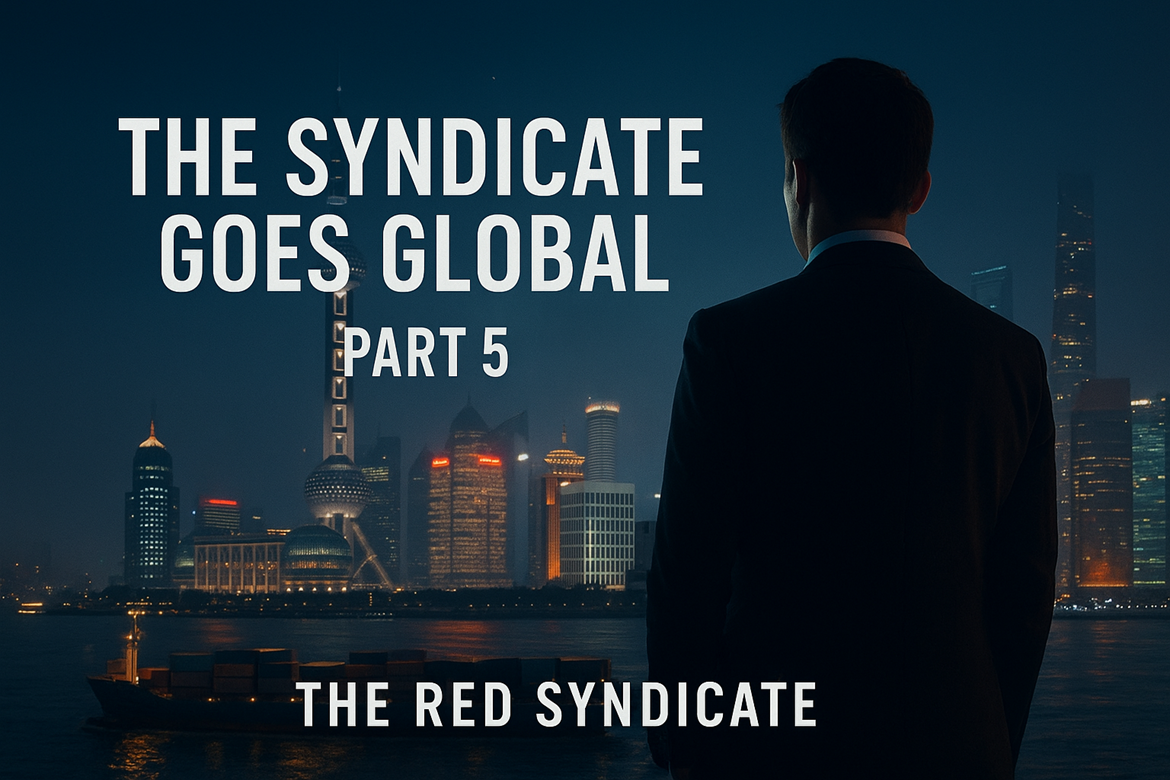
Stand once more on the Bund in Shanghai and look outward. Cargo ships slide past under flags from many countries. Containers stacked like bricks carry the goods of a vast trading empire. Somewhere in those holds are products of honest labor, the fruits of ordinary people’s hopes for a better life. Somewhere else, less visible, numbers stream across fiber optic cables, shifting fortunes between accounts that will never bear the true names of their owners.
The city that once taught the world how crime and politics could fuse into a single organism now sends that lesson abroad in more subtle form. Its skyline reflects in waters touched by vessels that dock in every major port on earth.
The Red Syndicate is no longer a local phenomenon. It is a mode of power that has learned to breathe global air.
In the final parts of this series, we will examine how this system intersects with the concept of elite capture, what it means for countries that believed themselves protected by distance or law, and what, if anything, can be done to resist an architecture of influence that hides in plain sight.
Next in the Series
Part 6 – Elite Capture and the Price of Silence
How political, business, and media elites become entangled in the syndicate’s web, why they rarely talk about it, and how their silence reshapes the choices available to everyone else.
© 2025 The Red Syndicate Investigations / Common Sense Evaluation. All rights reserved.
Sorry, the comment form is closed at this time.