The Red Syndicate – Part 4
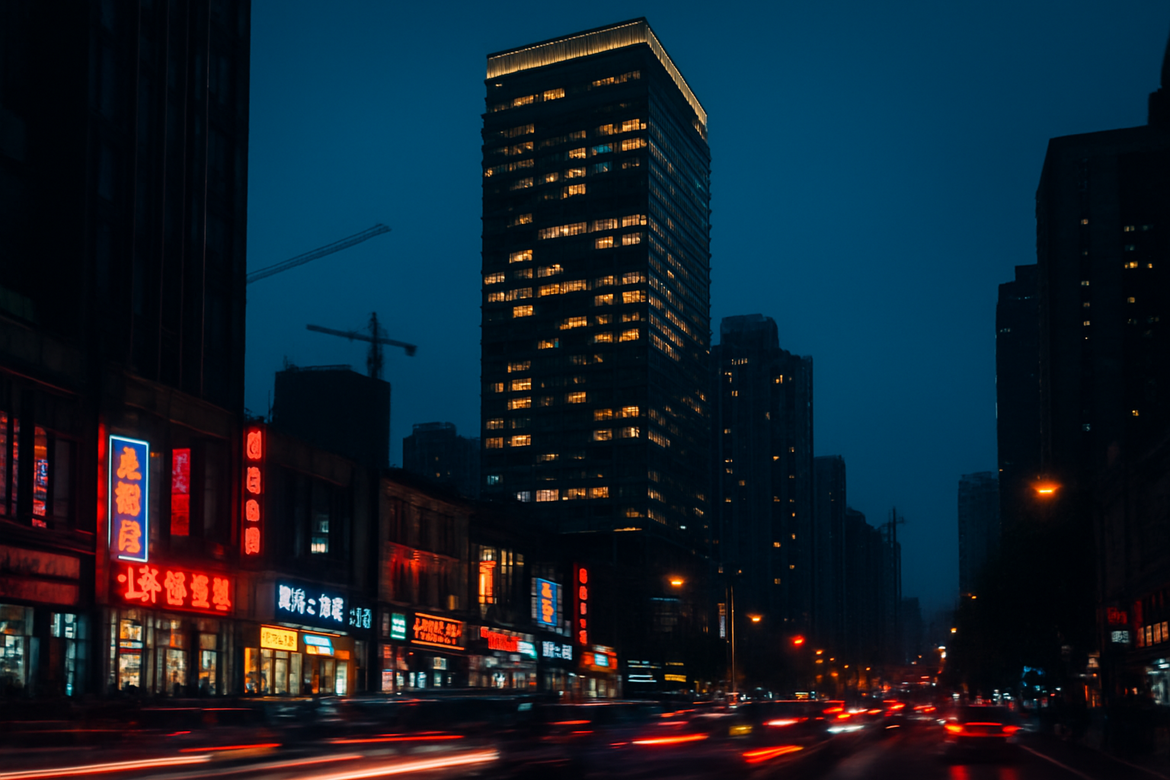
Reform and opening brought skyscrapers and markets, but it also created a new underworld fused with official power.
The first skyscrapers of the new China did not rise over Shanghai or Shenzhen. They rose in the minds of the men who realized that ideology could be converted, brick by brick, into cash.
In the late 1970s, Beijing was a gray city of bicycles and ration coupons. Streets were quiet at night. Store shelves were half empty. A generation had grown up repeating slogans and standing in line. The Cultural Revolution had burned through institutions and reputations alike. When the dust finally settled, the Chinese Communist Party faced a crisis it could no longer hide. The country was poor, exhausted, and falling behind.
Into this vacuum stepped Deng Xiaoping, a survivor of purges, a veteran of Yan’an, and a man who understood that power depended on results. He did not talk about the Green Gang or the old Shanghai. He spoke instead of “reform and opening,” of letting some get rich first, of “crossing the river by feeling for the stones.”
But beneath the careful language lay a familiar logic. To revive the economy, the Party would have to loosen control over money while tightening control over politics. It would allow markets to bloom, then graft itself onto them. Old habits from the underworld, once used for survival, now reappeared as tools for enrichment.
A new era was beginning, and with it, a new underworld.
Opening the Gates
In 1978, at the Third Plenum of the Eleventh Central Committee, the Party officially shifted its focus from class struggle to economic development. The phrase sounded dry. Its consequences were anything but.
Collective farms began to contract land to individual households. State factories were given more autonomy over hiring and production. Special Economic Zones appeared along the coast, offering tax breaks and looser regulations to attract foreign capital.
The gates opened slowly at first, then wider. Foreign businessmen arrived, some in cheap suits, others in tailored ones. They brought technology, consumer goods, and cash. Local officials watched them closely, calculating opportunities.
For decades, political loyalty had been the only currency that mattered. Now there was another one. Money returned to public life, not as an enemy of socialism, but as its new instrument.
The Party promised that reform would make the system more efficient and more just. In reality, it created a landscape where rules were flexible, information was uneven, and those closest to power had the best chance to win.
It was, in other words, fertile ground for a new kind of syndicate.
Cadres as Gatekeepers
The shift to a mixed economy did not weaken the Party’s control. It changed the form of that control.
Local officials remained responsible for enforcing regulations, issuing permits, and allocating land. They also became responsible for attracting investment, hitting growth targets, and keeping social order. Their careers depended less on ideological purity and more on delivering economic results.
This combination turned them into gatekeepers. Entrepreneurs, foreign companies, and rural migrants all had to pass through them to get what they wanted. A factory license, a land lease, a bank loan, a contract with a state-owned enterprise, all these flowed through the hands of officials who often earned modest salaries but wielded enormous informal power.
The temptation was obvious. Many officials saw no reason to refuse a “gift” from a company eager to move to the front of the line. Some demanded a share in the profits or placed relatives in key positions. Others used their authority to steer public contracts toward private firms they secretly controlled.
The underworld no longer stood outside the state. It seeped into it. The Party had once studied how syndicates controlled docks and markets. Now its own members controlled access to the most profitable resource of all, the new Chinese marketplace.
The Birth of the “Red Capitalist”
As private and quasi-private enterprises multiplied, a new figure emerged in Chinese life: the “red capitalist.”
Some were former engineers or managers who left state factories to start their own companies. Others were returnees from Hong Kong or overseas who brought capital and skills. Still others were children of senior cadres who used their family connections to secure land, licenses, and financing at bargain prices.
These businesspeople depended on political protection. In return, they offered something the Party needed: growth, employment, and a modern image. It was a mutually rewarding arrangement.
In coastal cities, deals took shape in hotel banquet rooms, karaoke bars, and golf courses. Contracts were signed after rounds of toasts. “Consulting fees” appeared on balance sheets, disguising bribes. Shell companies registered under the names of relatives hid the true beneficiaries of profitable ventures.
The structure resembled a joint venture between a government and an invisible cartel. The Party provided policy support, legal cover, and access to land and markets. The entrepreneurs provided money, both for official projects and for private pockets.
The new capitalists were not outsiders challenging the system. They were its offspring.
Smuggling, Protection, and the Gray Economy
Reform created opportunities not only for legitimate business but also for smuggling on a scale the old Green Gang could never have imagined.
China’s long coastline and porous borders became channels for untaxed goods. Cars, cigarettes, alcohol, electronics, and oil flowed in and out through networks that linked local officials, customs officers, and criminal groups.
One of the most notorious examples surfaced in the 1990s in the port city of Xiamen. A businessman named Lai Changxing built a smuggling empire that evaded billions of dollars in customs duties. He did not do it with boats alone. He did it with relationships. Officials across the police, customs, and security services accepted bribes, gifts, and ownership stakes. In return, they looked the other way, altered paperwork, or provided intelligence on investigations.
When the scandal finally exploded, dozens of officials were arrested. Some received long prison terms. Others were sentenced to death. The Party portrayed the crackdown as proof of its determination to fight corruption.
Yet the scale of the case revealed something more disturbing. Smuggling had fused seamlessly with official structures. The boundaries between bureaucrats and gangsters had blurred into a single gray network.
Across the country, smaller versions of the same pattern played out. Local authorities ran “protection” operations, sometimes under the banner of economic development. Crime bosses who could deliver stability and revenue received quiet tolerance. Entrepreneurs who refused to pay were harassed by inspectors or suddenly discovered they had violated obscure regulations.
The state did not simply tolerate the new underworld. Parts of it partnered with it.
Privatizing the Old Monopoly
Under Mao, the state had monopolized the commanding heights of the economy. Under reform, those heights were partially privatized, sometimes openly, sometimes through back channels.
State-owned enterprises were restructured, merged, or sold. Many of the buyers were insiders, managers who already controlled the assets, or investors with political backing. The process often took place in a fog of incomplete disclosures and hurried valuations.
Mines, factories, and transport firms passed into the hands of individuals who, on paper, were simply businesspeople, but in practice were deeply entangled with local party committees. In some cases, organized crime groups moved in as well, offering muscle for land seizures, debt collection, and labor control.
Coal mining regions in particular became notorious for deadly accidents, illegal operations, and collusion between owners and inspectors. Profits rose. Safety plummeted. Families who complained faced threats. Journalists who reported too aggressively encountered censorship or intimidation.
The pattern was familiar. A formal monopoly gave way to a hybrid system where private gain thrived under public protection, and where the lines of responsibility were deliberately blurred.
The Return of Protection Rackets
In villages and small towns, another form of the new underworld took shape. Local strongmen, sometimes former soldiers or ex-convicts, built groups that offered “protection” for markets, construction sites, and entertainment venues. They collected fees from vendors and businesses, enforced their claims through beatings or vandalism, and settled disputes.
What made this new generation different was its relationship to official power. Many strongmen had patrons in the local police or party apparatus. Some held minor posts themselves. Their violence could be switched on or off depending on political needs.
When protests broke out over land seizures or unpaid wages, these groups sometimes appeared alongside uniformed officers, intimidating organizers. When elections for village committees were introduced, they backed favored candidates. Their presence allowed authorities to keep their hands clean while sending a clear message.
These arrangements resembled the old relationship between the Green Gang and certain warlords or police officials, but now they operated within a system that claimed to be building “rule of law.” Publicly, the Party denounced “evil forces” and organized crime. Privately, some of its local agents still found those forces useful.
Anti-Corruption as Housekeeping
Every system that tolerates corruption eventually must discipline it, not to eliminate it completely, but to manage it. In the reform era, anti-corruption campaigns became a recurring feature of political life.
Inspections would sweep through provinces. High-profile cases would be announced. Officials were paraded on television in handcuffs, confessing their crimes. Some were executed. Others quietly disappeared into prisons.
These campaigns served several purposes at once. They frightened lower-level cadres, reminded them that their positions were conditional, and allowed the central leadership to remove rivals or rebalance power among factions. They also reassured the public that the Party was serious about self-correction.
Yet the campaigns rarely touched the deeper architecture of the system. Officials still controlled access to land, credit, and permits. Information about their wealth remained hidden. Whistleblowers faced retaliation. Media outlets were allowed to expose certain scandals but not others.
Corruption in such a setting behaved less like an aberration and more like a tax, sometimes reduced, sometimes raised, but rarely abolished.
Shadow Finance and the Rise of Informal Networks
As China’s economy accelerated in the 1990s and 2000s, formal banks struggled to meet the demand for credit. State-owned banks prioritized politically important projects and large state firms. Small businesses and private ventures turned to informal lenders, many with criminal ties.
So-called “underground banks” handled transfers for companies and individuals who wanted to move money across borders or conceal its origin. Loan sharks provided capital at high interest rates, using threats instead of contracts to ensure repayment.
At the same time, party-connected investors began to use complex webs of shell companies and offshore entities to invest abroad. Wealth that had once been hidden under mattresses or in local property now flowed into foreign real estate, luxury goods, and financial markets.
The techniques echoed earlier smuggling and money-laundering methods, refined by access to global finance. The underworld was no longer limited to physical contraband. It moved through spreadsheets and wire transfers.
For ordinary citizens, this shadow system was invisible. For those inside it, it was a way to convert political advantage into generational wealth.
The New Urban Nightlife
In the big cities, the effects of reform were most visible after dark. Bars, nightclubs, and massage parlors multiplied. Casinos operated illegally in back rooms and high-rise apartments. Drugs, once nearly eradicated, resurfaced in designer forms.
Behind many of these businesses stood organized groups that looked very different from the rough gangs of the past. They wore suits, carried smartphones, and drove imported cars. Some were former rural migrants who had worked their way up through street-level crime. Others were the sons of officials and businessmen, using their status as a shield.
Police crackdowns came in waves. Raids shut down hundreds of venues at a time. Yet the nightlife always regenerated, often with the same operators, sometimes under new names and licenses.
The persistence of these operations was not accidental. They functioned as nodes in a much larger network that included landlords, security companies, local regulators, and sometimes senior officials. In exchange for stability and informal revenue, authorities allowed certain lines not to be crossed and looked away from others.
Shanghai, Guangzhou, and Shenzhen again became cities where the line between legitimate entertainment and criminal exploitation was intentionally blurred.
Continuity Under New Slogans
On the surface, the story of reform and opening is one of dramatic transformation. Villages turned into cities. State farms turned into industrial parks. Millions were lifted out of poverty. Foreign executives praised the country’s efficiency. Economists pointed to growth rates that had no parallel in modern history.
Yet the deeper patterns explored in this series did not vanish. They adapted.
The Party remained the ultimate arbiter of opportunity. Access to that arbiter often depended on personal networks that functioned like a legal syndicate. Those who mastered these networks prospered. Those who did not were left to navigate a maze of paperwork and unwritten rules.
The underworld no longer wore the face of Du Yuesheng or carried boxes of opium up gangplanks at the Bund. It wore the face of the businessman who held a monopoly because his cousin chaired a committee, the official who protected a smuggling ring in exchange for shares, the security chief who used thugs to clear a village slated for redevelopment.
The tools had changed. The code had not.
A System Looking Outward
As China’s wealth and influence expanded beyond its borders, the same logic of intertwined state, business, and hidden networks began to appear abroad.
State-linked companies invested in ports, mines, and infrastructure projects on several continents. Local partners were chosen through opaque tenders. Allegations of bribery and kickbacks surfaced in some countries. Political elites in partner states sometimes found the arrangement convenient. The techniques that once shaped Shanghai’s underworld now adapted to global geopolitics.
Inside China, this outward expansion was presented as a peaceful rise, a natural extension of economic power. Outside, it sometimes looked like the export of a system where deals were made behind closed doors and accountability was optional.
The new underworld was not confined to any single city or border. It flowed wherever opportunity met opacity.
Echoes from the Bund
Walk along the Bund in Shanghai today and you will see glass towers bearing the names of banks, insurers, and multinationals. Tour boats slide along the river, their decks glowing with LED lights. Tourists pose for photographs where foreign merchants once unloaded cargo and gang couriers once met in the shadows.
The city presents itself as a monument to progress. Yet the history that unfolded here a century ago still whispers beneath the pavements.
Back then, a criminal syndicate learned how to fuse business, politics, and force into a single machine. The revolution studied that machine, then built its own. Reform did not dismantle it. Reform extended it.
The underworld that now exists is not merely a collection of criminals in the shadows. It is the network of relationships in which official authority, private gain, and organized coercion intersect. It is the quiet understanding that certain people and institutions stand above the rules they enforce on others.
Understanding that network is essential for anyone who wants to understand how power really works in the world’s most populous nation and in the global system that increasingly depends on it.
Next in the Series
Part 5 – The Syndicate Goes Global
How financial secrecy, offshore wealth, and elite networks carried the Red Syndicate’s logic beyond China’s borders, and what that means for countries that believed they were immune.
Source Notes
This article draws on:
- Official Chinese documents and speeches from the reform era, particularly those associated with Deng Xiaoping’s economic policies
- Scholarly work on local governance, privatization, and corruption in reform-era China
- Investigative reporting and court records related to major smuggling and corruption cases, including the Xiamen scandal involving Lai Changxing
- Research on organized crime in contemporary Chinese cities and its links to local political structures
- Studies of informal finance, underground banking, and capital flight
© 2025 The Red Syndicate Investigations / Common Sense Evaluation. All rights reserved.
Sorry, the comment form is closed at this time.