Jul 032025
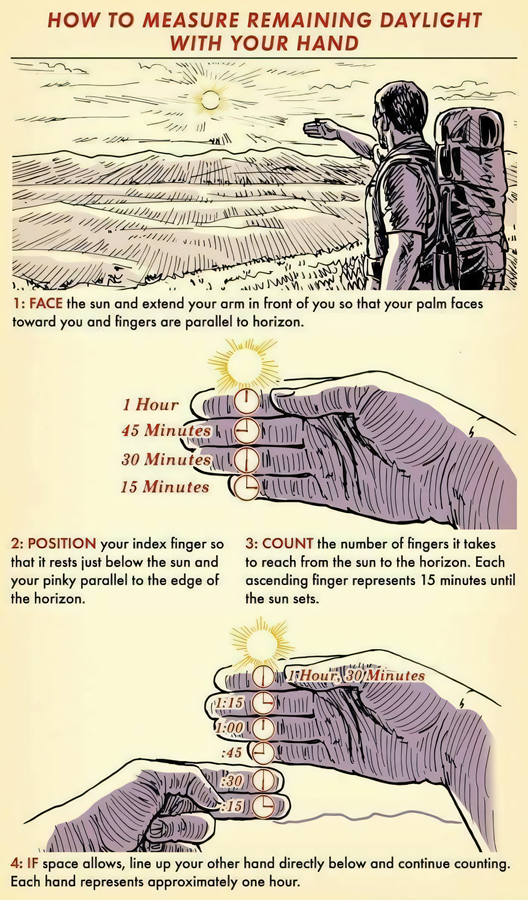
You can estimate the amount of remaining daylight by using your hand and the horizon. This is a popular outdoorsman trick known as the “hand method” or “finger rule.” Here’s how to do it:
Step-by-Step: How to Measure Remaining Daylight with Your Hand
- Face the Sun: Stand facing the setting sun, making sure you have a clear view of the horizon.
- Extend Your Arm: Stretch your arm out fully in front of you, palm facing you, fingers horizontal to the ground.
- Stack Your Fingers:
- Place your bottom pinky finger on the horizon line.
- Stack your fingers one over the other (palm-side toward you) toward the bottom edge of the sun.
- Count how many fingers fit between the horizon and the sun.
- Estimate Time:
- Each finger width (from pinky to index) represents roughly 15 minutes of remaining daylight.
- A full hand (4 fingers) is about 1 hour.
- If you can fit 2 hands (8 fingers), that’s about 2 hours of light left.
Notes & Tips:
- This method works best closer to the equator and near sunset, when the sun’s angle is more horizontal.
- It’s an approximation, but surprisingly accurate for planning hikes or travel before dark.
- The trick works because the sun moves about 15 degrees per hour, and each finger equals around 1 degree at arm’s length.
Example:
You see the sun is 1½ hand-widths (6 fingers) above the horizon. That means you have approximately 1 hour and 30 minutes of daylight left.
Sorry, the comment form is closed at this time.